
solo para uso en investigación
T0070907 Antagonista de PPARγ
Cat. No.S2871
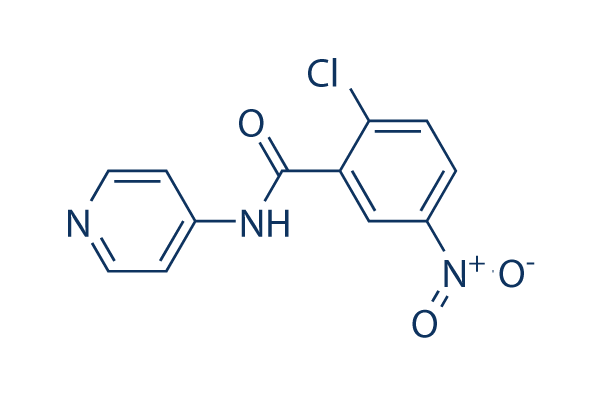
Estructura química
Peso molecular: 277.66
Control de calidad
| Dianas relacionadas | HDAC PARP ATM/ATR DNA-PK WRN DNA/RNA Synthesis Topoisomerase Sirtuin Casein Kinase eIF |
|---|---|
| Otros PPAR Inhibidores | GW9662 GW6471 WY-14643 (Pirinixic Acid) GSK3787 GW0742 AZ6102 Harmine Astaxanthin Eupatilin GSK0660 |
Cultivo celular, tratamiento y concentración de trabajo
| Líneas celulares | Tipo de ensayo | Concentración | Tiempo de incubación | Formulación | Descripción de la actividad | PMID |
|---|---|---|---|---|---|---|
| OR6 | Cytotoxicity assay | 72 hrs | Cytotoxicity against african green monkey OR6 cells after 72 hrs by WST1 assay, CC50=2.7μM. | 23891183 | ||
| OR6 | Antiviral assay | 72 hrs | Antiviral activity against HCV infected in african green monkey OR6 cells assessed as inhibition of viral RNA replication after 72 hrs by luciferase reporter gene assay, ED50=4.9μM. | 23891183 | ||
| Haga clic para ver más datos experimentales de líneas celulares | ||||||
Información química, almacenamiento y estabilidad
| Peso molecular | 277.66 | Fórmula | C12H8ClN3O3 |
Almacenamiento (Desde la fecha de recepción) | |
|---|---|---|---|---|---|
| Nº CAS | 313516-66-4 | Descargar SDF | Almacenamiento de soluciones madre |
|
|
| Sinónimos | N/A | Smiles | C1=CC(=C(C=C1[N+](=O)[O-])C(=O)NC2=CC=NC=C2)Cl | ||
Solubilidad
|
In vitro |
DMSO
: 55 mg/mL
(198.08 mM)
Water : Insoluble Ethanol : Insoluble |
Calculadora de Molaridad
|
In vivo |
|||||
Calculadora de formulación in vivo (Solución clara)
Paso 1: Introduzca la información a continuación (Recomendado: Un animal adicional para tener en cuenta la pérdida durante el experimento)
Paso 2: Introduzca la formulación in vivo (Esto es solo la calculadora, no la formulación. Por favor, contáctenos primero si no hay una formulación in vivo en la sección de Solubilidad.)
Resultados del cálculo:
Concentración de trabajo: mg/ml;
Método para preparar el líquido maestro de DMSO: mg fármaco predissuelto en μL DMSO ( Concentración del líquido maestro mg/mL, Por favor, contáctenos primero si la concentración excede la solubilidad del DMSO del lote del fármaco. )
Método para preparar la formulación in vivo: Tomar μL DMSO líquido maestro, luego añadirμL PEG300, mezclar y clarificar, luego añadirμL Tween 80, mezclar y clarificar, luego añadir μL ddH2O, mezclar y clarificar.
Método para preparar la formulación in vivo: Tomar μL DMSO líquido maestro, luego añadir μL Aceite de maíz, mezclar y clarificar.
Nota: 1. Por favor, asegúrese de que el líquido esté claro antes de añadir el siguiente disolvente.
2. Asegúrese de añadir el (los) disolvente(s) en orden. Debe asegurarse de que la solución obtenida, en la adición anterior, sea una solución clara antes de proceder a añadir el siguiente disolvente. Se pueden utilizar métodos físicos como el vórtice, el ultrasonido o el baño de agua caliente para ayudar a la disolución.
Mecanismo de acción
| Targets/IC50/Ki |
PPARγ
|
|---|---|
| In vitro |
T0070907 es un potente y selectivo antagonista de PPARγ. Con una afinidad de unión aparente de 1 nM, este compuesto modifica covalentemente PPARγ en la cisteína 313 en la hélice 3 del PPARγ2 humano. Bloquea la función de PPARγ tanto en ensayos de genes reporteros basados en células como en ensayos de diferenciación de adipocitos. De acuerdo con su papel como antagonista de PPARγ, este compuesto químico bloquea el reclutamiento de péptidos derivados de coactivadores inducido por agonistas a PPARγ en un ensayo homogéneo basado en fluorescencia resuelta en el tiempo y promueve el reclutamiento del correpresor transcripcional NCoR a PPARγ tanto en ensayos de "pull-down" de glutatión S-transferasa como en un ensayo de "gel shift" dependiente de PPARγ/receptor X de retinoides (RXR) α. Los estudios con receptores mutantes sugieren que modula la interacción de PPARγ con estas proteínas cofactor afectando la conformación de la hélice 12 del dominio de unión a ligando de PPARγ. Curiosamente, mientras que el reclutamiento de NCoR inducido por T0070907 al heterodímero PPARγ/RXRα puede ser casi completamente revertido por el tratamiento simultáneo con el agonista de RXRα LGD1069, el tratamiento con este compuesto tiene solo efectos modestos en el reclutamiento de coactivadores inducido por LGD1069 al heterodímero PPARγ/RXRα. Este tratamiento químico inhibe la proliferación, la invasión y la migración, pero no afecta significativamente la apoptosis. La inhibición molecular utilizando un receptor dominante negativo (Δ462) produce resultados similares. También media una disminución dosis-dependiente en la fosforilación de PPARγ y su capacidad para unirse al ADN, y puede afectar directamente la señalización de la proteína quinasa activada por mitógenos. |
| Ensayo de quinasa |
Ensayo de unión de ligandos
|
|
Para determinar la afinidad de unión de T0070907 a los PPAR, se realiza un ensayo de proximidad por centelleo (SPA) con las siguientes modificaciones. Una reacción de 90 μl contiene tampón SPA (10 mM KH2PO4, 10 mM KH2PO4, 2 mM EDTA, 50 mM NaCl, 1 mM ditiotreitol, 2 mM CHAPS, 10% (v/v) glicerol, pH 7,1), 50 ng de GST-PPARγ (o 150 ng de GST-PPARα, GST-PPARδ), 5 nM de radioligandos marcados con 3H y 5 μl de este compuesto en Me2SO. Después de la incubación durante 1 h a temperatura ambiente, se añaden 10 μl de perlas SPA recubiertas de polilisina (a 20 mg/ml en tampón SPA), y la mezcla se incuba durante 1 h antes de la lectura en Packard Topcount.
|
|
| In vivo |
El preacondicionamiento con lipopolisacárido atenúa significativamente el desarrollo de disfunción renal, lesión hepatocelular e insuficiencia circulatoria, así como el aumento de los niveles plasmáticos de interleucina-1 [beta] causado por endotoxemia grave. Este compuesto puede atenuar todos estos efectos beneficiosos proporcionados por el preacondicionamiento con lipopolisacárido |
Referencias |
|
Soporte técnico
Tel: +1-832-582-8158 Ext:3
Si tiene alguna otra consulta, por favor deje un mensaje.

Los productos son solo para uso de investigación. No para uso humano. No vendemos a pacientes.
©Copyright 2013 Selleck Chemicals. Todos los derechos reservados.