DNA-dependent protein kinase (DNA-PK) is a nuclear protein Serine (Ser)/Threonine (Thr) kinase that acts as both a molecular sensor and transmitter of DNA damage, and plays important roles in the DNA repair of double stranded breaks (DSBs), mediating immunoglobulin V(D)J gene recombination events, as well as telomere stabilization.

DNA-PK Inhibitors
| Nº Cat. | Nombre del producto | Información | Citas de uso del producto | Validaciones del producto |
|---|---|---|---|---|
| S8586 | Nedisertib (M3814) | Nedisertib (M3814, Peposertib, MSC2490484A) es un inhibidor de la DNA activated protein kinase (DNA-PK) altamente potente y selectivo, biodisponible por vía oral, con una IC50 de < 3 nM. |
|
|
| S8843 | AZD7648 | AZD7648 es un potente inhibidor de DNA-PK con una IC50 de 0,6 nM en ensayos bioquímicos y más de 100 veces selectivo frente a otras 396 quinasas. |
|
|
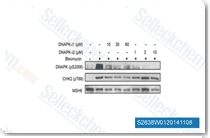
| S2638 | NU7441 (KU-57788) | NU7441 (KU-57788) es un inhibidor muy potente y selectivo de DNA-PK con IC50 de 14 nM. También inhibe mTOR y PI3K con IC50 de 1,7 μM y 5 μM en ensayos libres de células, respectivamente, y reduce la frecuencia de NHEJ mientras aumenta la tasa de HDR después de la escisión de ADN mediada por Cas9. |
|
|
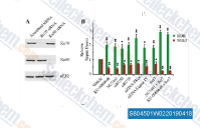
| S8045 | KU-0060648 | KU-0060648 es un inhibidor dual de DNA-PK y PI3Kα, PI3Kβ, PI3Kδ con IC50 de 8,6 nM y 4 nM, 0,5 nM, 0,1 nM respectivamente, y una menor inhibición de PI3Kγ con IC50 de 0,59 μM. |
|
|
| S8593 | VX-984 | VX-984 (M9831) es un inhibidor de la DNA-PK oralmente activo, potente, selectivo y ATP-competitivo. Este compuesto suprime eficazmente la unión de extremos no homólogos (NHEJ) y aumenta las roturas de doble cadena de ADN (DSBs). Mejora los efectos citotóxicos de la radiación ionizante (IR) en varias líneas celulares cancerosas, incluidas las líneas celulares de cáncer de pulmón no microcítico (NSCLC), in vitro. Además, este inhibidor reduce la autofosforilación de DNA-PKcs. | ||
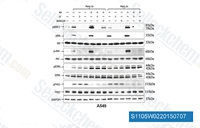
| S1105 | LY294002 | LY294002 (SF 1101, NSC 697286) es la primera molécula sintética conocida por inhibir PI3Kα/δ/β con IC50 de 0,5 μM/0,57 μM/0,97 μM, respectivamente; más estable en solución que la Wortmannina, y también bloquea la formación de autofagosomas. No solo se une a las PI3K de clase I y a otras quinasas relacionadas con PI3K, sino también a nuevos objetivos aparentemente no relacionados con la familia PI3K. Este compuesto también inhibe CK2 con una IC50 de 98 nM. Es un inhibidor no específico de DNA-PKcs y activa la autophagy y la apoptosis. |
|
|
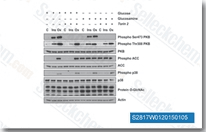
| S2817 | Torin 2 | Torin 2 es un inhibidor potente y selectivo de mTOR con una IC50 de 0,25 nM en la línea celular p53−/− MEFs; una selectividad 800 veces mayor para mTOR que para PI3K y propiedades farmacocinéticas mejoradas. Este compuesto inhibe ATM/ATR/DNA-PK con una EC50 de 28 nM/35 nM/118 nM, respectivamente, en líneas celulares PC3. Disminuye la viabilidad celular e induce Autophagy y Apoptosis. |
|
|
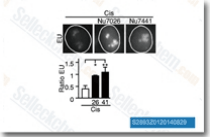
| S2893 | NU7026 | NU7026 (LY293646) es un potente inhibidor de DNA-PK con una IC50 de 0,23 μM en ensayos libres de células, 60 veces más selectivo para DNA-PK que PI3K e inactivo contra ATM y ATR. Este compuesto mejora la detención celular G2/M y la apoptosis. |
|
|
| S7891 | CC-115 | CC-115 es un inhibidor dual de la proteína quinasa dependiente de ADN (DNA-PK) y de la diana de rapamicina en mamíferos (mTOR) con valores de IC50 de 0,013 μM y 0,021 μM, respectivamente. Tiene actividad antineoplásica potencial. |
|
|
| S8379 | YU238259 | YU238259 es un nuevo inhibidor de la reparación de ADN dependiente de homología (HDR), pero no inhibe la unión de extremos no homólogos (NHEJ), en ensayos reporteros GFP basados en células. |
|
|
DNA-dependent protein kinase (DNA-PK) is composed of three key components including two DNA-binding subunits Ku70 and Ku80 (Ku86), as well as one DNA-dependent protein kinase catalytic subunit (DNA-PKcs). Based on protein sequence similarity, DNA-PK belongs to the phosphatidylinositol-3-kinase (PI3K) family, whereas, DNA-PK is not known to phosphorylate lipids and is therefore called PI3K-like kinase (PI3KK). The carboxyl-terminal region of Ku70 contains a SAP domain that is believed to be involved in chromosomal organization. The carboxyl-terminal region of Ku80 is required for the Ku70 and Ku80 heterodimer interaction with DNA-PKcs. The Ku heterodimer can bind to a variety of double-stranded end structures, including blunt ends, overhangs are the 3' or 5' end, and covalently closed hairpin ends. Like ATM and ATR, DNA-PKcs is structurally similar as it contains carboxyl-terminal domains, a large amino-terminal domain in addition to FAT and FATC domains flanking the kinase domain. The DNA-PKcs structure contains a channel large enough to accommodate double-stranded DNA, while the structure of Ku heterodimer is an asymmetric open ring, allowing the DNA to pass through the center. DNA-PKcs is one of the largest kinases identified to date, and it is the only kinase that is absolutely dependent on DNA binding for activity. DNA-PK has a strong preference for phosphorylating Serine (Ser) and Threonine (Thr) residues that are followed by glutamine or, less commonly, a hydrophobic residue. [1][2]
DNA-PK is involved in the ligation step of the non-homologous end joining (NHEJ) pathway required for DNA double-stranded break (DSB) repair, V(D)J recombination and telomere stabilization. A heterodimer of Ku70 and Ku80 initially binds to the double-stranded DNA broken ends and translocates inwards in an ATP-independent manner and recruits DNA-PKcs. This results in the stabilization of the protein/DNA binding and enabling NHEJ to proceed. Moreover, DNA-PKcs acts as a scaffold protein by joining two broken DNA ends together in a complex containing two DNA-PKcs molecules that contributes to the synapsis of the broken DNA ends and the localization of DNA repair proteins such as DNA ligase IV/XRCC4 complex to the site of damage. DNA-PK is activated in cis by the DNA to which it is bound, and stimulated by Ku heterodimer as well as the interaction of two molecules of DNA-PKcs, while end-bridging through synapsis is required for full kinase activation. DNA-PKcs autophosphorylation at multiple sites, including Thr2609 and Ser2056, results in an inactivation of DNA-PK kinase activity and NHEJ ability. To ensure NHEJ can proceed efficiently, DNA-PK phosphorylates and activates the Werner syndrome protein (WRN) to remove 3' phosphate or 3' phosphoglycolate groups generated following IR, and the nuclease Artemis to remove 5' overhangs and shorten 3' overhangs. In addition, DNA-PK promotes processing of hairpin DNA structures in V(D)J recombination by activation of Artemis. Cells that lack DNA-PKcs are acutely radiosensitive and have defective DSB repair, while mice lacking DNA-PKcs remain viable but are immunodeficient (due to the absence of immune development) as a result of accumulated processed DNA intermediates. Additionally, DNA-PK has been strongly implicated in telomere maintenance. DNA-PKcs-/- mice display significant telomeric fusion events consistent with the role of DNA-PKcs in telomere maintenance. Furthermore, DNA-PK is involved in the modulation of transcription by phosphorylation of RNA polymerases including pol I and pol II through its kinase activity, thereby regulating the function of these enzymes. By direct p53 phosphorylation, the modification of Ku70 releasing Bax, or suppressing the expression of p21, DNA-PK plays a significant role in mediating a p53-dependent apoptotic response under a range of cellular conditions including exposure to ionizing radiation (IR), environmental carcinogens and chemotherapeutic agents or in cells that have critically shortened telomeres. [1][2]
Specific inhibitors of DNA-PK used to selectively reduce NHEJ activity have been shown to be effective as single-agent therapies in homologous recombination (HR) -defective tumors. Treatment with a flavone-based DNA-PK inhibitor IC87361 leads to tumor regression. The inhibitors of DNA-PK such as NU7441 enhance the cytotoxicity of physical and chemical agents, leading to reduced clonogenic survival and cellular proliferation, as well as increased apoptosis, regardless of p53 status. Moreover, DNA-PK inhibitors combined with other DNA-damage response (DDR) inhibitors enhance the therapeutic potential of anticancer agents. [3][4]

Los productos son solo para uso de investigación. No para uso humano. No vendemos a pacientes.
©Copyright 2013 Selleck Chemicals. Todos los derechos reservados.