
solo para uso en investigación
Latanoprost Immunology & Inflammation related agonista
Cat. No.S4709
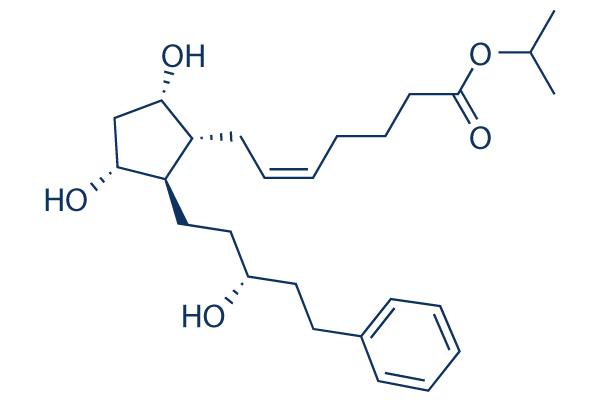
Estructura química
Peso molecular: 432.59
Control de calidad
| Dianas relacionadas | PD-1/PD-L1 CXCR STING AhR CD markers Interleukins Anti-infection Antioxidant COX Histamine Receptor |
|---|---|
| Otros Immunology & Inflammation related Inhibidores | Cl-amidine Bestatin (Ubenimex) Bindarit (AF 2838) Tranilast Tempol Sinomenine GI254023X (GI4023) ATP Geniposidic acid CORM-3 |
Información química, almacenamiento y estabilidad
| Peso molecular | 432.59 | Fórmula | C26H40O5 |
Almacenamiento (Desde la fecha de recepción) | 2 years -20°C liquid |
|---|---|---|---|---|---|
| Nº CAS | 130209-82-4 | Descargar SDF | Almacenamiento de soluciones madre |
|
|
| Sinónimos | Xalatan, PhXA41, PHXA-41 | Smiles | CC(C)OC(=O)CCCC=CCC1C(CC(C1CCC(CCC2=CC=CC=C2)O)O)O | ||
Solubilidad
|
In vitro |
|
Calculadora de Molaridad
|
In vivo |
|||||
Calculadora de formulación in vivo (Solución clara)
Paso 1: Introduzca la información a continuación (Recomendado: Un animal adicional para tener en cuenta la pérdida durante el experimento)
Paso 2: Introduzca la formulación in vivo (Esto es solo la calculadora, no la formulación. Por favor, contáctenos primero si no hay una formulación in vivo en la sección de Solubilidad.)
Resultados del cálculo:
Concentración de trabajo: mg/ml;
Método para preparar el líquido maestro de DMSO: mg fármaco predissuelto en μL DMSO ( Concentración del líquido maestro mg/mL, Por favor, contáctenos primero si la concentración excede la solubilidad del DMSO del lote del fármaco. )
Método para preparar la formulación in vivo: Tomar μL DMSO líquido maestro, luego añadirμL PEG300, mezclar y clarificar, luego añadirμL Tween 80, mezclar y clarificar, luego añadir μL ddH2O, mezclar y clarificar.
Método para preparar la formulación in vivo: Tomar μL DMSO líquido maestro, luego añadir μL Aceite de maíz, mezclar y clarificar.
Nota: 1. Por favor, asegúrese de que el líquido esté claro antes de añadir el siguiente disolvente.
2. Asegúrese de añadir el (los) disolvente(s) en orden. Debe asegurarse de que la solución obtenida, en la adición anterior, sea una solución clara antes de proceder a añadir el siguiente disolvente. Se pueden utilizar métodos físicos como el vórtice, el ultrasonido o el baño de agua caliente para ayudar a la disolución.
Mecanismo de acción
| Targets/IC50/Ki |
retinoid X receptor α
PGF-prostanoid receptor
|
|---|---|
| In vitro |
Latanoprost funcionó como un activador indirecto de la proteína quinasa activada por AMP y como un antagonista selectivo del receptor X retinoide α (RXRα) capaz de antagonizar selectivamente la transcripción de un heterodímero RXRα/receptor γ activado por proliferadores de peroxisomas. Este compuesto indujo anormalidades morfológicas y disminución de la viabilidad de las células HCS in vitro. Induce la detención del ciclo celular de las células HCS. Este químico induce cambios anormales de la membrana plasmática, fragmentación del ADN y anormalidades ultraestructurales de las células HCS. La activación de la caspasa en las células HCS también es activada por el tratamiento con este compuesto. Induce la interrupción de la MTP y cambios cuantitativos de los reguladores pro-apoptóticos asociados a las mitocondrias en las células HCS. Este compuesto es eficaz para inhibir la adipogénesis, reducir la lipogénesis, promover la oxidación de ácidos grasos y mejorar la translocación de GLUT4 y la captación de glucosa tanto en adipocitos como en miotubos.
|
| In vivo |
Latanoprost, un fármaco clínico para el tratamiento del glaucoma primario de ángulo abierto y la hipertensión intraocular, mejora eficazmente los trastornos de glucosa y lípidos en dos modelos de ratón de diabetes tipo 2. Su tratamiento mejora la tolerancia a la glucosa. La administración crónica de este compuesto disminuye los lípidos séricos y mejora la señalización de la insulina en el tejido adiposo blanco y el músculo esquelético. Activa eficazmente la AMPK y regula los genes relevantes para el metabolismo de la glucosa y los lípidos en ratones diabéticos.
|
Referencias |
|
Información del ensayo clínico
(datos de https://clinicaltrials.gov, actualizado el 2024-05-22)
| Número NCT | Reclutamiento | Condiciones | Patrocinador/Colaboradores | Fecha de inicio | Fases |
|---|---|---|---|---|---|
| NCT05333419 | Completed | Open Angle Glaucoma|Ocular Hypertension |
PolyActiva Pty Ltd |
March 4 2022 | Phase 1 |
| NCT02622334 | Completed | Glaucoma |
Hoffmann-La Roche |
December 29 2015 | Phase 1 |
| NCT00941525 | Completed | Open Angle Glaucoma|Ocular Hypertension |
Aristotle University Of Thessaloniki |
September 2009 | Phase 4 |
Soporte técnico
Tel: +1-832-582-8158 Ext:3
Si tiene alguna otra consulta, por favor deje un mensaje.

Los productos son solo para uso de investigación. No para uso humano. No vendemos a pacientes.
©Copyright 2013 Selleck Chemicals. Todos los derechos reservados.