
solo para uso en investigación
Bindarit (AF 2838) Inhibidor de MCP/CCL
Cat. No.S3032
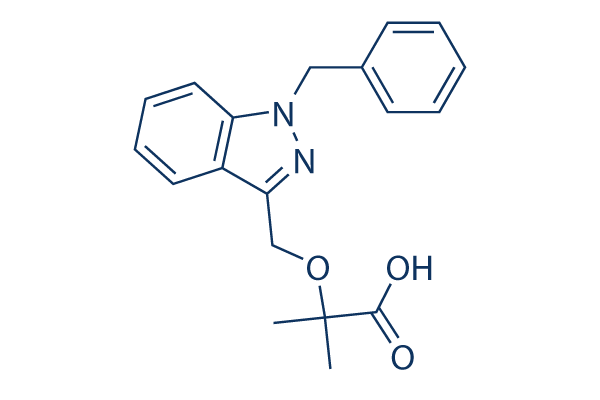
Estructura química
Peso molecular: 324.37
Control de calidad
| Dianas relacionadas | PD-1/PD-L1 CXCR STING AhR CD markers Interleukins Anti-infection Antioxidant COX Histamine Receptor |
|---|---|
| Otros Immunology & Inflammation related Inhibidores | Cl-amidine Bestatin (Ubenimex) Tranilast Tempol Sinomenine GI254023X (GI4023) ATP Geniposidic acid CORM-3 Oxymatrine |
Cultivo celular, tratamiento y concentración de trabajo
| Líneas celulares | Tipo de ensayo | Concentración | Tiempo de incubación | Formulación | Descripción de la actividad | PMID |
|---|---|---|---|---|---|---|
| SK-N-MC | qHTS assay | qHTS of pediatric cancer cell lines to identify multiple opportunities for drug repurposing: Primary screen for SK-N-MC cells | 29435139 | |||
| NB-EBc1 | qHTS assay | qHTS of pediatric cancer cell lines to identify multiple opportunities for drug repurposing: Primary screen for NB-EBc1 cells | 29435139 | |||
| SK-N-SH | qHTS assay | qHTS of pediatric cancer cell lines to identify multiple opportunities for drug repurposing: Primary screen for SK-N-SH cells | 29435139 | |||
| Haga clic para ver más datos experimentales de líneas celulares | ||||||
Información química, almacenamiento y estabilidad
| Peso molecular | 324.37 | Fórmula | C19H20N2O3 |
Almacenamiento (Desde la fecha de recepción) | |
|---|---|---|---|---|---|
| Nº CAS | 130641-38-2 | Descargar SDF | Almacenamiento de soluciones madre |
|
|
Solubilidad
|
In vitro |
DMSO
: 64 mg/mL
(197.3 mM)
Ethanol : 64 mg/mL Water : Insoluble |
Calculadora de Molaridad
|
In vivo |
|||||
Calculadora de formulación in vivo (Solución clara)
Paso 1: Introduzca la información a continuación (Recomendado: Un animal adicional para tener en cuenta la pérdida durante el experimento)
Paso 2: Introduzca la formulación in vivo (Esto es solo la calculadora, no la formulación. Por favor, contáctenos primero si no hay una formulación in vivo en la sección de Solubilidad.)
Resultados del cálculo:
Concentración de trabajo: mg/ml;
Método para preparar el líquido maestro de DMSO: mg fármaco predissuelto en μL DMSO ( Concentración del líquido maestro mg/mL, Por favor, contáctenos primero si la concentración excede la solubilidad del DMSO del lote del fármaco. )
Método para preparar la formulación in vivo: Tomar μL DMSO líquido maestro, luego añadirμL PEG300, mezclar y clarificar, luego añadirμL Tween 80, mezclar y clarificar, luego añadir μL ddH2O, mezclar y clarificar.
Método para preparar la formulación in vivo: Tomar μL DMSO líquido maestro, luego añadir μL Aceite de maíz, mezclar y clarificar.
Nota: 1. Por favor, asegúrese de que el líquido esté claro antes de añadir el siguiente disolvente.
2. Asegúrese de añadir el (los) disolvente(s) en orden. Debe asegurarse de que la solución obtenida, en la adición anterior, sea una solución clara antes de proceder a añadir el siguiente disolvente. Se pueden utilizar métodos físicos como el vórtice, el ultrasonido o el baño de agua caliente para ayudar a la disolución.
Mecanismo de acción
| Características |
Bindarit is devoid of immunosuppressive effects.
|
|---|---|
| Targets/IC50/Ki |
MCP-1/CCL2
MCP-3/CCL7
MCP-2/CCL8
|
| In vitro |
El tratamiento con Bindarit causa una inhibición dosis-dependiente de la capacidad de los monocitos humanos para producir proteína quimiotáctica de monocitos-1 (MCP-1) en respuesta a LPS bacteriano o C. albicans con IC50 de 172 µM y 403 µM, respectivamente. La inhibición de la producción de MCP-1 inducida por LPS por este compuesto se asocia con niveles reducidos de transcritos de ARNm de MCP-1 con IC50 de 75 µM. Inhibe la producción de MCP-1 por células MM6 estimuladas con LPS con IC50 de 425 μM, sin afectar la liberación de IL-8 o IL-6. Este químico inhibe la liberación de MCP-1 de la línea celular de osteoblastos Saos-2 estimulada con IL-1. Incluso a la concentración máxima, no exhibe un efecto citotóxico directo in vitro sobre el melanoma humano IIB-MEL-J o las EC, aunque inhibe la expresión de MCP-1. Este compuesto (10-300 μM) reduce la proliferación, migración e invasión de células musculares lisas vasculares (VSMC) de rata. Induce la regulación a la baja de la vía clásica de NF-κB. Este químico muestra un efecto inhibidor específico sobre la activación del promotor de MCP-1 inducida por p65 y p65/p50, sin efecto sobre otros promotores activados probados, lo que indica que actúa sobre una subpoblación específica de isoformas de NF-κB y selecciona sus dianas dentro de toda la vía inflamatoria de NF-κB. Modula la proliferación y migración de células cancerosas, principalmente a través de la regulación negativa de la señalización de TGF-β y AKT. |
| In vivo |
La administración oral de Bindarit a 50 mg/kg en ratones NZB/W retrasa la aparición de proteinuria, protege significativamente contra el deterioro de la función renal y prolonga la supervivencia de ratones NZB/W o ratones lúpicos. Este tratamiento con el compuesto regula completamente al alza el MCP-1 durante la progresión de la nefritis. La inhibición de MCP-1 con este químico también reduce el crecimiento tumoral y el reclutamiento de macrófagos, lo que produce masas tumorales necróticas en xenoinjertos de melanoma humano. Este compuesto es eficaz para reducir la formación de neointima tanto en modelos animales de lesión vascular no hiperlipémicos como hiperlipémicos, mediante un efecto directo sobre la proliferación y migración de VSMC y mediante la reducción del contenido de macrófagos neointimales. La administración de este químico resulta en una enfermedad metastásica alterada en ratones con xenoinjertos de cáncer de próstata PC-3M-Luc2 y un deterioro de la tumorigénesis local en ratones Balb/c con células de cáncer de mama murino 4T1-Luc. Además, este tratamiento disminuye significativamente la infiltración de macrófagos asociados a tumores y células supresoras de origen mieloide en tumores primarios 4T1-Luc. |
Referencias |
|
Información del ensayo clínico
(datos de https://clinicaltrials.gov, actualizado el 2024-05-22)
| Número NCT | Reclutamiento | Condiciones | Patrocinador/Colaboradores | Fecha de inicio | Fases |
|---|---|---|---|---|---|
| NCT01269242 | Completed | Coronary Restenosis |
Aziende Chimiche Riunite Angelini Francesco S.p.A |
January 2009 | Phase 2 |
| NCT01109212 | Completed | Diabetic Nephropathy |
Aziende Chimiche Riunite Angelini Francesco S.p.A|Mario Negri Institute for Pharmacological Research |
March 2007 | Phase 2 |
Soporte técnico
Tel: +1-832-582-8158 Ext:3
Si tiene alguna otra consulta, por favor deje un mensaje.

Los productos son solo para uso de investigación. No para uso humano. No vendemos a pacientes.
©Copyright 2013 Selleck Chemicals. Todos los derechos reservados.