
solo para uso en investigación
Amlexanox Immunology & Inflammation related modulador
Cat. No.S3648
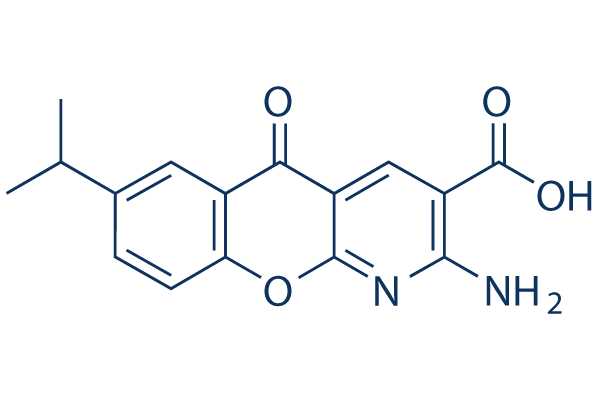
Estructura química
Peso molecular: 298.29
Control de calidad
| Dianas relacionadas | PD-1/PD-L1 CXCR STING AhR CD markers Interleukins Anti-infection Antioxidant COX Histamine Receptor |
|---|---|
| Otros Immunology & Inflammation related Inhibidores | Cl-amidine Bestatin (Ubenimex) Bindarit (AF 2838) Tranilast Tempol Sinomenine GI254023X (GI4023) ATP Geniposidic acid CORM-3 |
Cultivo celular, tratamiento y concentración de trabajo
| Líneas celulares | Tipo de ensayo | Concentración | Tiempo de incubación | Formulación | Descripción de la actividad | PMID |
|---|---|---|---|---|---|---|
| ARPE-19 cells | Function assay | 1 μM | Inhibition of TBK1 by Amlx (1 µM) reduces HG-induced mitophagic flux | |||
| HCT-116 | Function assay | 100 μM | 48 h | Amlexanox stimulates expression from a NMD reporter vector. | ||
| PC3 | Function assay | 20 nM, 100 nM, 1μM and 5 μM | leads to dosage-dependent downregulation of EMT-inducing transcriptional factors Zeb1 and N-cadherin, and upregulation of epithelial-specific protein E-cadherin | |||
| DU145 | Function assay | 20 nM, 100 nM, 1μM and 5 μM | leads to dosage-dependent downregulation of EMT-inducing transcriptional factors Zeb1 and N-cadherin, and upregulation of epithelial-specific protein E-cadherin | |||
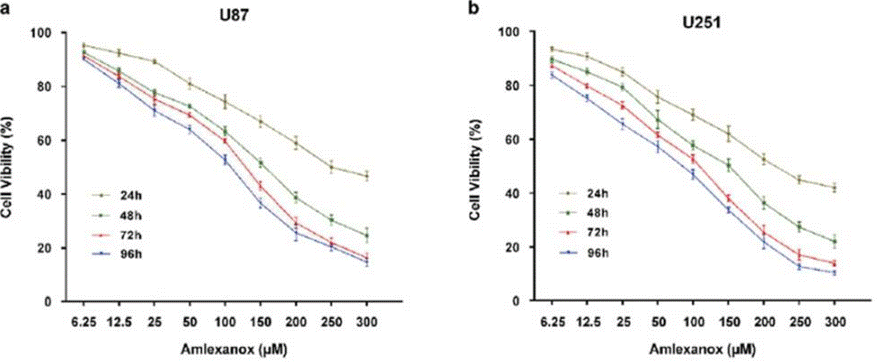
| U87 | Proliferation assay | 0-300 μM | 24, 48, 72 and 96 h | The IC50 values for 72 h of amlexanox treatment were approximately 140 μM in U87 cells. | ||
| U251 | Proliferation assay | 0-300 μM | 24, 48, 72 and 96 h | The IC50 values for 72 h of amlexanox treatment were approximately 120 μM in U251 cells. | ||
| NIH 3T3 cells | Function assay | 1 mM or 0.375 mM | 24 h | Cells exhibited a dramatic change in their morphology that included a larger and more flattened phenotype and often displayed long processes that are stable for at least 10 days | ||
| HUVEC | Function assay | 1 mM or 0.375 mM | 24 h | modify cell morphology | ||
| Swiss 3T3 | Function assay | 1 mM | 10-360 min | Amlexanox was able to stimulate the tyrosine phosphorylation of cortactin in a rapid and sustained manner. | ||
| Haga clic para ver más datos experimentales de líneas celulares | ||||||
Información química, almacenamiento y estabilidad
| Peso molecular | 298.29 | Fórmula | C16H14N2O4 |
Almacenamiento (Desde la fecha de recepción) | |
|---|---|---|---|---|---|
| Nº CAS | 68302-57-8 | Descargar SDF | Almacenamiento de soluciones madre |
|
|
| Sinónimos | CHX-3673, Amoxanox, AA-673 | Smiles | CC(C)C1=CC2=C(C=C1)OC3=NC(=C(C=C3C2=O)C(=O)O)N | ||
Solubilidad
|
In vitro |
DMSO
: 59 mg/mL
(197.79 mM)
Ethanol : 2 mg/mL Water : Insoluble |
Calculadora de Molaridad
|
In vivo |
|||||
Calculadora de formulación in vivo (Solución clara)
Paso 1: Introduzca la información a continuación (Recomendado: Un animal adicional para tener en cuenta la pérdida durante el experimento)
Paso 2: Introduzca la formulación in vivo (Esto es solo la calculadora, no la formulación. Por favor, contáctenos primero si no hay una formulación in vivo en la sección de Solubilidad.)
Resultados del cálculo:
Concentración de trabajo: mg/ml;
Método para preparar el líquido maestro de DMSO: mg fármaco predissuelto en μL DMSO ( Concentración del líquido maestro mg/mL, Por favor, contáctenos primero si la concentración excede la solubilidad del DMSO del lote del fármaco. )
Método para preparar la formulación in vivo: Tomar μL DMSO líquido maestro, luego añadirμL PEG300, mezclar y clarificar, luego añadirμL Tween 80, mezclar y clarificar, luego añadir μL ddH2O, mezclar y clarificar.
Método para preparar la formulación in vivo: Tomar μL DMSO líquido maestro, luego añadir μL Aceite de maíz, mezclar y clarificar.
Nota: 1. Por favor, asegúrese de que el líquido esté claro antes de añadir el siguiente disolvente.
2. Asegúrese de añadir el (los) disolvente(s) en orden. Debe asegurarse de que la solución obtenida, en la adición anterior, sea una solución clara antes de proceder a añadir el siguiente disolvente. Se pueden utilizar métodos físicos como el vórtice, el ultrasonido o el baño de agua caliente para ayudar a la disolución.
Mecanismo de acción
| Targets/IC50/Ki |
TBK1
IKK-ε
|
|---|---|
| In vitro |
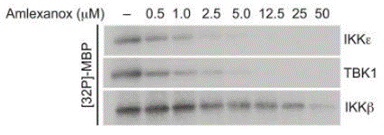
Relación dosis-respuesta de la inhibición por amlexanox de la actividad de IKK-ε y TBK1 determinada por la fosforilación de MBP, mostrando una IC50 de aproximadamente 1-2 μM. Este compuesto también bloquea la actividad de TBK1 a aproximadamente las mismas concentraciones, pero no tiene efecto sobre IKK-α o IKK-β y a estas concentraciones no bloquea ninguna otra quinasa de un amplio panel que representa la mayoría de las familias de quinasas. La inhibición de IKK-ε o TBK1 por este químico es competitiva para su sustrato ATP, lo que indica que interactúa con las enzimas en el sitio de unión de ATP. Aumenta la fosforilación de TBK1 en Ser172 en adipocitos 3T3-L1 y bloquea la fosforilación estimulada por ácido poliinosínico:policitidílico (poly I:C) del factor 3 sensible al interferón (IRF3), un sustrato presunto de IKK-ε y TBK1.
|
| In vivo |
El tratamiento de ratones obesos con Amlexanox eleva el gasto energético a través de una termogénesis aumentada, produciendo pérdida de peso, mejora la sensibilidad a la insulina y disminuye la esteatosis.
|
Referencias |
Aplicaciones
| Métodos | Biomarcadores | Imágenes | PMID |
|---|---|---|---|
| Western blot | IKKε / TBK1 / IKKβ MMP2 / MMP9 IKBKE / MST1 / MST2 / p-MST / LAST1 / LAST2 / p-YAP1 / YAP1 / Axl / c-Myc / Cyr61 p-p65 / p-IκBα / S100A13 |
|
23396211 |
| Growth inhibition assay | Cell viability |
|
29048430 |
Soporte técnico
Tel: +1-832-582-8158 Ext:3
Si tiene alguna otra consulta, por favor deje un mensaje.

Los productos son solo para uso de investigación. No para uso humano. No vendemos a pacientes.
©Copyright 2013 Selleck Chemicals. Todos los derechos reservados.