
solo para uso en investigación
Vandetanib VEGFR inhibidor
Cat. No.S1046
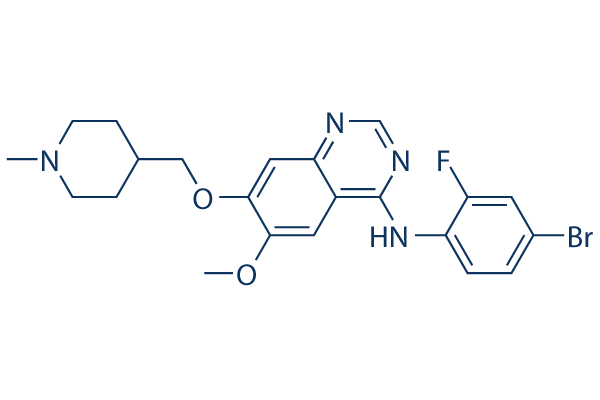
Estructura química
Peso molecular: 475.35
Control de calidad
| Dianas relacionadas | EGFR PDGFR FGFR c-Met Src MEK CSF-1R FLT3 HER2 c-Kit |
|---|---|
| Otros VEGFR Inhibidores | SAR131675 SU 5402 Cediranib (AZD2171) Vatalanib (PTK787) 2HCl Anlotinib (AL3818) Dihydrochloride Linifanib (ABT-869) Apatinib (YN968D1) Apatinib (YN968D1) mesylate Ki8751 ZM 323881 HCl |
Cultivo celular, tratamiento y concentración de trabajo
| Líneas celulares | Tipo de ensayo | Concentración | Tiempo de incubación | Formulación | Descripción de la actividad | PMID |
|---|---|---|---|---|---|---|
| SN179 | Function Assay | 500 nM | 16 h | increases CXCR4 expression significantly | 25676691 | |
| SN186 | Function Assay | 500 nM | 16 h | increases CXCR4 expression significantly | 25676691 | |
| SN179 | Function Assay | 500 nM | 16 h | enhances the CXCL12 directed migration | 25676691 | |
| SN179 | Function Assay | 500 nM | 16 h | increases basal migration | 25676691 | |
| Jurkat | Growth Inhibition Assay | 72 h | GI50=1.5 ± 0.2 μM | 24681205 | ||
| K-562 | Growth Inhibition Assay | 72 h | GI50=1.8 ± 0.1 μM | 24681205 | ||
| NCTC-2544 | Growth Inhibition Assay | 72 h | GI50=4.6 ± 0.3 μM | 24681205 | ||
| A-431 | Growth Inhibition Assay | 72 h | GI50=2.4 ± 0.3 μM | 24681205 | ||
| SK-N-SH | Growth Inhibition Assay | 0.625-20 μM | 48 h | DMSO | inhibits cell growth in a dose dependent manner | 24399074 |
| SH-SY5Y | Growth Inhibition Assay | 0.625-20 μM | 48 h | DMSO | inhibits cell growth in a dose dependent manner | 24399074 |
| SK-N-SH | Apoptosisi Assay | 5/10/20 μM | 48 h | DMSO | induces apoptosis dose dependently | 24399074 |
| SH-SY5Y | Apoptosisi Assay | 5/10/20 μM | 48 h | DMSO | induces apoptosis dose dependently | 24399074 |
| SK-N-SH | Function Assay | 5/10/20 μM | 48 h | DMSO | induces G1 phase cell cycle arrest | 24399074 |
| SH-SY5Y | Function Assay | 5/10/20 μM | 48 h | DMSO | induces G1 phase cell cycle arrest | 24399074 |
| SK-N-SH | Function Assay | 1/5/10 μM | 48 h | DMSO | inhibits RET phosphorylation | 24399074 |
| SH-SY5Y | Function Assay | 1/5/10 μM | 48 h | DMSO | inhibits RET phosphorylation | 24399074 |
| SK-N-SH | Function Assay | 5/10 μM | 48 h | DMSO | inhibits human NB cell migration | 24399074 |
| SH-SY5Y | Function Assay | 5/10 μM | 48 h | DMSO | inhibits human NB cell migration | 24399074 |
| SK-N-SH | Function Assay | 5/10 μM | 48 h | DMSO | inhibits human NB cell invasion | 24399074 |
| SH-SY5Y | Function Assay | 5/10 μM | 48 h | DMSO | inhibits human NB cell invasion | 24399074 |
| SK-N-SH | Function Assay | 5 μM | 24/48/72 h | DMSO | suppresses the expression of CXCR4 and MMP14 mRNA | 24399074 |
| SH-SY5Y | Function Assay | 5 μM | 24/48/72 h | DMSO | suppresses the expression of CXCR4 and MMP14 mRNA | 24399074 |
| SK-N-SH | Function Assay | 5 μM | 48/72 h | DMSO | suppresses expression of the CXCR4 and MMP14 protein | 24399074 |
| SH-SY5Y | Function Assay | 5 μM | 48/72 h | DMSO | suppresses expression of the CXCR4 and MMP14 protein | 24399074 |
| HMEpC | Growth Inhibition Assay | 1 nM-100 μM | 48 h | DMSO | inhibits cell growth in a dose dependent manner | 24138843 |
| MCF-7 | Growth Inhibition Assay | 1 nM-100 μM | 48 h | DMSO | inhibits cell growth in a dose dependent manner | 24138843 |
| ZR-75-1 | Growth Inhibition Assay | 1 nM-100 μM | 48 h | DMSO | inhibits cell growth in a dose dependent manner | 24138843 |
| MDA-MB-231 | Growth Inhibition Assay | 1 nM-100 μM | 48 h | DMSO | inhibits cell growth in a dose dependent manner | 24138843 |
| MDA-MB-468 | Growth Inhibition Assay | 1 nM-100 μM | 48 h | DMSO | inhibits cell growth in a dose dependent manner | 24138843 |
| T-47-D | Growth Inhibition Assay | 1 nM-100 μM | 48 h | DMSO | inhibits cell growth in a dose dependent manner | 24138843 |
| U251 | Function Assay | 2/4/8 μℳ | 6/12/24 h | DMSO | increases the LC3-II level in a time-dependent and dose-dependent manner | 23799852 |
| U87MG | Function Assay | 2/4/8 μℳ | 6/12/24 h | DMSO | increases the LC3-II level in a time-dependent and dose-dependent manner | 23799852 |
| U251 | Function Assay | 4 μℳ | 2/6/12 h | DMSO | suppresses basal levels of phosphorylation of S6 (S235/236), 4E-BP1 (T37/46), and Akt (S473) in a time-dependent manner | 23799852 |
| U87MG | Function Assay | 4 μℳ | 2/6/12 h | DMSO | suppresses basal levels of phosphorylation of S6 (S235/236), 4E-BP1 (T37/46), and Akt (S473) in a time-dependent manner | 23799852 |
| H1650 | Growth Inhibition Assay | IC50=3.5±1.2 μM | 23274758 | |||
| HUVECs | Growth Inhibition Assay | 72 h | IC50 = 7.1 μmol/L | 22611027 | ||
| KYN-2 | Growth Inhibition Assay | 72 h | IC50 = 8.1 μmol/L | 22611027 | ||
| HuH-7 | Growth Inhibition Assay | 72 h | IC50 = 9.4 μmol/L | 22611027 | ||
| HUVECs | Function Assay | 1/5/10 μM | 1 h | significantly inhibits VEGFR-2 phosphorylation | 22611027 | |
| HAK1-B | Function Assay | 1/5/10 μM | 1 h | suppresses EGFR phosphorylation | 22611027 | |
| UM-22A | Growth Inhibition Assay | 0-6 μM | 72 h | DMSO | inhibits cell growth in a dose dependent manner | 22307735 |
| UM-22B | Growth Inhibition Assay | 0-6 μM | 72 h | DMSO | inhibits cell growth in a dose dependent manner | 22307735 |
| PCI-37A | Growth Inhibition Assay | 0-6 μM | 72 h | DMSO | inhibits cell growth in a dose dependent manner | 22307735 |
| PCI-37B | Growth Inhibition Assay | 0-6 μM | 72 h | DMSO | inhibits cell growth in a dose dependent manner | 22307735 |
| PCI-15B | Growth Inhibition Assay | 0-6 μM | 72 h | DMSO | inhibits cell growth in a dose dependent manner | 22307735 |
| SCC-25 | Growth Inhibition Assay | 0-6 μM | 72 h | DMSO | inhibits cell growth in a dose dependent manner | 22307735 |
| UM-22A | Function Assay | 0-10 μM | 24 h | DMSO | inhibits the activation of the EGFR tyrosine kinase and also decreases the expression of phosphorylated forms of the downstream signaling elements, STAT3 and MAPK | 22307735 |
| UM-22B | Function Assay | 0-10 μM | 24 h | DMSO | inhibits the activation of the EGFR tyrosine kinase and also decreases the expression of phosphorylated forms of the downstream signaling elements, STAT3 and MAPK | 22307735 |
| PCI-15B | Function Assay | 0-10 μM | 24 h | DMSO | inhibits the activation of the EGFR tyrosine kinase and also decreases the expression of phosphorylated forms of the downstream signaling elements, STAT3 and MAPK | 22307735 |
| PCI-37A | Function Assay | 1 μM | 24 h | DMSO | downregulates VEGF production | 22307735 |
| UM-22A | Function Assay | 1 μM | 24 h | DMSO | downregulates VEGF production | 22307735 |
| PCI-15B | Function Assay | 1 μM | 24 h | DMSO | downregulates VEGF production | 22307735 |
| PCI-15B | Invasion Assay | 24 h | DMSO | EC50=558 nM | 22307735 | |
| PCI-37A | Invasion Assay | 24 h | DMSO | EC50=1695 nM | 22307735 | |
| UM-22A | Invasion Assay | 24 h | DMSO | EC50=0.3 nM | 22307735 | |
| SCC-25 | Invasion Assay | 24 h | DMSO | EC50=10 nM | 22307735 | |
| UM-22B | Invasion Assay | 24 h | DMSO | EC50=2424 nM | 22307735 | |
| PCI-37B | Invasion Assay | 24 h | DMSO | EC50=1726 nM | 22307735 | |
| 201T | Function Assay | 2.5 μM | 48 h | DMSO | inhibits phospho-MAPK following EGF | 22258476 |
| 273T | Function Assay | 2.5 μM | 48 h | DMSO | inhibits phospho-MAPK following EGF | 22258476 |
| A549 | Function Assay | 2.5 μM | 48 h | DMSO | inhibits phospho-MAPK following EGF | 22258476 |
| 201T | Function Assay | 1/5/10 μM | 48 h | DMSO | blocks the phosphorylation of Akt induced by VEGFC | 22258476 |
| H2052 | Growth Inhibition Assay | IC50=1.07±0.04 μM | 21970874 | |||
| H2452 | Growth Inhibition Assay | IC50=3.52±1.13 μM | 21970874 | |||
| H28 | Growth Inhibition Assay | IC50=0.32±0.07 μM | 21970874 | |||
| MSTO-211H | Growth Inhibition Assay | IC50=1.42±0.03 μM | 21970874 | |||
| Hth83 | Growth Inhibition Assay | 72 h | DMSO | IC50=3.30 ± 0.66 μM | 21220477 | |
| C643 | Growth Inhibition Assay | 72 h | DMSO | IC50=3.65 ± 1.22 μM | 21220477 | |
| 8505C | Growth Inhibition Assay | 72 h | DMSO | IC50=7.56 ± 1.13 μM | 21220477 | |
| Hth74 | Growth Inhibition Assay | 72 h | DMSO | IC50=8.56 ± 1.01 μM | 21220477 | |
| SW1736 | Growth Inhibition Assay | 72 h | DMSO | IC50=9.05 ± 0.55 μM | 21220477 | |
| Hth7 | Growth Inhibition Assay | 72 h | DMSO | IC50=9.66 ± 0.38 μM | 21220477 | |
| Hth104 | Growth Inhibition Assay | 72 h | DMSO | IC50=±16.98 ± NA μM | 21220477 | |
| HTB3 | Growth Inhibition Assay | 0-20 μM | 24 h | inhibits cell growth in a dose dependent manner | 19220256 | |
| HT1376 | Growth Inhibition Assay | 0-20 μM | 24 h | inhibits cell growth in a dose dependent manner | 19220256 | |
| RT4 | Growth Inhibition Assay | 0-20 μM | 24 h | inhibits cell growth in a dose dependent manner | 19220256 | |
| J82 | Growth Inhibition Assay | 0-20 μM | 24 h | inhibits cell growth in a dose dependent manner | 19220256 | |
| CRL1749 | Growth Inhibition Assay | 0-20 μM | 24 h | inhibits cell growth in a dose dependent manner | 19220256 | |
| T24 | Growth Inhibition Assay | 0-20 μM | 24 h | inhibits cell growth in a dose dependent manner | 19220256 | |
| SUP | Growth Inhibition Assay | 0-20 μM | 24 h | inhibits cell growth in a dose dependent manner | 19220256 | |
| HTB9 | Growth Inhibition Assay | 0-20 μM | 24 h | inhibits cell growth in a dose dependent manner | 19220256 | |
| ACC3 | Growth Inhibition Assay | 0-10 μM | 72 h | inhibits cell growth in a dose dependent manner | 18698025 | |
| ACC2 | Growth Inhibition Assay | 0-10 μM | 72 h | inhibits cell growth in a dose dependent manner | 18698025 | |
| ACCM | Growth Inhibition Assay | 0-10 μM | 72 h | inhibits cell growth in a dose dependent manner | 18698025 | |
| ACC3 | Apoptosisi Assay | 0-10 μM | 72 h | induces apoptosis dose dependently | 18698025 | |
| ACC2 | Apoptosisi Assay | 0-10 μM | 72 h | induces apoptosis dose dependently | 18698025 | |
| ACCM | Apoptosisi Assay | 0-10 μM | 72 h | induces apoptosis dose dependently | 18698025 | |
| EHMES-1 | Growth Inhibition Assay | 72 h | DMSO | IC50=10.6 μM | 18364248 | |
| EHMES-10 | Growth Inhibition Assay | 72 h | DMSO | IC50=0.3 μM | 18364248 | |
| 211H | Growth Inhibition Assay | 72 h | DMSO | IC50=2.2 μM | 18364248 | |
| H28 | Growth Inhibition Assay | 72 h | DMSO | IC50=1.8 μM | 18364248 | |
| H2052 | Growth Inhibition Assay | 72 h | DMSO | IC50=8.0 μM | 18364248 | |
| H2452 | Growth Inhibition Assay | 72 h | DMSO | IC50=5.5 μM | 18364248 | |
| CNE-1 | Growth Inhibition Assay | 0.1-25.6 μM | 48 h | IC50=3.6 μM | 17631646 | |
| CNE-2 | Growth Inhibition Assay | 0.1-25.6 μM | 48 h | IC50=6.2 μM | 17631646 | |
| C666-1 | Growth Inhibition Assay | 0.1-25.6 μM | 48 h | IC50=23.4 μM | 17631646 | |
| CNE-1 | Growth Inhibition Assay | 0.1-25.6 μM | 72 h | IC50=2.3 μM | 17631646 | |
| CNE-2 | Growth Inhibition Assay | 0.1-25.6 μM | 72 h | IC50=3.6 μM | 17631646 | |
| C666-1 | Growth Inhibition Assay | 0.1-25.6 μM | 72 h | IC50=4.86 μM | 17631646 | |
| CNE-1 | Function Assay | 6 μM | 24 h | delays G0/G1 cell cycle progression | 17631646 | |
| CNE-2 | Function Assay | 6 μM | 24 h | delays G0/G1 cell cycle progression | 17631646 | |
| C666-1 | Function Assay | 6 μM | 24 h | delays G0/G1 cell cycle progression | 17631646 | |
| KDR15 | Function assay | Inhibitory activity against VEGF stimulated autophosphorylation of VEGFR2 expressed in KDR15 cells, IC50 = 0.015 μM. | 16302797 | |||
| Sf9 | Function assay | Inhibition of human recombinant histidine-tagged RET (700-1020) expressed in Sf9 cells by ELISA, IC50 = 0.097 μM. | 20409618 | |||
| TPC1 | Antiproliferative assay | 72 hrs | Antiproliferative activity against human TPC1 cells expressing RET/PCT1 after 72 hrs by [3H]thymidine incorporation assay, IC50 = 0.116 μM. | 20409618 | ||
| HEK293 | Function assay | Inhibition of FGFR1/VEGFR2 chimeric construct expressed in HEK293 cells by ELISA, ED50 = 0.15 μM. | 19101155 | |||
| Sf21 | Function assay | 15 mins | Inhibition of recombinant His-tagged human KDR expressed in insect Sf21 cells preincubated for 15 mins followed by substrate addition measured after 20 mins by HTRF assay, IC50 = 0.175 μM. | 26874741 | ||
| umbilical vein endothelial cells | Function assay | Inhibition of VEGF-induced proliferation of human umbilical vein endothelial cells, IC50 = 0.4 μM. | 15743202 | |||
| BA/F3 | Function assay | 48 hrs | Inhibition of KIF5B/RET (unknown origin) expressed in mouse BA/F3 cells assessed as reduction in cell viability after 48 hrs by Cell titre glo-based luminescence assay, IC50 = 0.4 μM. | 26874741 | ||
| BA/F3 | Function assay | 48 hrs | Inhibition of KDR (unknown origin) expressed in mouse BA/F3 cells assessed as reduction in cell viability after 48 hrs by Cell titre glo-based luminescence assay, IC50 = 0.63 μM. | 26874741 | ||
| umbilical vein endothelial cells | Function assay | Inhibition of basic FGF-induced proliferation of human umbilical vein endothelial cells, IC50 = 1.2 μM. | 15743202 | |||
| HL60 | Antiproliferative assay | 72 hrs | Antiproliferative activity against human HL60 cells after 72 hrs by MTT assay, IC50 = 1.492 μM. | 26995527 | ||
| 293 | Function assay | Inhibitory activity against VEGFR2 transiently transfected in 293 adenovirus transfected kidney cells by ELISA, IC50 = 1.66 μM. | 16275072 | |||
| 293 | Function assay | Inhibition of VEGFR2 in 293 adenovirus transfected kidney cells by cell-based ELISA assay, IC50 = 1.66 μM. | 16321531 | |||
| HEK293 | Function assay | Inhibition of VEGFR2 phosphorylation in HEK293 cells by cell-based ELISA, IC50 = 1.66 μM. | 16460936 | |||
| HT-29 | Antiproliferative assay | 72 hrs | Antiproliferative activity against human HT-29 cells after 72 hrs by MTT assay, IC50 = 1.925 μM. | 26995527 | ||
| DU145 | Antiproliferative assay | 72 hrs | Antiproliferative activity against human DU145 cells after 72 hrs by MTT assay, IC50 = 1.974 μM. | 26995527 | ||
| MGHU3 | Antiproliferative assay | 72 hrs | Antiproliferative activity against human MGHU3 cells after 72 hrs by CellTiter-Glo assay, IC50 = 2.5 μM. | 30309671 | ||
| A549 | Antiproliferative assay | 72 hrs | Antiproliferative activity against human A549 cells after 72 hrs by CellTiter-Glo assay, IC50 = 2.5 μM. | 30309671 | ||
| RT112 | Antiproliferative assay | 72 hrs | Antiproliferative activity against human RT112 cells after 72 hrs by CellTiter-Glo assay, IC50 = 2.5 μM. | 30309671 | ||
| A549 | Antiproliferative assay | 72 hrs | Antiproliferative activity against human A549 cells after 72 hrs by MTT assay, IC50 = 2.63 μM. | 26995527 | ||
| CHO | Function assay | Inhibition of VEGFR induced autophosphorylation of human Vascular endothelial growth factor receptor 2 (VEGFR2) transfected in CHO cells, IC50 = 2.673 μM. | 12477352 | |||
| MCF7 | Antiproliferative assay | 72 hrs | Antiproliferative activity against human MCF7 cells after 72 hrs by MTT assay, IC50 = 3.536 μM. | 26995527 | ||
| PANC1 | Antiproliferative assay | 72 hrs | Antiproliferative activity against human PANC1 cells after 72 hrs by MTT assay, IC50 = 4.107 μM. | 26995527 | ||
| HT-29 | Antiproliferative assay | 10 uM | 72 hrs | Antiproliferative activity against human HT-29 cells at 10 uM after 72 hrs by MTS assay, IC50 = 4.2 μM. | 21353546 | |
| EAhy926 | Antiproliferative assay | 10 uM | 72 hrs | Antiproliferative activity against human EAhy926 cells at 10 uM after 72 hrs by MTS assay, IC50 = 5.1 μM. | 21353546 | |
| MCF7 | Antiproliferative assay | 48 hrs | Antiproliferative activity against human MCF7 cells measured after 48 hrs by MTT assay, IC50 = 11.83 μM. | 27688180 | ||
| MCF7 | Cytotoxicity assay | 48 hrs | Cytotoxicity in human MCF7 cells assessed as inhibition of cell growth incubated for 48 hrs by MTT assay, IC50 = 16.52 μM. | 28942113 | ||
| MCF7 | Antiproliferative assay | 48 hrs | Antiproliferative activity against human MCF7 cells after 48 hrs by MTT assay, IC50 = 18.5 μM. | 26741358 | ||
| MCF7 | Antiproliferative assay | 48 hrs | Antiproliferative activity against human MCF7 cells after 48 hrs by MTT assay, IC50 = 18.5 μM. | 26475519 | ||
| HT-29 | Antiproliferative assay | 48 hrs | Antiproliferative activity against human HT-29 cells measured after 48 hrs by MTT assay, IC50 = 18.95 μM. | 27688180 | ||
| H460 | Antiproliferative assay | 48 hrs | Antiproliferative activity against human H460 cells measured after 48 hrs by MTT assay, IC50 = 37.1 μM. | 27688180 | ||
| A673 | qHTS assay | qHTS of pediatric cancer cell lines to identify multiple opportunities for drug repurposing: Primary screen for A673 cells | 29435139 | |||
| DAOY | qHTS assay | qHTS of pediatric cancer cell lines to identify multiple opportunities for drug repurposing: Primary screen for DAOY cells | 29435139 | |||
| BT-37 | qHTS assay | qHTS of pediatric cancer cell lines to identify multiple opportunities for drug repurposing: Primary screen for BT-37 cells | 29435139 | |||
| RD | qHTS assay | qHTS of pediatric cancer cell lines to identify multiple opportunities for drug repurposing: Primary screen for RD cells | 29435139 | |||
| SK-N-SH | qHTS assay | qHTS of pediatric cancer cell lines to identify multiple opportunities for drug repurposing: Primary screen for SK-N-SH cells | 29435139 | |||
| MG 63 (6-TG R) | qHTS assay | qHTS of pediatric cancer cell lines to identify multiple opportunities for drug repurposing: Primary screen for MG 63 (6-TG R) cells | 29435139 | |||
| NB1643 | qHTS assay | qHTS of pediatric cancer cell lines to identify multiple opportunities for drug repurposing: Primary screen for NB1643 cells | 29435139 | |||
| OHS-50 | qHTS assay | qHTS of pediatric cancer cell lines to identify multiple opportunities for drug repurposing: Primary screen for OHS-50 cells | 29435139 | |||
| SK-N-SH | qHTS assay | qHTS of pediatric cancer cell lines to identify multiple opportunities for drug repurposing: Confirmatory screen for SK-N-SH cells | 29435139 | |||
| Rh41 | qHTS assay | qHTS of pediatric cancer cell lines to identify multiple opportunities for drug repurposing: Primary screen for Rh41 cells | 29435139 | |||
| Rh41 | qHTS assay | qHTS of pediatric cancer cell lines to identify multiple opportunities for drug repurposing: Confirmatory screen for Rh41 cells | 29435139 | |||
| SK-N-MC | qHTS assay | qHTS of pediatric cancer cell lines to identify multiple opportunities for drug repurposing: Primary screen for SK-N-MC cells | 29435139 | |||
| LAN-5 | qHTS assay | qHTS of pediatric cancer cell lines to identify multiple opportunities for drug repurposing: Primary screen for LAN-5 cells | 29435139 | |||
| Rh18 | qHTS assay | qHTS of pediatric cancer cell lines to identify multiple opportunities for drug repurposing: Primary screen for Rh18 cells | 29435139 | |||
| Haga clic para ver más datos experimentales de líneas celulares | ||||||
Información química, almacenamiento y estabilidad
| Peso molecular | 475.35 | Fórmula | C22H24BrFN4O2 |
Almacenamiento (Desde la fecha de recepción) | |
|---|---|---|---|---|---|
| Nº CAS | 443913-73-3 | Descargar SDF | Almacenamiento de soluciones madre |
|
|
| Sinónimos | ZD6474 | Smiles | CN1CCC(CC1)COC2=C(C=C3C(=C2)N=CN=C3NC4=C(C=C(C=C4)Br)F)OC | ||
Solubilidad
|
In vitro |
DMSO
: 60 mg/mL
(126.22 mM)
Calentado con baño de agua a 50°C;
Ultrasonido;
Water : Insoluble Ethanol : Insoluble |
Calculadora de Molaridad
|
In vivo |
|||||
Calculadora de formulación in vivo (Solución clara)
Paso 1: Introduzca la información a continuación (Recomendado: Un animal adicional para tener en cuenta la pérdida durante el experimento)
Paso 2: Introduzca la formulación in vivo (Esto es solo la calculadora, no la formulación. Por favor, contáctenos primero si no hay una formulación in vivo en la sección de Solubilidad.)
Resultados del cálculo:
Concentración de trabajo: mg/ml;
Método para preparar el líquido maestro de DMSO: mg fármaco predissuelto en μL DMSO ( Concentración del líquido maestro mg/mL, Por favor, contáctenos primero si la concentración excede la solubilidad del DMSO del lote del fármaco. )
Método para preparar la formulación in vivo: Tomar μL DMSO líquido maestro, luego añadirμL PEG300, mezclar y clarificar, luego añadirμL Tween 80, mezclar y clarificar, luego añadir μL ddH2O, mezclar y clarificar.
Método para preparar la formulación in vivo: Tomar μL DMSO líquido maestro, luego añadir μL Aceite de maíz, mezclar y clarificar.
Nota: 1. Por favor, asegúrese de que el líquido esté claro antes de añadir el siguiente disolvente.
2. Asegúrese de añadir el (los) disolvente(s) en orden. Debe asegurarse de que la solución obtenida, en la adición anterior, sea una solución clara antes de proceder a añadir el siguiente disolvente. Se pueden utilizar métodos físicos como el vórtice, el ultrasonido o el baño de agua caliente para ayudar a la disolución.
Mecanismo de acción
| Targets/IC50/Ki |
VEGFR2
(Cell-free assay) 40 nM
VEGFR3
(Cell-free assay) 110 nM
EGFR
(Cell-free assay) 500 nM
|
|---|---|
| In vitro |
Vandetanib también inhibe VEGFR3 y EGFR con IC50 de 110 nM y 500 nM, respectivamente. Este compuesto no es sensible a PDGFRβ, Flt1, Tie-2 y FGFR1 con IC50 de 1,1-3,6 μM, mientras que casi no tiene actividad contra MEK, CDK2, c-Kit, erbB2, FAK, PDK1, Akt e IGF-1R con IC50 superiores a 10 μM. Inhibe la proliferación de HUVEC estimulada por VEGF, EGF y bFGF con IC50 de 60 nM, 170 nM y 800 nM, sin efecto sobre el crecimiento basal de células endoteliales. Este químico inhibe el crecimiento de células tumorales con IC50 de 2,7 μM (A549) a 13,5 μM (Calu-6). Muestra un efecto inhibidor sobre la ABCG2-ATPasa basal. Las células A431 parentales y las que expresan ABCG2 mostraron sensibilidades similares a este compuesto. La exposición a los inhibidores de EGFR disminuye los niveles de pEGFR en las células A431, y este compuesto muestra solo un efecto moderado. Muestra un efecto leve pero medible, mientras que el gefitinib, el pelitinib y el neratinib inhiben completamente el eflujo mediado por ABCG2 de mitoxantrona de las células A431/ABCG2, de manera similar al inhibidor específico de ABCG2 Ko143. Inhibe tanto las líneas celulares PC3wt como PC3R con IC50 similares de 13,3 μM y 11,5 μM, respectivamente. Este químico suprime la fosforilación de VEGFR2 en HUVEC y de EGFR en células de hepatoma e inhibe la proliferación celular. Causa una acumulación de células en las fases G0-G1 en células GEO y OVCAR-3 y aumenta la apoptosis en células OVCAR-3, ZR-75-1, MCF-10A ras y GEO. Este compuesto causa una inhibición dosis-dependiente de la fosforilación de EGFR en fibroblastos de ratón NIH-EGFR y células de cáncer de mama humanas MCF-10A ras, dos líneas celulares que sobreexpresan el EGFR humano. Su tratamiento resulta en una inhibición dosis-dependiente del crecimiento en agar blando en siete líneas celulares humanas (mama, colon, gástrico y ovárico) con EGFR funcional pero que carecen de VEGFR2.
|
| Ensayo de quinasa |
Inhibición de quinasa
|
|
Vandetanib se incuba con la enzima, 10 mM de MnCl2 y 2 μM de ATP en placas de 96 pocillos recubiertas con un sustrato de copolímero aleatorio de poli(Glu, Ala, Tyr) 6:3:1. La tirosina fosforilada se detecta posteriormente mediante incubación secuencial con un anticuerpo de IgG de ratón anti-fosfotirosina 4G10, un anticuerpo de oveja anti-inmunoglobulina de ratón unido a peroxidasa de rábano y ácido 2,2′-azino-bis(3-etilbenzotiazolina-6-sulfónico). Esta metodología se adapta para examinar la selectividad frente a tirosina quinasas asociadas con EGFR, PDGFRβ, Tie-2, FGFR1, c-kit, erbB2, IGF-1R y FAK. Todos los ensayos enzimáticos (tirosina o serina-treonina) utilizaron concentraciones de ATP apropiadas en o justo por debajo de la Km respectiva (0,2–14 μM). La selectividad frente a serina-treonina quinasas (CDK2, AKT y PDK1) se examina utilizando un ensayo de proximidad por centelleo (SPA) relevante en placas de 96 pocillos. Los ensayos de CDK2 contenían 10 mM de MnCl2, 4,5 μM de ATP, 0,15 μCi de [γ-33 P]ATP/reacción, 50 mM de HEPES (pH 7,5), 1 mM de DTT, 0,1 mM de ortovanadato de sodio, 0,1 mM de fluoruro de sodio, 10 mM de glicerofosfato de sodio, 1 mg/mL de BSA fracción V, y un sustrato de retinoblastoma (parte del gen del retinoblastoma, 792–928, expresado en un sistema de expresión de glutatión S-transferasa; concentración final de 0,22 μM). Las reacciones se dejaron proceder a temperatura ambiente durante 60 minutos antes de la inactivación durante 2 horas con 150 μL de una solución que contenía EDTA (concentración final de 62 mM), 3 μg de un anticuerpo de inmunoglobulina de conejo anti-glutatión S-transferasa y perlas de SPA-poliviniltolueno de proteína A (0,8 mg/reacción). Las placas se sellaron, centrifugaron (1200× g durante 5 minutos) y se contaron en un contador de centelleo de microplacas durante 30 segundos.
|
|
| In vivo |
El Vandetanib (2,5 mg/kg, i.v.) revierte una hipotensión inducida por VEGF en un 63%, pero no afecta significativamente una hipotensión inducida por bFGF. Este compuesto (100 mg/kg) inhibe la formación de vasos sanguíneos inducida por el tumor en un 79%. Este (12,5-100 mg/kg, por vía oral) muestra una gran inhibición del crecimiento tumoral en xenoinjertos de tumores humanos, incluyendo Calu-6, PC-3, MDA-MA-231, SKOV-3, SW620, A549, A431, B16-F10(AP3) y Lewis Lung, con pocos efectos sobre el peso corporal. En xenoinjertos de PC3wt, la administración de este compuesto solo ejerce efectos estimulantes paradójicos del crecimiento tumoral. En xenoinjertos de PC3R, la dosis baja de este químico (25 mg/kg) no tiene un efecto significativo en relación con el control, mientras que la dosis alta (50 mg/kg) inhibe significativamente el crecimiento tumoral en comparación con el control. En contraste, la combinación de dosis altas revela una interacción negativa significativa entre este compuesto 50 mg/kg y docetaxel 30 mg/kg en células PC3R. En ratones portadores de tumores, suprime la fosforilación de VEGFR2 y EGFR en los tejidos tumorales, disminuye significativamente la densidad de vasos tumorales, mejora la apoptosis de las células tumorales, suprime el crecimiento tumoral, mejora la supervivencia, reduce el número de metástasis intrahepáticas y regula al alza VEGF, TGF-alfa y EGF en los tejidos tumorales. El tratamiento con este compuesto no se asocia con eventos adversos graves, incluida la anomalía de ALT, la supresión de la médula ósea o la pérdida de peso corporal. Este tratamiento químico de ratones desnudos que portan xenoinjertos de cáncer de colon GEO palpables (que son sensibles a la inhibición de la señalización EGFR) induce una inhibición del crecimiento tumoral dosis-dependiente.
|
Referencias |
|
Aplicaciones
| Métodos | Biomarcadores | Imágenes | PMID |
|---|---|---|---|
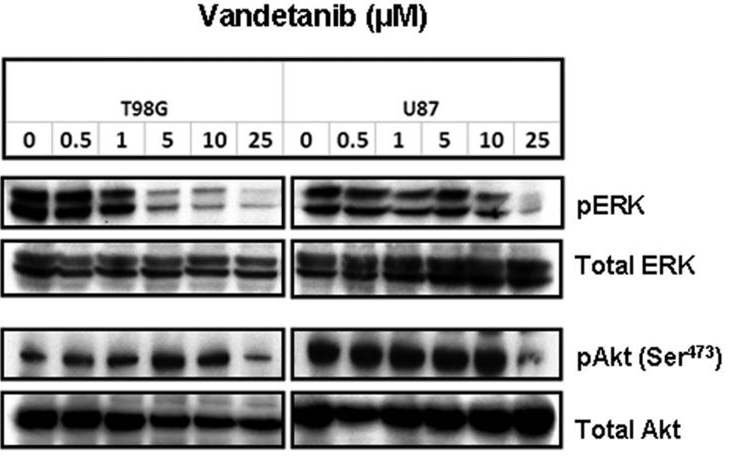
| Western blot | p-ERK / ERK / p-AKT / AKT p-EGFR / EGFR |
|
19622715 |
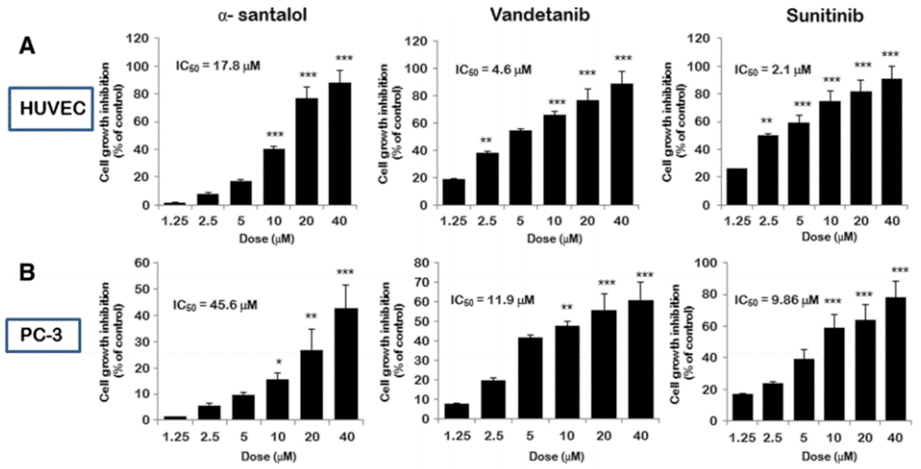
| Growth inhibition assay | Cell viability |
|
24261856 |
Información del ensayo clínico
(datos de https://clinicaltrials.gov, actualizado el 2024-05-22)
| Número NCT | Reclutamiento | Condiciones | Patrocinador/Colaboradores | Fecha de inicio | Fases |
|---|---|---|---|---|---|
| NCT03291379 | Completed | Carcinoma Hepatocellular|Metastatic Colorectal Cancer |
Boston Scientific Corporation|Biocompatibles UK Ltd |
May 17 2017 | Early Phase 1 |
| NCT02495103 | Terminated | Renal Cell Carcinoma|Hereditary Leiomyomatosis|Renal Cell Cancer |
National Cancer Institute (NCI)|National Institutes of Health Clinical Center (CC) |
August 26 2015 | Phase 1|Phase 2 |
| NCT02530411 | Unknown status | Neoplasms |
Velindre NHS Trust|Cancer Research UK|AstraZeneca |
April 2015 | Phase 2 |
| NCT02268734 | Completed | Metastatic Sporadic Medullary Thyroid Cancer |
Fondazione IRCCS Istituto Nazionale dei Tumori Milano |
April 2014 | -- |
| NCT01876784 | Completed | Differentiated Thyroid Cancer |
Genzyme a Sanofi Company|Sanofi |
September 17 2013 | Phase 3 |
| NCT01661179 | Completed | Unresectable Locally Advanced or Metastatic Medullary Thyroid Carcinoma |
Genzyme a Sanofi Company|Sanofi |
November 2012 | Phase 1|Phase 2 |
Soporte técnico
Tel: +1-832-582-8158 Ext:3
Si tiene alguna otra consulta, por favor deje un mensaje.

Los productos son solo para uso de investigación. No para uso humano. No vendemos a pacientes.
©Copyright 2013 Selleck Chemicals. Todos los derechos reservados.