MEK is a member of kinases in MAPK signal pathway which can activates p38 MAPK and JNK when MEK is ACTIVATED by TNF-alpha, GPCR and so on. MEK could be regulated by MEKKs or RAF. The Raf / MEK / ERK signal transduction is involved in cell growth, cell proliferation and cell survival. [show the full text]

MEK Inhibitors
| Nº Cat. | Nombre del producto | Información | Citas de uso del producto | Validaciones del producto |
|---|---|---|---|---|
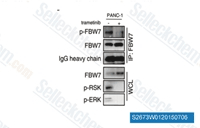
| S2673 | Trametinib (GSK1120212) | Trametinib (GSK1120212, JTP-74057) es un inhibidor MEK1/2 altamente específico y potente con IC50 de 0,92 nM/1,8 nM en ensayos sin células, y no inhibe las actividades quinasas de c-Raf, B-Raf, ERK1/2. Este compuesto activa la Autophagy e induce la Apoptosis. |
|
|
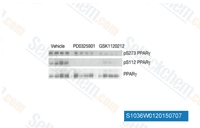
| S1036 | PD0325901 (Mirdametinib) | Mirdametinib (PD0325901) es un inhibidor selectivo y no competitivo de la MEK, con una IC50 de 0,33 nM en ensayos sin células, aproximadamente 500 veces más potente que CI-1040 en la fosforilación de ERK1 y ERK2. Fase 2. |
|
|
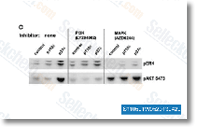
| S1008 | AZD6244 (Selumetinib) | Selumetinib (AZD6244, ARRY-142886) es un inhibidor de MEK potente y altamente selectivo con una IC50 de 14 nM para MEK1 y un valor de Kd de 530 nM para MEK2. También inhibe la fosforilación de ERK1/2 con una IC50 de 10 nM, sin inhibición de p38α, MKK6, EGFR, ErbB2, ERK2, B-Raf, etc. Selumetinib suprime la proliferación celular, la migración y desencadena la apoptosis. Fase 3. |
|
|
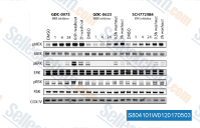
| S8041 | Cobimetinib (GDC-0973) | Cobimetinib (GDC-0973, RG7420) es un potente y altamente selectivo inhibidor de MEK1 con una IC50 de 4.2 nM, que no muestra inhibición significativa cuando se prueba contra un panel de más de 100 serina-treonina y tirosina quinasas. Este compuesto induce la apoptosis. Fase 3. |
|
|
| S7170 | Avutometinib (Ro5126766, CH5126766) | Avutometinib(RO5126766,CH5126766,VS 6766, CKI-27, R-7304, RG-7304) es un inhibidor dual de RAF/MEK con IC50 de 8,2 nM, 19 nM, 56 nM y 160 nM para BRAF V600E, BRAF, CRAF y MEK1, respectivamente. Fase 1. |
|
|
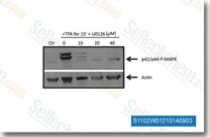
| S1102 | U0126-EtOH | U0126-EtOH es un inhibidor altamente selectivo de MEK1/2 con un IC50 de 0,07 μM/0,06 μM en ensayos sin células, 100 veces mayor afinidad por ΔN3-S218E/S222D MEK que PD98059. U0126 inhibe la autophagy y la mitophagy con actividad antiviral. |
|
|
| S1177 | PD 98059 | PD98059 es un inhibidor de MEK no competitivo con ATP con una IC50 de 2 μM en un ensayo libre de células, inhibe específicamente la activación de MAPK mediada por MEK-1; no inhibe directamente ERK1 o ERK2. PD98059 es un ligando para el receptor de hidrocarburos arilo (AHR) y funciona como un antagonista de AHR. |
|
|
| S1020 | CI-1040 (PD184352) | PD184352 (CI-1040) es un inhibidor no competitivo de ATP de MEK1/2 con una IC50 de 17 nM en ensayos basados en células, 100 veces más selectivo para MEK1/2 que para MEK5. PD184352 (CI-1040) induce selectivamente la apoptosis. |
|

|
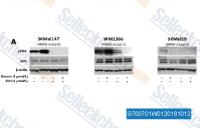
| S7007 | MEK162 (Binimetinib, ARRY-162) | Binimetinib (MEK162, ARRY-162, ARRY-438162) es un potente inhibidor de MEK1/2 con una IC50 de 12 nM en un ensayo sin células. Binimetinib induce la detención del ciclo celular en G1 y la apoptosis en líneas celulares de CPNPC humanas e induce la autophagy. Fase 3. |
|
|
| S1531 | (E/Z)-BIX02189 | (E/Z)-BIX02189 es un inhibidor selectivo de MEK5 con una IC50 de 1,5 nM, también inhibe la actividad catalítica de ERK5 con una IC50 de 59 nM en ensayos libres de células, y no inhibe las quinasas estrechamente relacionadas MEK1, MEK2, ERK2 y JNK2. |
|
|
In the mitogen-activated protein kinase (MAPK) pathway, receptor tyrosine kinase activation results in adaptor proteins phosphorylating RAS. This results in the activation of the RAF-MEK-ERK kinase signalling pathway, and consequently leads to the activation of several downstream substrates that affect a number of transcription factors. The knock-on effect is that a myriad of cellular processes such as cell proliferation, survival, transformation, translational control and cytoskeletal rearrangement. In oncology, the MAPK pathway is a key contributor to tumor progression, angiogenesis, and metastasis.
In the RAS-RAF-MEK-ERK pathway, MEK has been the target of oncology research. The MEK kinase is expressed from MEK1 and MEK2 – two genes that share ~80% structural homology – that display slightly different isoforms of MEK to produce potentially different functions. Both MEK1 and MEK2 kinases are implicated in ~30% of all human cancers where MAPK signalling pathway is involved.[1] These dual-specificity kinases phosphorylate both tyrosine and threonine residues; MEK1 and MEK2 sequentially phosphorylate ERK1 at 185Tyr and then at 183Thr. MEK exists just downstream of RAF in the classical MAPK pathway known as RAS-RAF-MEK-ERK pathway. Phosphorylation of MEK by RAF results in the phosphorylation of ERK1 and ERK2. MEK kinases show very high specificity for ERK, in fact it is the only known substrate for MEK. Therefore, constitutive phosphorylation of MEK in the RAF-MEK-ERK kinase pathway occurs by either the overexpression or mutation of receptor tyrosine kinases, and/or mutations of RAS and RAF (A-RAF and B-RAF).[2]
The MEK enzyme itself consists of hydrophobic allosteric pockets adjacent to the ATP-binding site that facilitates the design of highly selective allosteric inhibitors. This is in contRASt to the many kinases for which there is no allosteric-binding site. Consequently, this feature is recognized by many pharmaceutical companies as a characteristic that facilitates more selective inhibitor design since the more conserved ATP-binding site is not directly targeted. MEK1 and MEK2 are positioned at the focal point of many mitogenic signaling pathways that integrates into the ERK pathway. Characteristics such as unusually restricted and unique substrate specificities, plus the integrating role of mitogenic signaling pathways demonstrates the benefits of developing a MEK inhibitor against the ERK pathway.[3]
The utility of targeting MEK inhibition is likely to be best realized among tumors where the MEK pathway is constitutively activated. Such a scenario includes activating mutations of BRAF that results in tumors that are dependent to MEK signaling, and consequently very sensitive to MEK inhibition.[4] This is likely to be the case among a sub-population of BRAF mutations observed in melanoma and thyroid cancers. Currently, MEK inhibition is likely to prove most effective when used in a combination strategy. This is because there is cross-talk involved between RAS-RAF-MEK-ERK and the PI3K-AKT pathway. As a consequence, inhibition of one pathway leads to constitutive signalling in the other. This is a reflection of the complexity of the kinase signalling pathways implicated in cancer.[2]
Aside from anti-tumor potential, MEK inhibition may play a role where inflammation is concerned. Several key protein downstream of MEK are involved in inflammatory responses including TNF, IL-1, and other cytokines. MEK signaling directly impacts both the expression of cytokines and subsequent activation pathways. Therefore, MEK inhibitors –particularly orally bioavailable compounds – may be suitable agents for the treatment of inflammatory disease. In addition, it should be noted that anaphylatoxins utilize the MEK kinase cascade to initiate disease processes such as arthritis.[2]

Los productos son solo para uso de investigación. No para uso humano. No vendemos a pacientes.
©Copyright 2013 Selleck Chemicals. Todos los derechos reservados.