
solo para uso en investigación
Tivozanib VEGFR inhibidor
Cat. No.S1207
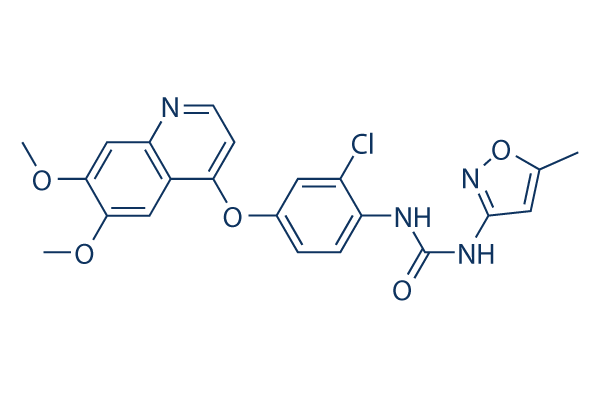
Estructura química
Peso molecular: 454.86
Control de calidad
| Dianas relacionadas | EGFR PDGFR FGFR c-Met Src MEK CSF-1R FLT3 HER2 c-Kit |
|---|---|
| Otros VEGFR Inhibidores | SAR131675 SU 5402 Cediranib (AZD2171) Vatalanib (PTK787) 2HCl Anlotinib (AL3818) Dihydrochloride Linifanib (ABT-869) Apatinib (YN968D1) Apatinib (YN968D1) mesylate Ki8751 ZM 323881 HCl |
Cultivo celular, tratamiento y concentración de trabajo
| Líneas celulares | Tipo de ensayo | Concentración | Tiempo de incubación | Formulación | Descripción de la actividad | PMID |
|---|---|---|---|---|---|---|
| MCF7 cells | Proliferation assay | Antiproliferative activity against human MCF7 cells, IC50=0.38 μM | 24583357 | |||
| DAOY | qHTS assay | qHTS of pediatric cancer cell lines to identify multiple opportunities for drug repurposing: Primary screen for DAOY cells | 29435139 | |||
| SJ-GBM2 | qHTS assay | qHTS of pediatric cancer cell lines to identify multiple opportunities for drug repurposing: Primary screen for SJ-GBM2 cells | 29435139 | |||
| BT-37 | qHTS assay | qHTS of pediatric cancer cell lines to identify multiple opportunities for drug repurposing: Primary screen for BT-37 cells | 29435139 | |||
| NB-EBc1 | qHTS assay | qHTS of pediatric cancer cell lines to identify multiple opportunities for drug repurposing: Primary screen for NB-EBc1 cells | 29435139 | |||
| U-2 OS | qHTS assay | qHTS of pediatric cancer cell lines to identify multiple opportunities for drug repurposing: Primary screen for U-2 OS cells | 29435139 | |||
| Saos-2 | qHTS assay | qHTS of pediatric cancer cell lines to identify multiple opportunities for drug repurposing: Primary screen for Saos-2 cells | 29435139 | |||
| SK-N-SH | qHTS assay | qHTS of pediatric cancer cell lines to identify multiple opportunities for drug repurposing: Primary screen for SK-N-SH cells | 29435139 | |||
| LAN-5 | qHTS assay | qHTS of pediatric cancer cell lines to identify multiple opportunities for drug repurposing: Primary screen for LAN-5 cells | 29435139 | |||
| Rh18 | qHTS assay | qHTS of pediatric cancer cell lines to identify multiple opportunities for drug repurposing: Primary screen for Rh18 cells | 29435139 | |||
| OHS-50 | qHTS assay | qHTS of pediatric cancer cell lines to identify multiple opportunities for drug repurposing: Primary screen for OHS-50 cells | 29435139 | |||
| RD | qHTS assay | qHTS of pediatric cancer cell lines to identify multiple opportunities for drug repurposing: Primary screen for RD cells | 29435139 | |||
| Rh41 | qHTS assay | qHTS of pediatric cancer cell lines to identify multiple opportunities for drug repurposing: Primary screen for Rh41 cells | 29435139 | |||
| A673 | qHTS assay | qHTS of pediatric cancer cell lines to identify multiple opportunities for drug repurposing: Confirmatory screen for A673 cells) | 29435139 | |||
| SK-N-MC | qHTS assay | qHTS of pediatric cancer cell lines to identify multiple opportunities for drug repurposing: Confirmatory screen for SK-N-MC cells | 29435139 | |||
| TC32 | qHTS assay | qHTS of pediatric cancer cell lines to identify multiple opportunities for drug repurposing: Confirmatory screen for TC32 cells | 29435139 | |||
| SK-N-SH | qHTS assay | qHTS of pediatric cancer cell lines to identify multiple opportunities for drug repurposing: Confirmatory screen for SK-N-SH cells | 29435139 | |||
| Haga clic para ver más datos experimentales de líneas celulares | ||||||
Información química, almacenamiento y estabilidad
| Peso molecular | 454.86 | Fórmula | C22H19ClN4O5 |
Almacenamiento (Desde la fecha de recepción) | |
|---|---|---|---|---|---|
| Nº CAS | 475108-18-0 | Descargar SDF | Almacenamiento de soluciones madre |
|
|
| Sinónimos | AV-951, KRN-951 | Smiles | CC1=CC(=NO1)NC(=O)NC2=C(C=C(C=C2)OC3=C4C=C(C(=CC4=NC=C3)OC)OC)Cl | ||
Solubilidad
|
In vitro |
DMSO
: 20 mg/mL
(43.96 mM)
Water : Insoluble Ethanol : Insoluble |
Calculadora de Molaridad
|
In vivo |
|||||
Calculadora de formulación in vivo (Solución clara)
Paso 1: Introduzca la información a continuación (Recomendado: Un animal adicional para tener en cuenta la pérdida durante el experimento)
Paso 2: Introduzca la formulación in vivo (Esto es solo la calculadora, no la formulación. Por favor, contáctenos primero si no hay una formulación in vivo en la sección de Solubilidad.)
Resultados del cálculo:
Concentración de trabajo: mg/ml;
Método para preparar el líquido maestro de DMSO: mg fármaco predissuelto en μL DMSO ( Concentración del líquido maestro mg/mL, Por favor, contáctenos primero si la concentración excede la solubilidad del DMSO del lote del fármaco. )
Método para preparar la formulación in vivo: Tomar μL DMSO líquido maestro, luego añadirμL PEG300, mezclar y clarificar, luego añadirμL Tween 80, mezclar y clarificar, luego añadir μL ddH2O, mezclar y clarificar.
Método para preparar la formulación in vivo: Tomar μL DMSO líquido maestro, luego añadir μL Aceite de maíz, mezclar y clarificar.
Nota: 1. Por favor, asegúrese de que el líquido esté claro antes de añadir el siguiente disolvente.
2. Asegúrese de añadir el (los) disolvente(s) en orden. Debe asegurarse de que la solución obtenida, en la adición anterior, sea una solución clara antes de proceder a añadir el siguiente disolvente. Se pueden utilizar métodos físicos como el vórtice, el ultrasonido o el baño de agua caliente para ayudar a la disolución.
Mecanismo de acción
| Targets/IC50/Ki |
VEGFR2
(Cell-free assay) 6.5 nM
VEGFR3
(Cell-free assay) 15 nM
EphB2
(Cell-free assay) 24 nM
VEGFR1
(Cell-free assay) 30 nM
PDGFRα
(Cell-free assay) 40 nM
PDGFRβ
(Cell-free assay) 49 nM
c-Kit
(Cell-free assay) 78 nM
Tie-2
(Cell-free assay) 78 nM
EphB4
(Cell-free assay) 480 nM
FGFR1
(Cell-free assay) 530 nM
c-Met
(Cell-free assay) 550 nM
Abl
(Cell-free assay) 620 nM
|
|---|---|
| In vitro |
AV-951 es un nuevo derivado de quinolina-urea. AV-951 bloquea la activación dependiente de VEGF de las quinasas de proteínas activadas por mitógenos y la proliferación de células endoteliales.
|
| Ensayo de quinasa |
Ensayos de quinasas
|
|
Los ensayos de quinasas sin células se realizan por cuadruplicado con 1 μM de ATP para determinar los valores de IC50 de AV-951 contra una variedad de tirosina quinasas recombinantes de receptores y no receptores, incluyendo VEGFR1, VEGFR2, VEGFR3, c-Kit, PDGFRβ, Flt-3 y FGFR1.
|
|
| In vivo |
Estudios in vivo muestran que AV-951 también disminuye la densidad de microvasos y suprime los niveles de fosforilación de VEGFR2 en xenoinjertos tumorales, especialmente a una concentración de 1 mg/kg (administración p.o.). AV-951 muestra una inhibición casi completa del crecimiento de xenoinjertos tumorales (TGI>85%) en ratas atímicas. Otro estudio en un modelo de tumor diseminado peritoneal en ratas muestra que AV-951 podría prolongar la supervivencia de las ratas portadoras de tumores con un MST de 53,5 días. AV-951 muestra actividad antitumoral contra muchos xenoinjertos de tumores humanos, incluyendo cáncer de pulmón, mama, colon, ovario, páncreas y próstata.
|
Referencias |
|
Información del ensayo clínico
(datos de https://clinicaltrials.gov, actualizado el 2024-05-22)
| Número NCT | Reclutamiento | Condiciones | Patrocinador/Colaboradores | Fecha de inicio | Fases |
|---|---|---|---|---|---|
| NCT04645160 | Recruiting | Cholangiocarcinoma|Bile Duct Neoplasm|Biliary Tract Malignancy |
National Cancer Institute (NCI)|National Institutes of Health Clinical Center (CC) |
March 4 2022 | Phase 1|Phase 2 |
| NCT03136627 | Completed | Carcinoma Renal Cell |
AVEO Pharmaceuticals Inc.|Bristol-Myers Squibb |
March 22 2017 | Phase 1|Phase 2 |
| NCT01853644 | Completed | Recurrent Epithelial Ovarian Cancer|Recurrent Fallopian Tube Cancer|Recurrent Primary Peritoneal Cancer |
Northwestern University|National Comprehensive Cancer Network |
June 6 2013 | Phase 2 |
| NCT01834183 | Withdrawn | Renal Cell Carcinoma |
Dana-Farber Cancer Institute |
June 2013 | Phase 2 |
| NCT01807156 | Terminated | Hepatocellular Cancer |
Emory University|AVEO Pharmaceuticals Inc. |
March 2013 | Phase 2 |
Soporte técnico
Tel: +1-832-582-8158 Ext:3
Si tiene alguna otra consulta, por favor deje un mensaje.
Preguntas frecuentes
Pregunta 1:
Would you please provide a little bit more detail regarding how to prepare it for in vivo treatment and the storage condition?
Respuesta:
For in vivo formula, we recommend to use 2% DMSO+30% PEG 300+ddH2O up to 1mg/mL. Once dissolved in solution, please make small aliquots and store them at -80C up to 6 months without repeated thawing and refreezing.

Los productos son solo para uso de investigación. No para uso humano. No vendemos a pacientes.
©Copyright 2013 Selleck Chemicals. Todos los derechos reservados.