
Datos técnicos
| Fórmula | C22H19ClN4O5 |
||||||
| Peso molecular | 454.86 | Número CAS | 475108-18-0 | ||||
| Solubilidad (25°C)* | In vitro | DMSO | 56 mg/mL (123.11 mM) | ||||
| Water | Insoluble | ||||||
| Ethanol | Insoluble | ||||||
| In vivo (Agregue los solventes al producto individualmente y en orden.) |
|
||||||
|
* <1 mg/ml significa ligeramente soluble o insoluble. * Tenga en cuenta que Selleck prueba la solubilidad de todos los compuestos internamente, y la solubilidad real puede diferir ligeramente de los valores publicados. Esto es normal y se debe a ligeras variaciones entre lotes. * Envío a temperatura ambiente (Las pruebas de estabilidad demuestran que este producto se puede enviar sin medidas de refrigeración.) |
|||||||
Preparación de soluciones madre
Actividad biológica
| Descripción | Tivozanib es un potente y selectivo inhibidor de VEGFR para VEGFR1/2/3 con una IC50 de 30 nM/6,5 nM/15 nM, y también inhibe PDGFR y c-Kit, con baja actividad observada contra FGFR-1, Flt3, c-Met, EGFR e IGF-1R. Fase 3. | |||||||||||
|---|---|---|---|---|---|---|---|---|---|---|---|---|
| Objetivos |
|
|||||||||||
| In vitro | AV-951 es un nuevo derivado de quinolina-urea. AV-951 bloquea la activación dependiente de VEGF de las quinasas de proteínas activadas por mitógenos y la proliferación de células endoteliales. | |||||||||||
| In vivo | Estudios in vivo muestran que AV-951 también disminuye la densidad de microvasos y suprime los niveles de fosforilación de VEGFR2 en xenoinjertos tumorales, especialmente a una concentración de 1 mg/kg (administración p.o.). AV-951 muestra una inhibición casi completa del crecimiento de xenoinjertos tumorales (TGI>85%) en ratas atímicas. Otro estudio en un modelo de tumor diseminado peritoneal en ratas muestra que AV-951 podría prolongar la supervivencia de las ratas portadoras de tumores con un MST de 53,5 días. AV-951 muestra actividad antitumoral contra muchos xenoinjertos de tumores humanos, incluyendo cáncer de pulmón, mama, colon, ovario, páncreas y próstata. |
Protocolo (de referencia)
| Ensayo de quinasa:[1] |
|
|---|---|
| Ensayo celular:[1] |
|
| Estudio en animales:[1] |
|
Referencias
|
Validación de productos por parte del cliente
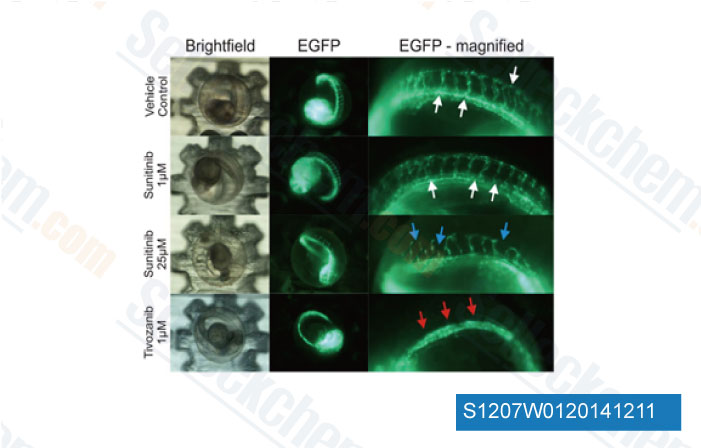
-
Datos de [ Cytometry A , 2014 , 85(6), 537-47 ]
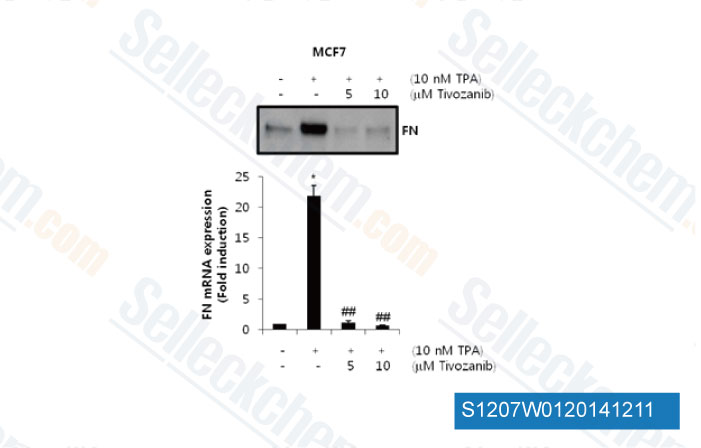
-
Datos de [ Cell Physiol Biochem , 2013 , 32(5), 1541-50 ]
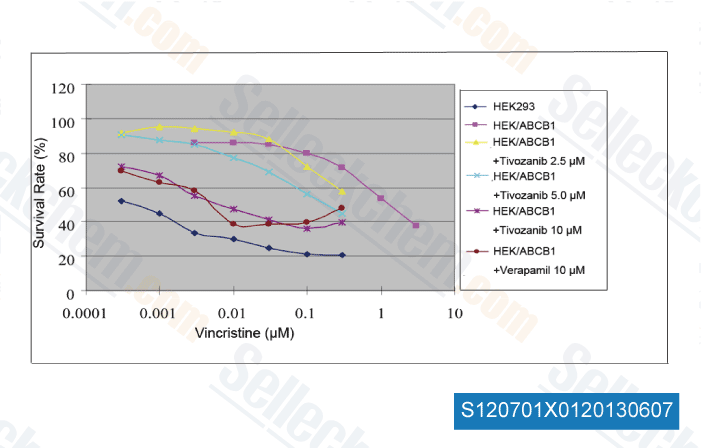
-
,
![<p> </p><p>Figure 7 shows the effect of Tivozanib on the accumulation of [<sup>3</sup>H]-mitoxantrone. The accumulation of [<sup>3</sup>H]-mitoxantrone in empty vector transfected HEK293/pcDNA3.1, ABCG2 vector transfected wild-type ABCG2-482-R2, mutant ABCG2-482-G2 and mutant ABCG2-482-T7 cells was measured by the Accumulation Assays. Columns are the mean of triplicate determinations; bars, SD. *P<0.05, **P<0.01 versus the control group. Fumitremorgin C (FTC) was used as a positive control of ABCG2 inhibitor.</p>](https://file.selleckchem.com/downloads/review/700px/Tivozanib-S120701Z0120130607.gif)
-
,
Sellecks Tivozanib Ha sido citado por 42 Publicaciones
| APOE- ε4-induced Fibronectin at the blood-brain barrier is a conserved pathological mediator of disrupted astrocyte-endothelia interaction in Alzheimer's disease [ bioRxiv, 2025, 2025.01.24.634732] | PubMed: 39975303 |
| Gliovascular transcriptional perturbations in Alzheimer's disease reveal molecular mechanisms of blood brain barrier dysfunction [ Nat Commun, 2024, 15(1):4758] | PubMed: 38902234 |
| Targeting PDGF signaling of cancer-associated fibroblasts blocks feedback activation of HIF-1α and tumor progression of clear cell ovarian cancer [ Cell Rep Med, 2024, S2666-3791(24)00201-5] | PubMed: 38670097 |
| Sensitizing cholangiocarcinoma to chemotherapy by inhibition of the drug-export pump MRP3 [ Biomed Pharmacother, 2024, 180:117533] | PubMed: 39405909 |
| Patient-derived rhabdomyosarcoma cells recapitulate the genetic and transcriptomic landscapes of primary tumors [ iScience, 2024, 27(10):110862] | PubMed: 39319271 |
| VEGF-A165a and angiopoietin-2 differently affect the barrier formed by retinal endothelial cells [ Exp Eye Res, 2024, 247:110062] | PubMed: 39187056 |
| ZDHHC2-Mediated AGK Palmitoylation Activates AKT-mTOR Signaling to Reduce Sunitinib Sensitivity in Renal Cell Carcinoma [ Cancer Res, 2023, 83(12):2034-2051] | PubMed: 37078777 |
| Relevance of the organic anion transporting polypeptide 1B3 (OATP1B3) in the personalized pharmacological treatment of hepatocellular carcinoma [ Biochem Pharmacol, 2023, 214:115681] | PubMed: 37429423 |
| Systematic identification of biomarker-driven drug combinations to overcome resistance [ Nat Chem Biol, 2022, 10.1038/s41589-022-00996-7] | PubMed: 35332332 |
| Impairment of the Retinal Endothelial Cell Barrier Induced by Long-Term Treatment with VEGF-A165 No Longer Depends on the Growth Factor's Presence [ Biomolecules, 2022, 12(5)734] | PubMed: 35625661 |
POLÍTICA DE DEVOLUCIÓN
La Política de Devolución Incondicional de Selleck Chemical garantiza una experiencia de compra en línea fluida para nuestros clientes. Si no está satisfecho con su compra de alguna manera, puede devolver cualquier artículo(s) dentro de los 7 días posteriores a su recepción. En caso de problemas de calidad del producto, ya sean problemas relacionados con el protocolo o con el producto, puede devolver cualquier artículo(s) dentro de los 365 días a partir de la fecha de compra original. Siga las instrucciones a continuación al devolver productos.
ENVÍO Y ALMACENAMIENTO
Los productos Selleck se transportan a temperatura ambiente. Si recibe el producto a temperatura ambiente, tenga la seguridad de que el Departamento de Inspección de Calidad de Selleck ha realizado experimentos para verificar que la colocación a temperatura normal durante un mes no afectará la actividad biológica de los productos en polvo. Después de la recogida, guarde el producto de acuerdo con los requisitos descritos en la hoja de datos. La mayoría de los productos Selleck son estables en las condiciones recomendadas.
NO PARA USO HUMANO, DIAGNÓSTICO VETERINARIO O TERAPÉUTICO.