
solo para uso en investigación
Phytol PPAR activador
Cat. No.S5121
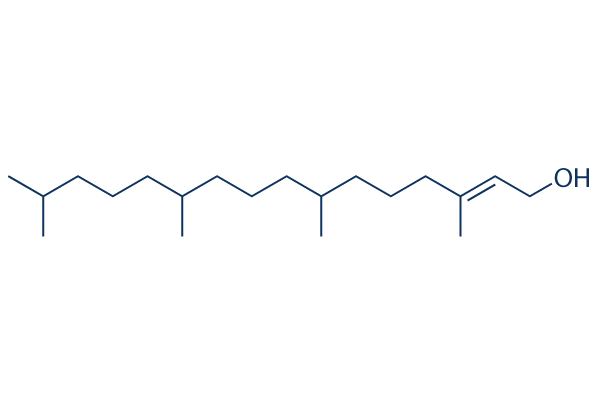
Estructura química
Peso molecular: 296.53
Control de calidad
| Dianas relacionadas | Dehydrogenase HSP Transferase P450 (e.g. CYP17) PDE phosphatase Vitamin Carbohydrate Metabolism Mitochondrial Metabolism Drug Metabolite |
|---|---|
| Otros PPAR Inhibidores | T0070907 GW9662 GW6471 WY-14643 (Pirinixic Acid) GSK3787 GW0742 AZ6102 Harmine Astaxanthin Eupatilin |
Información química, almacenamiento y estabilidad
| Peso molecular | 296.53 | Fórmula | C20H40O |
Almacenamiento (Desde la fecha de recepción) | 2 years -20°C liquid |
|---|---|---|---|---|---|
| Nº CAS | 150-86-7 | -- | Almacenamiento de soluciones madre |
|
|
Solubilidad
|
In vitro |
|
Calculadora de Molaridad
|
In vivo |
|||||
Calculadora de formulación in vivo (Solución clara)
Paso 1: Introduzca la información a continuación (Recomendado: Un animal adicional para tener en cuenta la pérdida durante el experimento)
Paso 2: Introduzca la formulación in vivo (Esto es solo la calculadora, no la formulación. Por favor, contáctenos primero si no hay una formulación in vivo en la sección de Solubilidad.)
Resultados del cálculo:
Concentración de trabajo: mg/ml;
Método para preparar el líquido maestro de DMSO: mg fármaco predissuelto en μL DMSO ( Concentración del líquido maestro mg/mL, Por favor, contáctenos primero si la concentración excede la solubilidad del DMSO del lote del fármaco. )
Método para preparar la formulación in vivo: Tomar μL DMSO líquido maestro, luego añadirμL PEG300, mezclar y clarificar, luego añadirμL Tween 80, mezclar y clarificar, luego añadir μL ddH2O, mezclar y clarificar.
Método para preparar la formulación in vivo: Tomar μL DMSO líquido maestro, luego añadir μL Aceite de maíz, mezclar y clarificar.
Nota: 1. Por favor, asegúrese de que el líquido esté claro antes de añadir el siguiente disolvente.
2. Asegúrese de añadir el (los) disolvente(s) en orden. Debe asegurarse de que la solución obtenida, en la adición anterior, sea una solución clara antes de proceder a añadir el siguiente disolvente. Se pueden utilizar métodos físicos como el vórtice, el ultrasonido o el baño de agua caliente para ayudar a la disolución.
Mecanismo de acción
| Targets/IC50/Ki |
PPARα
|
|---|---|
| In vitro |
El Phytol, un alcohol graso de cadena ramificada, es el precursor natural del ácido fitánico y del ácido pristánico, ácidos grasos de cadena ramificada que son ambos ligandos del receptor nuclear de hormonas, el receptor activado por proliferadores de peroxisomas α (PPARα). La adición de este compuesto regula al alza la expresión de genes diana de PPARα tanto a nivel de ARNm como de proteínas en hepatocitos HepG2 que expresan PPARα. Es un ligando específico para PPARα, aunque puede activar PPARγ moderadamente. In vitro, este químico reduce la actividad motora de los gusanos y provoca su muerte. Además, a dosis subletales (25 µg/mL) reduce el número de huevos de Schistosoma mansoni.
|
| In vivo |
En muchos estudios en animales, el Phytol se utiliza como precursor del ácido fitánico. La adición de este compuesto a la dieta da como resultado un aumento de los Metabolites de Phytol en los tejidos y el plasma. In vivo, una dosis única de este químico (40 mg/kg) administrada oralmente a ratones infectados con S. mansoni adultos resulta en reducciones de la carga de gusanos total y femenina del 51,2 % y 70,3 %, respectivamente. Además, reduce el número de huevos en las heces (76,6 %) y la frecuencia de huevos inmaduros (patrón de oogramas) se reduce significativamente. En el ámbito medicinal, este compuesto ha mostrado actividades antinociceptivas y antioxidantes, así como efectos antiinflamatorios y antialérgicos. Es un excelente inmunoestimulante, superior a una serie de adyuvantes comerciales en términos de inducción de la memoria a largo plazo y activación tanto de la inmunidad innata como adquirida.
|
Referencias |
|
Soporte técnico
Tel: +1-832-582-8158 Ext:3
Si tiene alguna otra consulta, por favor deje un mensaje.

Los productos son solo para uso de investigación. No para uso humano. No vendemos a pacientes.
©Copyright 2013 Selleck Chemicals. Todos los derechos reservados.