
solo para uso en investigación
Oxaliplatin inhibidor de la síntesis de ADN
Cat. No.S1224
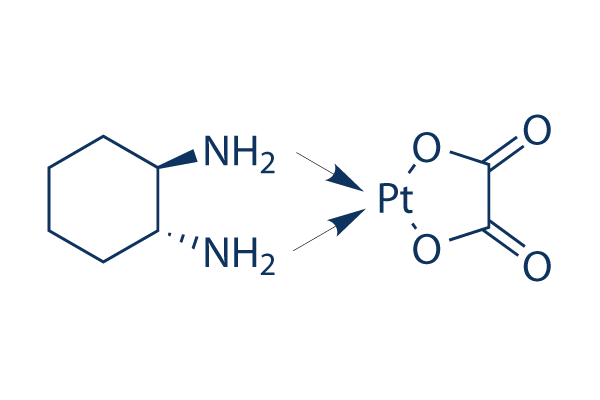
Estructura química
Peso molecular: 397.29
Saltar a
Control de calidad
Lote:
Pureza:
99.78%
99.78
| Dianas relacionadas | HDAC PARP ATM/ATR DNA-PK WRN Topoisomerase PPAR Sirtuin Casein Kinase eIF |
|---|---|
| Otros DNA/RNA Synthesis Inhibidores | CX-5461 (Pidnarulex) B02 SCR7 Favipiravir (T-705) EED226 RK-33 BMH-21 Triapine (3-AP) Carmofur YK-4-279 |
Cultivo celular, tratamiento y concentración de trabajo
| Líneas celulares | Tipo de ensayo | Concentración | Tiempo de incubación | Formulación | Descripción de la actividad | PMID |
|---|---|---|---|---|---|---|
| Caco2 | Function Assay | 30/100 μM | 16 h | DMSO | activates Nrf2 | 24556415 |
| Caco2 | Function Assay | 3/10/30 μM | 16 h | DMSO | increases the mRNA levels of AKR1C1, NQO1, HO-1, MRP2, andMRP3 dose-dependently | 24556415 |
| Caco2 | Function Assay | 30 μM | 24 h | DMSO | induces the expression of HO-1, AKR1C, and NQO1 | 24556415 |
| SW620 | Growth Inhibition Assay | 10-70 mg/L | 24/48/72 h | inhibits cell growth in both time and dose dependent manner | 24646305 | |
| SW480 | Growth Inhibition Assay | 48 h | IC50=20.8 ug/mL | 24720675 | ||
| HCT116 | Function Assay | 2/5 µM | 24/48 h | suppresses survivin mRNA expression | 24761411 | |
| HT-29 | Growth Inhibition Assay | 1 μM | 0-72 h | inhibits cell growth in a time dependent manner | 24997451 | |
| SW480 | Growth Inhibition Assay | 1 μM | 0-72 h | inhibits cell growth in a time dependent manner | 24997451 | |
| HUVEC | Growth Inhibition Assay | IC50=11.30 ± 1.02 μM | 25307448 | |||
| HEK293 | Growth Inhibition Assay | IC50=8.82 ± 5.59 μM | 25307448 | |||
| HT-29 | Growth Inhibition Assay | IC50>50 μM | 25307448 | |||
| HCT-116 | Growth Inhibition Assay | IC50=6.24 ± 2.97 μM | 25307448 | |||
| MCF-7 | Growth Inhibition Assay | IC50=14.24 ± 1.82 μM | 25307448 | |||
| HepG2 | Growth Inhibition Assay | IC50=14.24 ± 1.82 μM | 25307448 | |||
| A549 | Growth Inhibition Assay | IC50=51.08 ± 10.96 μM | 25307448 | |||
| SGC7901 | Growth Inhibition Assay | IC50=21.73 ± 3.08 μM | 25307448 | |||
| COC1 | Growth Inhibition Assay | IC50=46.20 ± 3.14 μM | 25307448 | |||
| HCT116 | Growth Inhibition Assay | 72 h | IC50=6.23±0.75 µg/mL | 25360631 | ||
| SW480 | Growth Inhibition Assay | 72 h | IC50=10.7±2.26 µg/mL | 25360631 | ||
| MIAPaCa-2 | Function Assay | 25 µM | 24/48 h | induces cleavage of PARP, caspase-9, caspase-8 and caspase-3 | 25444914 | |
| Panc-1 | Function Assay | 25 µM | 24/48 h | induces cleavage of PARP, caspase-9, caspase-8 and caspase-3 | 25444914 | |
| MIAPaCa-2 | Apoptosis Assay | 25 µM | 24 h | induces apoptosis in a synergistic manner combined with WA | 25444914 | |
| Panc-1 | Apoptosis Assay | 25 µM | 24 h | induces apoptosis in a synergistic manner combined with WA | 25444914 | |
| HPDE | Cell Viability Assay | 25/50 μM | 24/48 h | inhibits proliferation of PC cells in a synergistic manner combined with WA | 25444914 | |
| SW1990 | Cell Viability Assay | 25/50 μM | 24/48 h | inhibits proliferation of PC cells in a synergistic manner combined with WA | 25444914 | |
| MIAPaCa-2 | Cell Viability Assay | 25/50 μM | 24/48 h | inhibits proliferation of PC cells in a synergistic manner combined with WA | 25444914 | |
| Panc-1 | Cell Viability Assay | 25/50 μM | 24/48 h | inhibits proliferation of PC cells in a synergistic manner combined with WA | 25444914 | |
| A549/CDDP | Growth Inhibition Assay | IC50=18.6 ± 1.2 μM | 25625243 | |||
| A549 | Growth Inhibition Assay | IC50=5.8 ± 0.6 μM | 25625243 | |||
| SW480 | Function Assay | 10 µg/ml | 24 h | enhances cellular autophagic flux | 25749420 | |
| SW620 | Function Assay | 10 µg/ml | 24 h | enhances cellular autophagic flux | 25749420 | |
| SW480 | Function Assay | 10 µg/ml | 24 h | increases LC3-II accumulation and decreases P62 expression | 25749420 | |
| SW620 | Function Assay | 10 µg/ml | 24 h | increases LC3-II accumulation and decreases P62 expression | 25749420 | |
| HT-29 | Growth Inhibition Assay | IC50=5.22 μM | 25761479 | |||
| SNU-175 | Growth Inhibition Assay | IC50=1.51 μM | 25761479 | |||
| COLO-320DM | Growth Inhibition Assay | IC50=5.38 μM | 25761479 | |||
| DLD-1 | Growth Inhibition Assay | IC50=8.65 μM | 25761479 | |||
| DiFi | Growth Inhibition Assay | IC50=10.95 μM | 25761479 | |||
| HCT-15 | Growth Inhibition Assay | IC50=8.64 μM | 25761479 | |||
| SCM-1 | Growth Inhibition Assay | IC50=17.5 μM | 25789057 | |||
| TMK-1 | Growth Inhibition Assay | IC50=22.6 μM | 25789057 | |||
| MKN-45 | Growth Inhibition Assay | IC50=14.0 μM | 25789057 | |||
| AGS | Growth Inhibition Assay | IC50=10.6 μM | 25789057 | |||
| S3 | Growth Inhibition Assay | IC50=53.5 ± 1.5 μM | 25801007 | |||
| SiHa | Growth Inhibition Assay | IC50=0.8 ± 0.1 μM | 25801007 | |||
| HT-29 | Growth Inhibition Assay | IC50=35.6 μM | 26003085 | |||
| DLD-1 | Growth Inhibition Assay | IC50=32.2 μM | 26003085 | |||
| HT29 | Growth Inhibition Assay | IC50=63 μM ± 18 | 26004084 | |||
| MC38 | Growth Inhibition Assay | IC50=23 μM ± 2 | 26004084 | |||
| SW620 | Growth Inhibition Assay | IC50=3.68 μM | 26023085 | |||
| SW480 | Growth Inhibition Assay | IC50=2.86 μM | 26023085 | |||
| RKO | Growth Inhibition Assay | IC50=1.23 μM | 26023085 | |||
| LoVo | Growth Inhibition Assay | IC50=1.2 μM | 26023085 | |||
| KM12 | Growth Inhibition Assay | IC50=4.37 μM | 26023085 | |||
| HCT116p53- | Growth Inhibition Assay | IC50=1.08 μM | 26023085 | |||
| HCT116 | Growth Inhibition Assay | IC50=1.04 μM | 26023085 | |||
| HCT15 | Growth Inhibition Assay | IC50=1.43 μM | 26023085 | |||
| HT29 | Growth Inhibition Assay | IC50=2.69 μM | 26023085 | |||
| DLD1 | Growth Inhibition Assay | IC50=2.01 μM | 26023085 | |||
| Colo205 | Growth Inhibition Assay | IC50=3.33 μM | 26023085 | |||
| BE | Growth Inhibition Assay | IC50=3.33 μM | 26023085 | |||
| CT26 | Cell Viability Assay | 4 mM | 48 h | decreases cell viability to 53.2% | 26137012 | |
| CT26 | Function Assay | 4 mM | 48 h | increases the expression levels of autophagy-related proteins, such as LC3-II, Beclin1 and ATG5 | 26137012 | |
| CT26 | Function Assay | 4 mM | 48 h | induces autophagy | 26137012 | |
| SK-OV-3 | Function Assay | 50 μM | 48 h | promotes sensitivity of ovarian carcinoma to NK cell-mediated cytolysis | 26138671 | |
| OVCAR-5 | Function Assay | 20 μM | 24h | promotes sensitivity of ovarian carcinoma to NK cell-mediated cytolysis | 26138671 | |
| PA-1 | Function Assay | 10 μM | 24h | promotes sensitivity of ovarian carcinoma to NK cell-mediated cytolysis | 26138671 | |
| SK-OV-3 | Function Assay | 50 μM | 96 h | up-regulates the stress ligands for NK cell-activating receptors and TRAIL receptors | 26138671 | |
| OVCAR-5 | Function Assay | 30 μM | 48h | up-regulates the stress ligands for NK cell-activating receptors and TRAIL receptors | 26138671 | |
| PA-1 | Function Assay | 10 μM | 48h | up-regulates the stress ligands for NK cell-activating receptors and TRAIL receptors | 26138671 | |
| SK-OV-3 | Function Assay | 50 μM | 96 h | triggeres the production of type I IFNs and chemokines | 26138671 | |
| OVCAR-5 | Function Assay | 30 μM | 48h | triggeres the production of type I IFNs and chemokines | 26138671 | |
| PA-1 | Function Assay | 10 μM | 24h | triggeres the production of type I IFNs and chemokines | 26138671 | |
| SK-OV-3 | Cell Viability Assay | 0-100 μM | 24/48/72 h | inhibits cell viability in both time and dose dependent manner | 26138671 | |
| OVCAR-5 | Cell Viability Assay | 0-60 μM | 24/48/72 h | inhibits cell viability in both time and dose dependent manner | 26138671 | |
| PA-1 | Cell Viability Assay | 0-20 μM | 24/48 h | inhibits cell viability in both time and dose dependent manner | 26138671 | |
| HCT116 | Growth Inhibition Assay | IC50=0.41 ± 0.02 μM | 26148596 | |||
| HT29 | Growth Inhibition Assay | IC50=0.88 ± 0.2 μM | 26148596 | |||
| SNU-387 | Growth Inhibition Assay | IC50=25 ± 2.7 μM | 26160429 | |||
| SNU-475 | Growth Inhibition Assay | IC50>30 μM | 26160429 | |||
| Hep-G2 | Growth Inhibition Assay | IC50=13.1 ± 1.6 μM | 26160429 | |||
| SNU-398 | Growth Inhibition Assay | IC50=6.5 ± 1.1 μM | 26160429 | |||
| LoVo | Function Assay | 1/5 μM | 24/48 h | induces transcriptional repression of DUT-N | 26208523 | |
| HCT116 p53+/+ | Function Assay | 1/5 μM | 24/48 h | induces transcriptional repression of DUT-N | 26208523 | |
| MDA-MB-231 | Growth Inhibition Assay | IC50=23.1 ± 0.1 μM | 26211591 | |||
| MCF-7 | Growth Inhibition Assay | IC50=15.4 ± 0.3 μM | 26211591 | |||
| SK-BR-3 | Growth Inhibition Assay | IC50=31.0 ± 0.1 μM | 26211591 | |||
| LoVo | Growth Inhibition Assay | 48 h | IC50=94.83 μM | 26269759 | ||
| HCT116 | Growth Inhibition Assay | 48 h | IC50=11.86 μM | 26269759 | ||
| SW480 | Growth Inhibition Assay | 48 h | IC50=1.87 μM | 26269759 | ||
| CaES-17 | Cytotoxicity Assay | 0–160 μM | 48 h | IC50=5.5 ± 0.2 μM | 26474693 | |
| HKESC-2 | Cytotoxicity Assay | 0–160 μM | 48 h | IC50=5.8 ± 0.5 μM | 26474693 | |
| Haga clic para ver más datos experimentales de líneas celulares | ||||||
Información química, almacenamiento y estabilidad
| Peso molecular | 397.29 | Fórmula | C8H14N2O4Pt |
Almacenamiento (Desde la fecha de recepción) | 2 years 4°C(in the dark) powder |
|---|---|---|---|---|---|
| Nº CAS | 61825-94-3 | Descargar SDF | Almacenamiento de soluciones madre | Las soluciones son inestables. Preparar frescas o comprar tamaños pequeños preenvasados. Reenvasar al recibirlas. | |
| Sinónimos | L-OHP,NSC 266046 | Smiles | C1CCC(C(C1)[NH-])[NH-].C(=O)(C(=O)O)O.[Pt+2] | ||
Solubilidad
|
In vitro |
Water : 2 mg/mL Ethanol : Insoluble |
Calculadora de Molaridad
Calculadora de Dilución
Calculadora de Peso Molecular
|
In vivo |
|||||
Calculadora de formulación in vivo (Solución clara)
Paso 1: Introduzca la información a continuación (Recomendado: Un animal adicional para tener en cuenta la pérdida durante el experimento)
mg/kg
g
μL
Paso 2: Introduzca la formulación in vivo (Esto es solo la calculadora, no la formulación. Por favor, contáctenos primero si no hay una formulación in vivo en la sección de Solubilidad.)
% DMSO
%
% Tween 80
% ddH2O
%DMSO
%
Resultados del cálculo:
Concentración de trabajo: mg/ml;
Método para preparar el líquido maestro de DMSO: mg fármaco predissuelto en μL DMSO ( Concentración del líquido maestro mg/mL, Por favor, contáctenos primero si la concentración excede la solubilidad del DMSO del lote del fármaco. )
Método para preparar la formulación in vivo: Tomar μL DMSO líquido maestro, luego añadirμL PEG300, mezclar y clarificar, luego añadirμL Tween 80, mezclar y clarificar, luego añadir μL ddH2O, mezclar y clarificar.
Método para preparar la formulación in vivo: Tomar μL DMSO líquido maestro, luego añadir μL Aceite de maíz, mezclar y clarificar.
Nota: 1. Por favor, asegúrese de que el líquido esté claro antes de añadir el siguiente disolvente.
2. Asegúrese de añadir el (los) disolvente(s) en orden. Debe asegurarse de que la solución obtenida, en la adición anterior, sea una solución clara antes de proceder a añadir el siguiente disolvente. Se pueden utilizar métodos físicos como el vórtice, el ultrasonido o el baño de agua caliente para ayudar a la disolución.
Mecanismo de acción
| Características |
This product is not recommended to be dissolved in dimethylsulfoxide (DMSO).
|
|---|---|
| Targets/IC50/Ki |
DNA synthesis
(RT4, TCCSUP, A2780, HT-29, U-373MG, U-87MG, SK-MEL-2, HT-144 cells) |
| In vitro |
El principal mecanismo de acción de Oxaliplatin está mediado a través de la formación de aductos de ADN. Este compuesto induce lesiones primarias y secundarias del ADN que conducen a la apoptosis celular. Es activo contra las líneas celulares de melanoma humano C32 y G361 con IC50 de 0,98 mM y 0,14 mM, respectivamente. Este producto químico inhibe eficazmente las líneas celulares de carcinoma de vejiga RT4 y TCCSUP, la línea celular de carcinoma ovárico A2780, la línea celular de carcinoma de colon HT-29, las líneas celulares de glioblastoma U-373MG y U-87MG, y las líneas celulares de melanoma SK-MEL-2 y HT-144 con IC50 de 11 μM, 15 μM, 0,17 μM, 0,97 μM, 2,95 μM, 17,6 μM, 30,9 μM y 7,85 μM, respectivamente. |
| In vivo |
Una inyección i.p. semanal de Oxaliplatin a 10 mg/kg en ratones desnudos que portan tumores hepatocelulares HCCLM3 reduce significativamente el volumen tumoral y el índice apoptótico. Este compuesto (5 mg/kg, i.v. los días 1, 5 y 9) es activo sobre la leucemia-linfoma T L40 AKR con T/C de 1,77. También es eficaz en la leucemia L1210 injertada intracerebralmente, los xenoinjertos MA 16-C, los xenoinjertos de melanoma B16, los xenoinjertos pulmonares de Lewis y los xenoinjertos de carcinoma de colon C26. Este producto químico induce una alteración del transporte neuronal retrógrado en ratones. |
Referencias |
|
Aplicaciones
| Métodos | Biomarcadores | Imágenes | PMID |
|---|---|---|---|
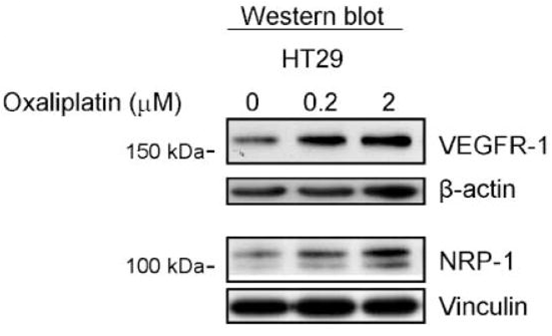
| Western blot | VEGFR-1 / NRP-1 p-AKT(Ser473) / AKT / PTEN / p-Src(Tyr416) p-Src(Y418) / p-FAK(Y861) |
|
18790786 |
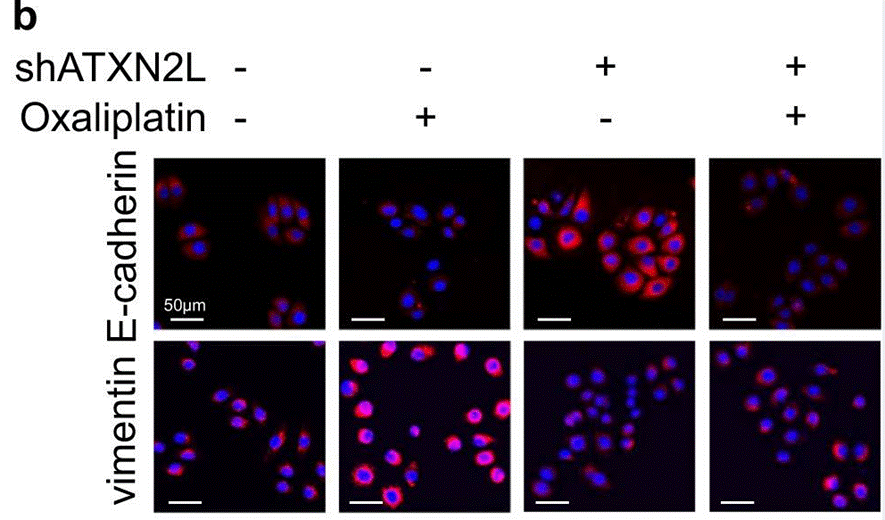
| Immunofluorescence | E-cadherin / Vimentin ATXN2L / G3BP1 |
|
30787271 |
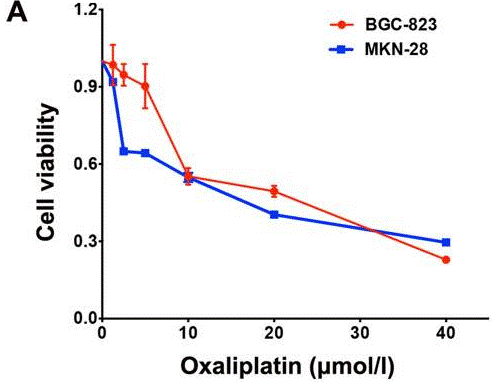
| Growth inhibition assay | Cell viability |
|
28339092 |
Información del ensayo clínico
(datos de https://clinicaltrials.gov, actualizado el 2024-05-22)
| Número NCT | Reclutamiento | Condiciones | Patrocinador/Colaboradores | Fecha de inicio | Fases |
|---|---|---|---|---|---|
| NCT06320301 | Recruiting | Biliary Tract Cancer|Gemox Chemotherapy |
Sun Yat-Sen Memorial Hospital of Sun Yat-Sen University|Suzhou Suncadia Biopharmaceuticals Co. Ltd. |
April 1 2024 | Phase 2 |
| NCT05922358 | Not yet recruiting | Gastrointestinal Tumors |
Fujian Cancer Hospital |
September 1 2023 | Phase 2 |
| NCT05780684 | Recruiting | Colorectal Cancer|Esophagus Cancer|Appendix Cancer|Small Bowel Cancer|Ampullary Cancer |
Dartmouth-Hitchcock Medical Center |
July 14 2023 | Not Applicable |
| NCT05322590 | Recruiting | Metastatic Colorectal Carcinoma|Neuropathy |
Bexion Pharmaceuticals Inc.|ICON plc|CTI Clinical Trial and Consulting Services |
January 9 2023 | Phase 1|Phase 2 |
Soporte técnico
Tel: +1-832-582-8158 Ext:3
Si tiene alguna otra consulta, por favor deje un mensaje.
Preguntas frecuentes
Pregunta 1:
Is it ok to dissolve it in saline?
Respuesta:
When dissolved in saline, it is partially converted to cisplatin and L-isomers. The L-isomer of this compound is inactive. DMF is a better choice.
Pregunta 2:
Is it ok to dissolve it in DMSO?
Respuesta:
Even though it is soluble in DMSO, the use of DMSO to dissolve this compound in biological studies is strongly discouraged. The DMSO inserts itself into the ligand and inactivates platin-containing compounds. DMF is a much better choice than DMSO.

Los productos son solo para uso de investigación. No para uso humano. No vendemos a pacientes.
©Copyright 2013 Selleck Chemicals. Todos los derechos reservados.