
solo para uso en investigación
EED226 DNA/RNA Synthesis inhibidor
Cat. No.S8496
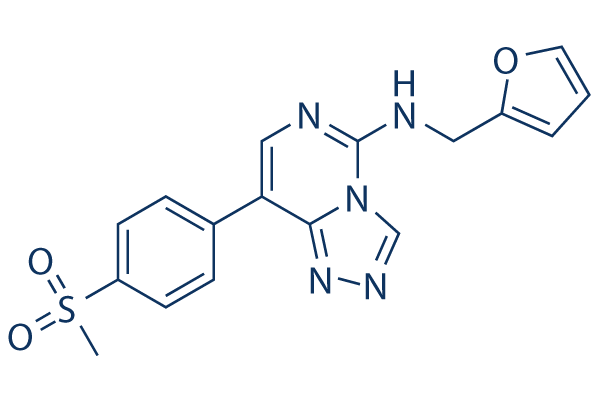
Estructura química
Peso molecular: 369.40
Control de calidad
- Citado en Nature Medicine por su máxima calidad
- COA
- SDS
- Hoja de datos
| Dianas relacionadas | HDAC JAK BET Histone Methyltransferase PKC PARP HIF PRMT EZH2 AMPK |
|---|---|
| Otros DNA/RNA Synthesis Inhibidores | CX-5461 (Pidnarulex) B02 SCR7 Favipiravir (T-705) RK-33 BMH-21 Triapine (3-AP) Carmofur YK-4-279 Halofuginone |
Cultivo celular, tratamiento y concentración de trabajo
| Líneas celulares | Tipo de ensayo | Concentración | Tiempo de incubación | Formulación | Descripción de la actividad | PMID |
|---|---|---|---|---|---|---|
| KARPAS422 | Antiproliferative assay | up to 14 days | Antiproliferative activity against human KARPAS422 cells harboring monoallelic Y641N EZH2 mutation assessed as reduction in cell viability measured every 3 to 4 days up to 14 days by Beckman Coulter-based method, IC50 = 0.08 μM. | 28092155 | ||
| G401 | Function assay | 48 hrs | Inhibition of EED in human G401 cells assessed as reduction in global H3K27me3 level after 48 hrs by ELISA, IC50 = 0.22 μM. | 28092155 | ||
| KARPAS422 | Antitumor assay | 300 mg/kg | 34 days | Antitumor activity against human KARPAS422 cells xenografted in Balb/C nude mouse assessed as tumor regression at 300 mg/kg, po BID for 34 days | 28092155 | |
| KARPAS422 | Antitumor assay | 1.5 to 40 mg/kg | 2 weeks | Antitumor activity against human KARPAS422 cells xenografted in Balb/C nude mouse assessed as reduction in tumor volume at 1.5 to 40 mg/kg, po BID for 2 weeks | 28092155 | |
| Haga clic para ver más datos experimentales de líneas celulares | ||||||
Información química, almacenamiento y estabilidad
| Peso molecular | 369.40 | Fórmula | C17H15N5O3S |
Almacenamiento (Desde la fecha de recepción) | |
|---|---|---|---|---|---|
| Nº CAS | 2083627-02-3 | Descargar SDF | Almacenamiento de soluciones madre |
|
|
| Sinónimos | N/A | Smiles | CS(=O)(=O)C1=CC=C(C=C1)C2=CN=C(N3C2=NN=C3)NCC4=CC=CO4 | ||
Solubilidad
|
In vitro |
DMSO
: 73 mg/mL
(197.61 mM)
Water : Insoluble Ethanol : Insoluble |
Calculadora de Molaridad
|
In vivo |
|||||
Calculadora de formulación in vivo (Solución clara)
Paso 1: Introduzca la información a continuación (Recomendado: Un animal adicional para tener en cuenta la pérdida durante el experimento)
Paso 2: Introduzca la formulación in vivo (Esto es solo la calculadora, no la formulación. Por favor, contáctenos primero si no hay una formulación in vivo en la sección de Solubilidad.)
Resultados del cálculo:
Concentración de trabajo: mg/ml;
Método para preparar el líquido maestro de DMSO: mg fármaco predissuelto en μL DMSO ( Concentración del líquido maestro mg/mL, Por favor, contáctenos primero si la concentración excede la solubilidad del DMSO del lote del fármaco. )
Método para preparar la formulación in vivo: Tomar μL DMSO líquido maestro, luego añadirμL PEG300, mezclar y clarificar, luego añadirμL Tween 80, mezclar y clarificar, luego añadir μL ddH2O, mezclar y clarificar.
Método para preparar la formulación in vivo: Tomar μL DMSO líquido maestro, luego añadir μL Aceite de maíz, mezclar y clarificar.
Nota: 1. Por favor, asegúrese de que el líquido esté claro antes de añadir el siguiente disolvente.
2. Asegúrese de añadir el (los) disolvente(s) en orden. Debe asegurarse de que la solución obtenida, en la adición anterior, sea una solución clara antes de proceder a añadir el siguiente disolvente. Se pueden utilizar métodos físicos como el vórtice, el ultrasonido o el baño de agua caliente para ayudar a la disolución.
Mecanismo de acción
| Targets/IC50/Ki |
EED
82 nM(Kd)
PRC2
114 nM(Kd)
|
|---|---|
| In vitro |
EED226 induce un cambio conformacional al unirse a EED, lo que lleva a la pérdida de actividad de PRC2. Este compuesto también inhibe eficazmente PRC2 que contiene una proteína EZH2 mutante resistente a los inhibidores competitivos de SAM. Regula la metilación de la histona H3K27 y la expresión génica diana de PRC2 en las células. En los ensayos enzimáticos in vitro, este químico inhibe PRC2 con una IC50 (concentración inhibitoria semimáxima) de 23,4 nM cuando se usa el péptido H3K27me0 como sustrato y una IC50 de 53,5 nM cuando se usa el mononucleosoma como sustrato, con el H3K27me3 estimulador añadido a 1 × Kact (1,0 μM). No es competitivo con SAM ni con el sustrato peptídico. Este compuesto se unió a EED y al complejo PRC2 con una estequiometría 1:1 y Kd de 82 nM y 114 nM, respectivamente. No altera el complejo PRC2 y aún podría ocupar su bolsillo de unión con un inhibidor de EZH2 competitivo de SAM unido a PRC2. Este químico muestra una notable selectividad para el complejo PRC2 sobre otras 21 proteínas metiltransferasas, quinasas y otras clases de proteínas. La única otra Histone Methyltransferase que puede ser inhibida por él es el complejo EZH1-PRC2. Con una permeabilidad moderada, conduce a una disminución dosis-dependiente de los marcadores globales H3K27me3 y H3K27me2 en células G401.
|
| In vivo |
Este compuesto induce eficazmente la regresión tumoral en un modelo de xenoinjerto de ratón. Su formulación en dispersión sólida es bien tolerada en animales. Este químico demuestra claramente una eficacia dosis-dependiente en el estudio de xenoinjertos de ratón. Inhibe el crecimiento de xenoinjertos de linfoma difuso de células B grandes (DLBCL) y reduce los niveles de H3K27me3 en una medida similar a un inhibidor de EZH2. Tiene una depuración in vivo e in vitro muy baja y una biodisponibilidad oral de aproximadamente el 100%, un bajo volumen de distribución (0,8 L/kg), una t1/2 terminal razonable (2,2 h) y una unión moderada a proteínas plasmáticas (PPB) (14,4%). Su solubilidad es relativamente baja y con poca dependencia del pH del medio.
|
Referencias |
|
Soporte técnico
Tel: +1-832-582-8158 Ext:3
Si tiene alguna otra consulta, por favor deje un mensaje.

Los productos son solo para uso de investigación. No para uso humano. No vendemos a pacientes.
©Copyright 2013 Selleck Chemicals. Todos los derechos reservados.