
Datos técnicos
| Fórmula | C8H14N2O4Pt |
|||
| Peso molecular | 397.29 | Número CAS | 61825-94-3 | |
| Solubilidad (25°C)* | In vitro | Water | 1.5 mg/mL (3.77 mM) | |
| DMF | 1.25 mg/mL (3.14 mM) | |||
| Ethanol | Insoluble | |||
|
* <1 mg/ml significa ligeramente soluble o insoluble. * Tenga en cuenta que Selleck prueba la solubilidad de todos los compuestos internamente, y la solubilidad real puede diferir ligeramente de los valores publicados. Esto es normal y se debe a ligeras variaciones entre lotes. * Envío a temperatura ambiente (Las pruebas de estabilidad demuestran que este producto se puede enviar sin medidas de refrigeración.) |
||||
Preparación de soluciones madre
Actividad biológica
| Descripción | Oxaliplatin es un agente alquilante del ADN que activa la autophagy. Oxaliplatin inhibe la síntesis de ADN al conformar aductos de ADN en las células RT4, TCCSUP, A2780, HT-29, U-373MG, U-87MG, SK-MEL-2 y HT-144.Las soluciones son inestables y deben prepararse frescas. No se recomienda DMSO para disolver fármacos a base de platino, lo que puede provocar fácilmente la inactivación del fármaco. | |
|---|---|---|
| Objetivos |
|
|
| In vitro | El principal mecanismo de acción de Oxaliplatin está mediado a través de la formación de aductos de ADN. Este compuesto induce lesiones primarias y secundarias del ADN que conducen a la apoptosis celular. Es activo contra las líneas celulares de melanoma humano C32 y G361 con IC50 de 0,98 mM y 0,14 mM, respectivamente. Este producto químico inhibe eficazmente las líneas celulares de carcinoma de vejiga RT4 y TCCSUP, la línea celular de carcinoma ovárico A2780, la línea celular de carcinoma de colon HT-29, las líneas celulares de glioblastoma U-373MG y U-87MG, y las líneas celulares de melanoma SK-MEL-2 y HT-144 con IC50 de 11 μM, 15 μM, 0,17 μM, 0,97 μM, 2,95 μM, 17,6 μM, 30,9 μM y 7,85 μM, respectivamente. |
|
| In vivo | Una inyección i.p. semanal de Oxaliplatin a 10 mg/kg en ratones desnudos que portan tumores hepatocelulares HCCLM3 reduce significativamente el volumen tumoral y el índice apoptótico. Este compuesto (5 mg/kg, i.v. los días 1, 5 y 9) es activo sobre la leucemia-linfoma T L40 AKR con T/C de 1,77. También es eficaz en la leucemia L1210 injertada intracerebralmente, los xenoinjertos MA 16-C, los xenoinjertos de melanoma B16, los xenoinjertos pulmonares de Lewis y los xenoinjertos de carcinoma de colon C26. Este producto químico induce una alteración del transporte neuronal retrógrado en ratones. |
|
| Características | No se recomienda disolver este producto en dimetilsulfóxido (DMSO). |
Protocolo (de referencia)
| Ensayo celular: |
|
|---|---|
| Estudio en animales: |
|
Referencias
|
Validación de productos por parte del cliente
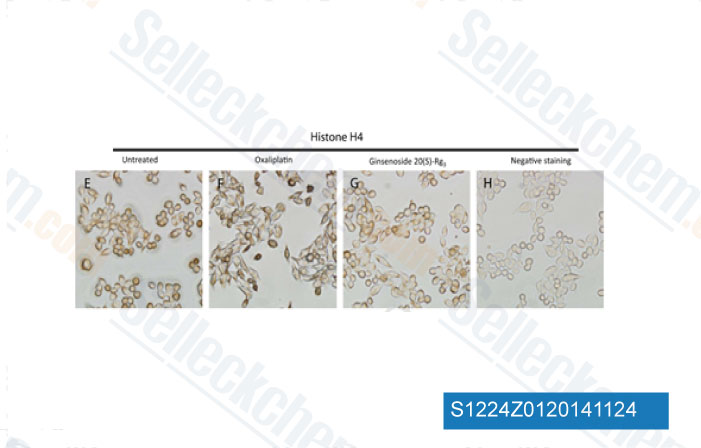
-
Datos de [ J Proteomics , 2014 , 10.1016/j.jprot.2014.10.009 ]
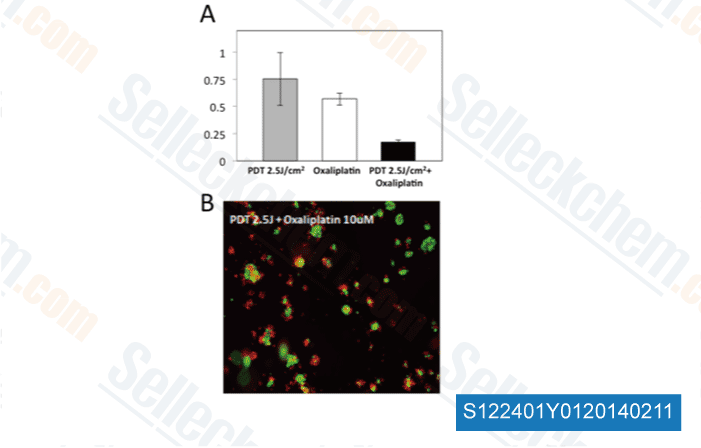
-
Datos de [ Optical Methods for Tumor Treatment and Detection , 2013 , 10.1117/12.2010730 ]
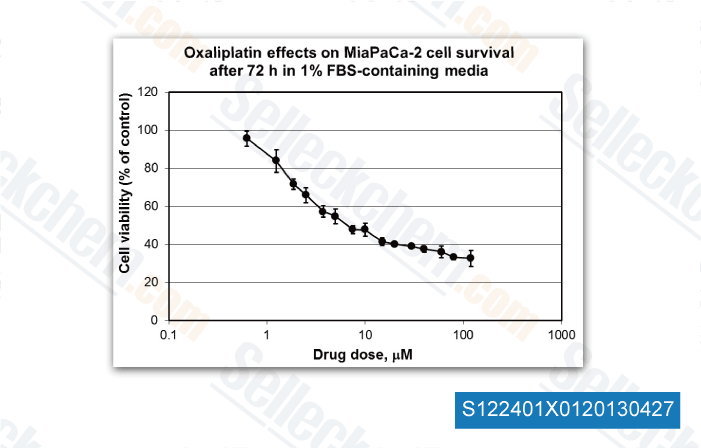
-
, 2013 , Dr. Edita Aksamitiene from Thomas Jefferson University
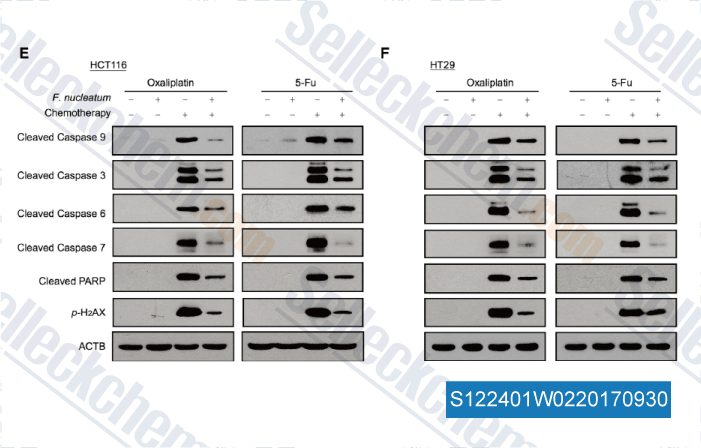
-
Datos de [ , , Cell, 2017, 170(3):548-563.e16 ]
Sellecks Oxaliplatin Ha sido citado por 282 Publicaciones
| Activation of lysosomal iron triggers ferroptosis in cancer [ Nature, 2025, 10.1038/s41586-025-08974-4] | PubMed: 40335696 |
| Cisplatin and temozolomide combinatorial treatment triggers hypermutability and immune surveillance in experimental cancer models [ Cancer Cell, 2025, S1535-6108(25)00223-5] | PubMed: 40513578 |
| The noncanonical function of liver-type phosphofructokinase potentiates the efficacy of HDAC inhibitors in cancer [ Signal Transduct Target Ther, 2025, 10(1):341] | PubMed: 41083431 |
| A pancreatic cancer organoid biobank links multi-omics signatures to therapeutic response and clinical evaluation of statin combination therapy [ Cell Stem Cell, 2025, S1934-5909(25)00265-6] | PubMed: 40812300 |
| Prediction of Patient Drug Response via 3D Bioprinted Gastric Cancer Model Utilized Patient-Derived Tissue Laden Tissue-Specific Bioink [ Adv Sci (Weinh), 2025, 12(10):e2411769] | PubMed: 39748450 |
| Targeting of the G9a, DNMT1 and UHRF1 epigenetic complex as an effective strategy against pancreatic ductal adenocarcinoma [ J Exp Clin Cancer Res, 2025, 44(1):13] | PubMed: 39810240 |
| Unveiling radiobiological traits and therapeutic responses of BRAFV600E-mutant colorectal cancer via patient-derived organoids [ J Exp Clin Cancer Res, 2025, 44(1):92] | PubMed: 40069844 |
| Gemcitabine and ATR inhibitors synergize to kill PDAC cells by blocking DNA damage response [ Mol Syst Biol, 2025, 21(3):231-253] | PubMed: 39838187 |
| Monitoring Response to Combinatorial Immunotherapies by Tracking both T Cells and Natural Killer Cells In Vivo via ImmunoPET-Raman Multimodal Gold Nanostars [ ACS Appl Mater Interfaces, 2025, 10.1021/acsami.5c11312] | PubMed: 41099635 |
| CBX3 promotes multidrug resistance by suppressing ferroptosis in colorectal carcinoma via the CUL3/NRF2/GPX2 axis [ Oncogene, 2025, 10.1038/s41388-025-03337-9] | PubMed: 40089640 |
POLÍTICA DE DEVOLUCIÓN
La Política de Devolución Incondicional de Selleck Chemical garantiza una experiencia de compra en línea fluida para nuestros clientes. Si no está satisfecho con su compra de alguna manera, puede devolver cualquier artículo(s) dentro de los 7 días posteriores a su recepción. En caso de problemas de calidad del producto, ya sean problemas relacionados con el protocolo o con el producto, puede devolver cualquier artículo(s) dentro de los 365 días a partir de la fecha de compra original. Siga las instrucciones a continuación al devolver productos.
ENVÍO Y ALMACENAMIENTO
Los productos Selleck se transportan a temperatura ambiente. Si recibe el producto a temperatura ambiente, tenga la seguridad de que el Departamento de Inspección de Calidad de Selleck ha realizado experimentos para verificar que la colocación a temperatura normal durante un mes no afectará la actividad biológica de los productos en polvo. Después de la recogida, guarde el producto de acuerdo con los requisitos descritos en la hoja de datos. La mayoría de los productos Selleck son estables en las condiciones recomendadas.
NO PARA USO HUMANO, DIAGNÓSTICO VETERINARIO O TERAPÉUTICO.