
solo para uso en investigación
RITA p53 activador
Cat. No.S2781
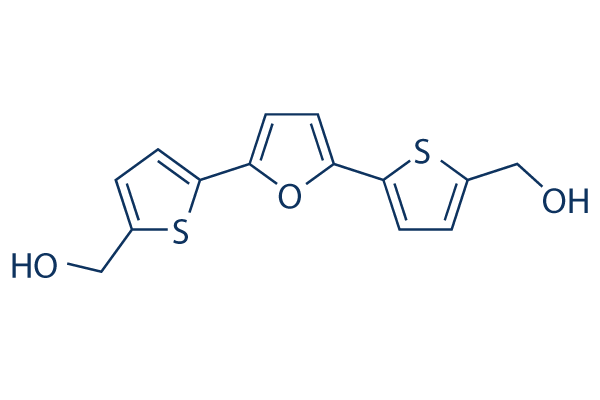
Estructura química
Peso molecular: 292.37
Control de calidad
- Citado en Nature Medicine por su máxima calidad
- COA
- NMR
- SDS
- Hoja de datos
Información química, almacenamiento y estabilidad
| Peso molecular | 292.37 | Fórmula | C14H12O3S2 |
Almacenamiento (Desde la fecha de recepción) | |
|---|---|---|---|---|---|
| Nº CAS | 213261-59-7 | Descargar SDF | Almacenamiento de soluciones madre |
|
|
| Sinónimos | NSC 652287 | Smiles | C1=C(SC(=C1)C2=CC=C(O2)C3=CC=C(S3)CO)CO | ||
Solubilidad
|
In vitro |
DMSO
: 58 mg/mL
(198.37 mM)
Ethanol : 8 mg/mL Water : Insoluble |
Calculadora de Molaridad
|
In vivo |
|||||
Calculadora de formulación in vivo (Solución clara)
Paso 1: Introduzca la información a continuación (Recomendado: Un animal adicional para tener en cuenta la pérdida durante el experimento)
Paso 2: Introduzca la formulación in vivo (Esto es solo la calculadora, no la formulación. Por favor, contáctenos primero si no hay una formulación in vivo en la sección de Solubilidad.)
Resultados del cálculo:
Concentración de trabajo: mg/ml;
Método para preparar el líquido maestro de DMSO: mg fármaco predissuelto en μL DMSO ( Concentración del líquido maestro mg/mL, Por favor, contáctenos primero si la concentración excede la solubilidad del DMSO del lote del fármaco. )
Método para preparar la formulación in vivo: Tomar μL DMSO líquido maestro, luego añadirμL PEG300, mezclar y clarificar, luego añadirμL Tween 80, mezclar y clarificar, luego añadir μL ddH2O, mezclar y clarificar.
Método para preparar la formulación in vivo: Tomar μL DMSO líquido maestro, luego añadir μL Aceite de maíz, mezclar y clarificar.
Nota: 1. Por favor, asegúrese de que el líquido esté claro antes de añadir el siguiente disolvente.
2. Asegúrese de añadir el (los) disolvente(s) en orden. Debe asegurarse de que la solución obtenida, en la adición anterior, sea una solución clara antes de proceder a añadir el siguiente disolvente. Se pueden utilizar métodos físicos como el vórtice, el ultrasonido o el baño de agua caliente para ayudar a la disolución.
Mecanismo de acción
| Características |
Inducer of DNA cross-links, not a DNA intercalator.
|
|---|---|
| Targets/IC50/Ki |
Mdm2
p53
|
| In vitro |
RITA muestra un patrón altamente selectivo de actividad citotóxica diferencial en las líneas celulares tumorales, debido a la acumulación celular en la fracción citosólica (S100). Este compuesto también inhibe el crecimiento de otras líneas celulares renales, incluidas ACHN y UO-31, con IC50 de 13 μM y 37 μM, respectivamente. El (10 nM) provoca la detención del ciclo celular con acumulación de células en la fase G2-M e induce la fragmentación del ADN y la Apoptosis a 100 nM, ambos con niveles de proteína p53 evaluados. Este químico (30 nM) también induce enlaces cruzados ADN-proteína y ADN-ADN en células A498. Mientras tanto, no tiene efectos sobre la relajación del ADN SV40 superenrollado mediada por top1. Suprime significativamente el crecimiento de las células HCT116 (97%) pero solo inhibe ligeramente el crecimiento de las células HCT116 TP53-/- (13%). Este compuesto es mucho más eficiente en la supresión del crecimiento en líneas celulares tumorales que expresan p53 de tipo salvaje que en líneas celulares que carecen de p53 y aquellas que expresan p53 mutante. Se une a p53 de longitud completa pero no a la proteína glutatión S-transferasa (GST) o HDM-2 (un regulador clave de p53 está fuertemente respaldado por el rescate de la letalidad embrionaria de MDM2). Este químico bloquea la interacción p53−HDM-2 y la ubiquitinación de p53. Disminuye sustancialmente la cantidad de HDM-2 que se coprecipita con p53, aunque ambas proteínas están reguladas al alza. Este compuesto previene las interacciones entre la GST-p53 purificada y las proteínas His-HDM-2 etiquetadas con 6XHis. Se ha demostrado que induce la Apoptosis al promover la fosforilación de p53Ser46. Este químico induce la activación de p53 junto con la regulación positiva de ASK-1, MKK-4 y c-Jun fosforilados. Induce la activación de la señalización JNK. Pero, por el contrario, otros resultados por resonancia magnética nuclear (RMN) muestran que no bloquea la formación del complejo entre p53 (residuos 1-312) y el dominio de unión a p53 N-terminal de MDM2 (residuos 1-118), lo que es muy probable que la unión de este compuesto requiera la conformación nativa de p53.
|
| In vivo |
RITA es bien tolerado en ratones después de la administración intraperitoneal, sin pérdida de peso observable a dosis de hasta 10 mg/kg durante 1 mes. Después de cinco inyecciones de 0,1 mg/kg de este compuesto, el crecimiento de los tumores HCT116 se suprime en un 40%, sin efectos aparentes en los tumores HCT116 TP53-/-. A una dosis de 1 o 10 mg/kg, muestra una fuerte actividad antitumoral. Cinco inyecciones de 1 mg/kg de este químico resultan en una disminución de más del doble en la tasa de crecimiento de los xenoinjertos p53-positivos sin ningún efecto en los xenoinjertos p53-nulos. Los tumores HCT116 son un 90% más pequeños en ratones tratados con 10 mg/kg que en ratones de control no tratados. Este compuesto inhibe el crecimiento tumoral de una manera dependiente del p53 de tipo salvaje.
|
Referencias |
|
Información del ensayo clínico
(datos de https://clinicaltrials.gov, actualizado el 2024-05-22)
| Número NCT | Reclutamiento | Condiciones | Patrocinador/Colaboradores | Fecha de inicio | Fases |
|---|---|---|---|---|---|
| NCT05260203 | Completed | Multiple Myeloma|Solitary Plasmacytoma|Amyloidosis|Chronic Myeloid Leukemia|Chronic Lymphocytic Leukemia|T Cell Non-Hodgkin Lymphoma|Lymphocytic Lymphoma|Hodgkin Lymphoma|B-cell Non Hodgkin Lymphoma|Acute Myeloid Leukemia|Myelodysplasia|Chronic Myeloproliferative Disorder|Treatment Adherence|Treatment Adherence and Compliance |
Advice Pharma Group srl |
June 4 2022 | Not Applicable |
| NCT05153551 | Completed | Autism Spectrum Disorder |
University of Michigan|Blue Cross Blue Shield of Michigan Foundation |
January 27 2022 | Not Applicable |
| NCT03806127 | Completed | Irritable Bowel Syndrome |
Urovant Sciences GmbH |
December 31 2018 | Phase 2 |
| NCT00779025 | Completed | Coitus |
Johnson & Johnson Consumer and Personal Products Worldwide |
January 2008 | Not Applicable |
Soporte técnico
Tel: +1-832-582-8158 Ext:3
Si tiene alguna otra consulta, por favor deje un mensaje.

Los productos son solo para uso de investigación. No para uso humano. No vendemos a pacientes.
©Copyright 2013 Selleck Chemicals. Todos los derechos reservados.