
solo para uso en investigación
Tetraethylthiuram disulfide (Disulfiram) Inhibidor de ALDH
Cat. No.: S1680
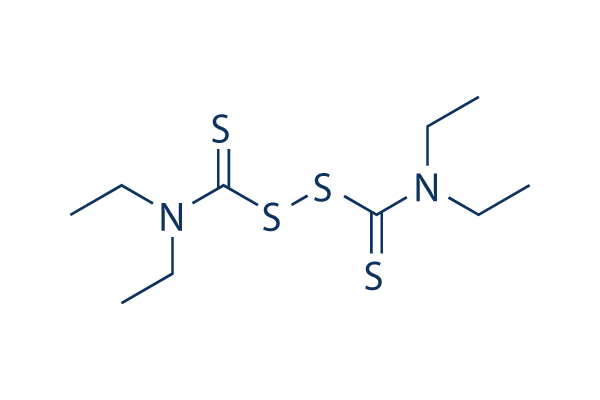
Estructura química
Peso molecular: 296.54
Control de calidad (Quality Control)
Cultivo celular, tratamiento y concentración de trabajo
(Cell Culture, Treatment & Working Concentration)
| Líneas celulares | Tipo de ensayo | Concentración | Tiempo de incubación | Formulación | Descripción de la actividad | PMID |
|---|---|---|---|---|---|---|
| insect cells | Function assay | 30 mins | Inhibition of recombinant human LOXL4 expressed in baculovirus infected insect cells using diaminopentane as substrate preincubated for 30 mins followed by substrate addition measured after 1 hr by fluorimetric method, IC50 = 0.059 μM. | 30098867 | ||
| CHO | Function assay | 30 mins | Inhibition of recombinant human LOXL3 expressed in CHO cells using diaminopentane as substrate preincubated for 30 mins followed by substrate addition measured after 1 hr by fluorimetric method, IC50 = 0.093 μM. | 30098867 | ||
| MCF7 | Antiproliferative assay | 72 hrs | Antiproliferative activity against human MCF7 cells expressing BCA2 and estrogen receptor after 72 hrs by MTT assay, IC50 = 0.1 μM. | 20222671 | ||
| NS0 | Function assay | 30 mins | Inhibition of recombinant LOXL2 (unknown origin) expressed in NS0 cells using diaminopentane as substrate preincubated for 30 mins followed by substrate addition measured after 1 hr by fluorimetric method, IC50 = 0.15 μM. | 30098867 | ||
| T47D | Antiproliferative assay | 72 hrs | Antiproliferative activity against human T47D cells expressing BCA2 and estrogen receptor after 72 hrs by MTT assay, IC50 = 0.17 μM. | 20222671 | ||
| MDA-MB-231 | Antiproliferative assay | 72 hrs | Antiproliferative activity against human MDA-MB-231 cells expressing BCA2 and ERalpha after 72 hrs by MTT assay, IC50 = 0.32 μM. | 20222671 | ||
| HEK293 | Function assay | 30 mins | Inhibition of recombinant human LOX expressed in HEK293 cells using diaminopentane as substrate preincubated for 30 mins followed by substrate addition measured after 1 hr by fluorimetric method, IC50 = 0.32 μM. | 30098867 | ||
| CHO | Function assay | Agonist activity at human TRPA1 channel expressed in CHO cells assessed as increase in intracellular calcium levels, EC50 = 3 μM. | 20356305 | |||
| CEM-SS | Antiviral assay | Antiviral activity against HIV-1 in CEM-SS cells using XXT assay, IC50 = 3.9 μM. | 9207937 | |||
| MCF10A | Antiproliferative assay | 72 hrs | Antiproliferative activity against human MCF10A cells after 72 hrs by MTT assay, IC50 = 10 μM. | 20222671 | ||
| HepG2 | Cytotoxicity assay | 72 hrs | Cytotoxicity against human HepG2 cells assessed as reduction in cell viability after 72 hrs by MTT assay, IC50 = 38 μM. | 29571571 | ||
| TC32 | qHTS assay | qHTS of pediatric cancer cell lines to identify multiple opportunities for drug repurposing: Primary screen for TC32 cells | 29435139 | |||
| DAOY | qHTS assay | qHTS of pediatric cancer cell lines to identify multiple opportunities for drug repurposing: Primary screen for DAOY cells | 29435139 | |||
| SJ-GBM2 | qHTS assay | qHTS of pediatric cancer cell lines to identify multiple opportunities for drug repurposing: Primary screen for SJ-GBM2 cells | 29435139 | |||
| A673 | qHTS assay | qHTS of pediatric cancer cell lines to identify multiple opportunities for drug repurposing: Primary screen for A673 cells | 29435139 | |||
| SK-N-MC | qHTS assay | qHTS of pediatric cancer cell lines to identify multiple opportunities for drug repurposing: Primary screen for SK-N-MC cells | 29435139 | |||
| BT-37 | qHTS assay | qHTS of pediatric cancer cell lines to identify multiple opportunities for drug repurposing: Primary screen for BT-37 cells | 29435139 | |||
| NB-EBc1 | qHTS assay | qHTS of pediatric cancer cell lines to identify multiple opportunities for drug repurposing: Primary screen for NB-EBc1 cells | 29435139 | |||
| U-2 OS | qHTS assay | qHTS of pediatric cancer cell lines to identify multiple opportunities for drug repurposing: Primary screen for U-2 OS cells | 29435139 | |||
| Saos-2 | qHTS assay | qHTS of pediatric cancer cell lines to identify multiple opportunities for drug repurposing: Primary screen for Saos-2 cells | 29435139 | |||
| SK-N-SH | qHTS assay | qHTS of pediatric cancer cell lines to identify multiple opportunities for drug repurposing: Primary screen for SK-N-SH cells | 29435139 | |||
| NB1643 | qHTS assay | qHTS of pediatric cancer cell lines to identify multiple opportunities for drug repurposing: Primary screen for NB1643 cells | 29435139 | |||
| LAN-5 | qHTS assay | qHTS of pediatric cancer cell lines to identify multiple opportunities for drug repurposing: Primary screen for LAN-5 cells | 29435139 | |||
| BT-12 | qHTS assay | qHTS of pediatric cancer cell lines to identify multiple opportunities for drug repurposing: Primary screen for BT-12 cells | 29435139 | |||
| Rh18 | qHTS assay | qHTS of pediatric cancer cell lines to identify multiple opportunities for drug repurposing: Primary screen for Rh18 cells | 29435139 | |||
| OHS-50 | qHTS assay | qHTS of pediatric cancer cell lines to identify multiple opportunities for drug repurposing: Primary screen for OHS-50 cells | 29435139 | |||
| RD | qHTS assay | qHTS of pediatric cancer cell lines to identify multiple opportunities for drug repurposing: Primary screen for RD cells | 29435139 | |||
| MG 63 (6-TG R) | qHTS assay | qHTS of pediatric cancer cell lines to identify multiple opportunities for drug repurposing: Primary screen for MG 63 (6-TG R) cells | 29435139 | |||
| fibroblast cells | qHTS assay | qHTS of pediatric cancer cell lines to identify multiple opportunities for drug repurposing: Primary screen for control Hh wild type fibroblast cells | 29435139 | |||
| Rh41 | qHTS assay | qHTS of pediatric cancer cell lines to identify multiple opportunities for drug repurposing: Primary screen for Rh41 cells | 29435139 | |||
| NB1643 | qHTS assay | qHTS of pediatric cancer cell lines to identify multiple opportunities for drug repurposing: Confirmatory screen for NB1643 cells | 29435139 | |||
| A673 | qHTS assay | qHTS of pediatric cancer cell lines to identify multiple opportunities for drug repurposing: Confirmatory screen for A673 cells) | 29435139 | |||
| LAN-5 | qHTS assay | qHTS of pediatric cancer cell lines to identify multiple opportunities for drug repurposing: Confirmatory screen for LAN-5 cells | 29435139 | |||
| DAOY | qHTS assay | qHTS of pediatric cancer cell lines to identify multiple opportunities for drug repurposing: Confirmatory screen for DAOY cells | 29435139 | |||
| SJ-GBM2 | qHTS assay | qHTS of pediatric cancer cell lines to identify multiple opportunities for drug repurposing: Confirmatory screen for SJ-GBM2 cells | 29435139 | |||
| BT-37 | qHTS assay | qHTS of pediatric cancer cell lines to identify multiple opportunities for drug repurposing: Confirmatory screen for BT-37 cells | 29435139 | |||
| TC32 | qHTS assay | qHTS of pediatric cancer cell lines to identify multiple opportunities for drug repurposing: Confirmatory screen for TC32 cells | 29435139 | |||
| U-2 OS | qHTS assay | qHTS of pediatric cancer cell lines to identify multiple opportunities for drug repurposing: Confirmatory screen for U-2 OS cells | 29435139 | |||
| Rh41 | qHTS assay | qHTS of pediatric cancer cell lines to identify multiple opportunities for drug repurposing: Confirmatory screen for Rh41 cells | 29435139 | |||
| RD | qHTS assay | qHTS of pediatric cancer cell lines to identify multiple opportunities for drug repurposing: Confirmatory screen for RD cells | 29435139 | |||
| Saos-2 | qHTS assay | qHTS of pediatric cancer cell lines to identify multiple opportunities for drug repurposing: Confirmatory screen for Saos-2 cells | 29435139 | |||
| Haga clic para ver más datos experimentales de líneas celulares | ||||||
Información química, almacenamiento y estabilidad (Chemical Information, Storage & Stability)
| Peso molecular | 296.54 | Fórmula | C10H20N2S4 |
Almacenamiento (Desde la fecha de recepción) | |
|---|---|---|---|---|---|
| Nº CAS | 97-77-8 | Descargar SDF | Almacenamiento de soluciones madre |
|
|
| Sinónimos | NSC 190940, Tetraethylthiuram disulfide, TETD | Smiles | CCN(CC)C(=S)SSC(=S)N(CC)CC | ||
Solubilidad (Solubility)
|
In vitro |
DMSO
: 59 mg/mL
(198.96 mM)
Ethanol : 59 mg/mL Water : Insoluble |
Calculadora de Molaridad
|
In vivo |
|||||
Calculadora de formulación in vivo (Solución clara)
Paso 1: Introduzca la información a continuación (Recomendado: Un animal adicional para tener en cuenta la pérdida durante el experimento)
Paso 2: Introduzca la formulación in vivo (Esto es solo la calculadora, no la formulación. Por favor, contáctenos primero si no hay una formulación in vivo en la sección de Solubilidad.)
Resultados del cálculo:
Concentración de trabajo: mg/ml;
Método para preparar el líquido maestro de DMSO: mg fármaco predissuelto en μL DMSO ( Concentración del líquido maestro mg/mL, Por favor, contáctenos primero si la concentración excede la solubilidad del DMSO del lote del fármaco. )
Método para preparar la formulación in vivo: Tomar μL DMSO líquido maestro, luego añadirμL PEG300, mezclar y clarificar, luego añadirμL Tween 80, mezclar y clarificar, luego añadir μL ddH2O, mezclar y clarificar.
Método para preparar la formulación in vivo: Tomar μL DMSO líquido maestro, luego añadir μL Aceite de maíz, mezclar y clarificar.
Nota: 1. Por favor, asegúrese de que el líquido esté claro antes de añadir el siguiente disolvente.
2. Asegúrese de añadir el (los) disolvente(s) en orden. Debe asegurarse de que la solución obtenida, en la adición anterior, sea una solución clara antes de proceder a añadir el siguiente disolvente. Se pueden utilizar métodos físicos como el vórtice, el ultrasonido o el baño de agua caliente para ayudar a la disolución.
Mecanismo de acción (Mechanism of Action)
| Targets/IC50/Ki |
ALDH1
(Cell-free assay) 0.15 μM
ALDH2
(Cell-free assay) 1.45 μM
|
|---|---|
| In vitro |
Disulfiram-copper complex potently inhibits the proteasomal activity in cultured breast cancer MDA-MB-231 and MCF10DCIS.com cells, but not normal, immortalized MCF-10A cells, before induction of apoptotic cancer cell death. This compound (DS), a clinically used anti-alcoholism drug, strongly inhibits constitutive and 5-FU-induced NF-kappaB activity in a dose-dependent manner. It inhibits both NF-kappaB nuclear translocation and DNA binding activity but has no effect on 5-FU-induced IkappaBalpha degradation. This chemical significantly enhances the apoptotic effect of 5-FU on DLD-1 and RKO(WT) cell lines and synergistically potentiated the cytotoxicity of 5-FU to both cell lines. It also effectively abolishes 5-FU chemoresistance in a 5-FU resistant cell line H630(5-FU) in vitro. Oseltamivir decreases the number of viable cells, and the addition of CuCl(2) significantly enhances the DSF-induced cell death to less than 10% of control. This compound given to melanoma cells in combination with Cu2+ or Zn2+ decreases expression of cyclin A and reduces proliferation in vitro at lower concentrations than disulfiram alone. |
| In vivo |
Disulfiram significantly inhibits the tumor growth (by 74%), associated with in vivo proteasome inhibition (as measured by decreased levels of tumor tissue proteasome activity and accumulation of ubiquitinated proteins and natural proteasome substrates p27 and Bax) and apoptosis induction (as shown by caspase activation and apoptotic nuclei formation) in mice bearing MDA-MB-231 tumor xenografts. This compound blocks the P-glycoprotein extrusion pump, inhibits the transcription factor nuclear factor-kappaB, sensitizes tumors to chemotherapy, reduces angiogenesis, and inhibits tumor growth in mice. It inhibits growth and angiogenesis in melanomas transplanted in severe combined immunodeficient mice, and these effects are potentiated by Zn2+ supplementation. |
Referencias |
|
Información del ensayo clínico (Clinical Trial Information)
(datos de https://clinicaltrials.gov, actualizado el 2026-02-10)
| Número NCT | Reclutamiento | Condiciones | Patrocinador/Colaboradores | Fecha de inicio | Fases |
|---|---|---|---|---|---|
| NCT06793488 | RECRUITING | Alcohol Use Disorder |
Columbia University |
2025-09-15 | EARLY_PHASE1 |
| NCT06319872 | RECRUITING | Alcohol Use Disorder; Retinal Dystrophies; Age-Related Macular Degeneration; Retinitis Pigmentosa; Stargardt Disease |
University of Rochester |
2025-05-19 | PHASE1 |
| NCT01777919 | NOT_YET_RECRUITING | Glioblastoma Multiforme |
Olympion Medical Center |
2027-01 | PHASE2 |
| NCT07477457 | RECRUITING | Osteosarcoma; Metastasis |
Memorial Sloan Kettering Cancer Center |
2026-03-11 | PHASE2 |
| NCT07719127 | NOT_YET_RECRUITING | Brain (Nervous System) Cancers |
Case Comprehensive Cancer Center |
2026-10 | PHASE1 |
| NCT07534332 | NOT_YET_RECRUITING | Rheumatoid Arthritis; Inflammation; Obesity |
University of Oklahoma |
2026-09 | PHASE2 |

Los productos son solo para uso de investigación. No para uso humano. No vendemos a pacientes.
©Copyright 2013 Selleck Chemicals. Todos los derechos reservados.