
solo para uso en investigación
PHA-767491 HCl CDK Inhibidor
Cat. No.: S2742
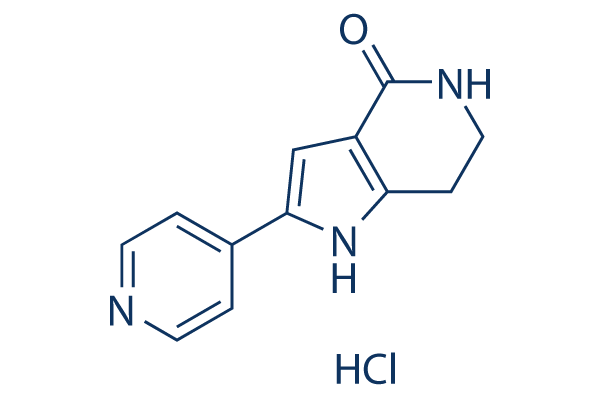
Estructura química
Peso molecular: 249.7
Control de calidad (Quality Control)
Cultivo celular, tratamiento y concentración de trabajo
(Cell Culture, Treatment & Working Concentration)
| Líneas celulares | Tipo de ensayo | Concentración | Tiempo de incubación | Formulación | Descripción de la actividad | PMID |
|---|---|---|---|---|---|---|
| human SF268 cells | Proliferation assay | 72 h | Antiproliferative activity against p53 deficient human SF268 cells after 72 hrs, IC50=0.86 μM | |||
| human HCT116 cells | Proliferation assay | 72 h | Antiproliferative activity against human HCT116 cells expressing p53 gene after 72 hrs by proliferative assay, IC50=0.97 μM | |||
| human HCT16 cells | Proliferation assay | 72 h | Antiproliferative activity against human HCT16 cells after 72 hrs by luciferase based assay, IC50=1 μM | |||
| human SW403 cells | Proliferation assay | 72 h | Antiproliferative activity against human SW403 cells after 72 hrs by luciferase based assay, IC50=1 μM | |||
| human A2780 cells | Proliferation assay | 72 h | Antiproliferative activity against human A2780 cells expressing p53 gene after 72 hrs by proliferative assay, IC50=1.07 μM | |||
| human SW48 cells | Proliferation assay | 72 h | Antiproliferative activity against human SW48 cells after 72 hrs by luciferase based assay, IC50=1.2 μM | |||
| human MCF7 cells | Proliferation assay | 72 h | Antiproliferative activity against human MCF7 cells after 72 hrs by luciferase based assay, IC50=1.3 μM | |||
| human U2OS cells | Proliferation assay | 72 h | Antiproliferative activity against human U2OS cells expressing p53 gene after 72 hrs by proliferative assay, IC50=1.49 μM | |||
| human COLO205 cells | Proliferation assay | 72 h | Antiproliferative activity against human COLO205 cells after 72 hrs by luciferase based assay, IC50=1.5 μM | |||
| human OVCAR8 cells | Proliferation assay | 72 h | Antiproliferative activity against p53 deficient human OVCAR8 cells after 72 hrs by proliferative assay, IC50=1.56 μM | |||
| human L363 cells | Proliferation assay | 72 h | Antiproliferative activity against human L363 cells after 72 hrs by luciferase based assay, IC50=1.6 μM | |||
| human NHDF cells | Proliferation assay | 72 h | Antiproliferative activity against human NHDF cells after 72 hrs by luciferase based assay, IC50=1.6 μM | |||
| human NCI-H929 cells | Proliferation assay | 72 h | Antiproliferative activity against human NCI-H929 cells after 72 hrs by luciferase based assay, IC50=1.8 μM | |||
| human SF539 cells | Proliferation assay | 72 h | Antiproliferative activity against human SF539 cells expressing p53 gene after 72 hrs by proliferative assay, IC50=2.34 μM | |||
| human SW480 cells | Proliferation assay | 72 h | Antiproliferative activity against p53 deficient human SW480 cells after 72 hrs by proliferative assay, IC50=2.67 μM | |||
| human NCI60 cells | Proliferation assay | Antiproliferative activity against human NCI60 cells, IC50=3.1 μM | ||||
| human Jurkat cells | Proliferation assay | 72 h | Antiproliferative activity against p53 deficient human Jurkat cells after 72 hrs by proliferative assay, IC50=3.2 μM | |||
| human HCT15 cells | Proliferation assay | 72 h | Antiproliferative activity against human HCT15 cells expressing p53 gene after 72 hrs by proliferative assay, IC50=3.81 μM | |||
| human OPM2 cells | Proliferation assay | 72 h | Antiproliferative activity against human OPM2 cells after 72 hrs by luciferase based assay, IC50=4.5 μM | |||
| human HT-29 cells | Proliferation assay | 72 h | Antiproliferative activity against human HT-29 cells after 72 hrs by luciferase based assay, IC50=5 μM | |||
| human K562 cells | Proliferation assay | 72 h | Antiproliferative activity against p53 deficient human K562 cells after 72 hrs, IC50=5.87 μM | |||
| U937 cells | Function assay | Inhibition of TNFalpha production in U937 cells, IC50=19 μM | ||||
| human HeLa cells | Function assay | 5 μM | 24 h | Induction of apoptosis in human HeLa cells assessed as appearance of PARP at 5 uM after 24 hrs | ||
| NHDF | Function assay | 5 μM | 16 h | Induction of cell cycle arrest in thymidine deficient NHDF assessed as DNA synthesis in S-phase at 5 uM after 16hrs FACS analysis in presence of serum | ||
| Haga clic para ver más datos experimentales de líneas celulares | ||||||
Información química, almacenamiento y estabilidad (Chemical Information, Storage & Stability)
| Peso molecular | 249.7 | Fórmula | C12H11N3O.HCl |
Almacenamiento (Desde la fecha de recepción) | |
|---|---|---|---|---|---|
| Nº CAS | 942425-68-5 | Descargar SDF | Almacenamiento de soluciones madre |
|
|
| Sinónimos | CAY10572, NMS 1116354 | Smiles | C1CNC(=O)C2=C1NC(=C2)C3=CC=NC=C3.Cl | ||
Solubilidad (Solubility)
|
In vitro |
DMSO
: 24 mg/mL
(96.11 mM)
Water : Insoluble Ethanol : Insoluble |
Calculadora de Molaridad
|
In vivo |
|||||
Calculadora de formulación in vivo (Solución clara)
Paso 1: Introduzca la información a continuación (Recomendado: Un animal adicional para tener en cuenta la pérdida durante el experimento)
Paso 2: Introduzca la formulación in vivo (Esto es solo la calculadora, no la formulación. Por favor, contáctenos primero si no hay una formulación in vivo en la sección de Solubilidad.)
Resultados del cálculo:
Concentración de trabajo: mg/ml;
Método para preparar el líquido maestro de DMSO: mg fármaco predissuelto en μL DMSO ( Concentración del líquido maestro mg/mL, Por favor, contáctenos primero si la concentración excede la solubilidad del DMSO del lote del fármaco. )
Método para preparar la formulación in vivo: Tomar μL DMSO líquido maestro, luego añadirμL PEG300, mezclar y clarificar, luego añadirμL Tween 80, mezclar y clarificar, luego añadir μL ddH2O, mezclar y clarificar.
Método para preparar la formulación in vivo: Tomar μL DMSO líquido maestro, luego añadir μL Aceite de maíz, mezclar y clarificar.
Nota: 1. Por favor, asegúrese de que el líquido esté claro antes de añadir el siguiente disolvente.
2. Asegúrese de añadir el (los) disolvente(s) en orden. Debe asegurarse de que la solución obtenida, en la adición anterior, sea una solución clara antes de proceder a añadir el siguiente disolvente. Se pueden utilizar métodos físicos como el vórtice, el ultrasonido o el baño de agua caliente para ayudar a la disolución.
Mecanismo de acción (Mechanism of Action)
| Características |
The first inhibitor that directly affects the mechanisms controlling initiation as opposed to elongation in DNA replication.
|
|---|---|
| Targets/IC50/Ki |
Cdc7
(Cell-free assay) 10 nM
CDK9
(Cell-free assay) 34 nM
GSK-3β
(Cell-free assay) 220 nM
CDK2
(Cell-free assay) 240 nM
CDK1
(Cell-free assay) 250 nM
CDK5
(Cell-free assay) 460 nM
MK2
(Cell-free assay) 470 nM
PLK1
(Cell-free assay) 980 nM
|
| In vitro |
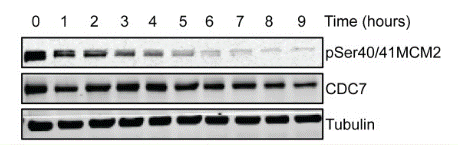
PHA-767491 displays approximately 20-fold selectivity for Cdk1, Cdk2 and GSK3-β, 50-fold selectivity for MK2 and Cdk5 and 100-fold selectivity for PLK1 and CHK2. PHA-767491 inhibits cell proliferation in a variety of human cell lines with IC50 of 0.86 μM for SF-268 to 5.87 μM for K562, and significantly induces apoptosis in a p53-independent manner in almost all cell lines in contrast with 5-FU which only works in a few of cell lines. Unlike current DNA synthesis inhibitors, PHA-767491 treatment at 5 μM blocks the initiation of DNA replication but not replication fork progression, due to specific inhibition of Cdc7 kinase and Mcm2 phosphorylation at the Cdc7-dependent Ser40 site. The up-regulated Mcl-1 levels in ABT-737-resistant OCI-LY1 and SU-DHL-4 cells can be significantly decreased by PHA-767491 treatment at 3 μM possibly due to the inhibition of Cdk9, leading to the restoration of the sensitivity to ABT-737. The direct mitochondrial dependent pro-apoptosis effect of PHA-767491 is also observed when applied at 1 μM in quiescent chronic lymphocytic leukemia (CLL) cells through the similar mechanism with EC50 of 0.34-0.97 μM. While in proliferating CLL cells stimulated by CD154 and interleukin-4, PHA-767491 treatment at 5 μM abolishes DNA synthesis by inhibiting Cdc7 rather than triggering cell death. |
| Ensayo de quinasa |
Ensayos de cinasa in vitro
|
|
La inhibición de Cdc7 y CDK9 por PHA-767491 (IC50) se determina utilizando el ensayo basado en el intercambiador aniónico fuerte (resina Dowex 1-X8, forma formato). Para cada enzima, se determinan inicialmente los valores Km absolutos para ATP y el sustrato específico, y luego cada ensayo se realiza a concentraciones optimizadas de mezcla de ATP/33P-γ-ATP (2Km) y sustrato (5Km). El ensayo de la cinasa Cdc7 se realiza en un tampón que contiene 50 mM Hepes pH 7,9, 15 mM MgCl2, 2 mM β-glicerofosfato, 0,2 mg/mL BSA, 1 mM DTT, 3 μM Na3VO4, mezcla de ATP/33P-γ-ATP 2Km, Mcm2 5Km (aa 10-294), 37 nM de Cdc7/Dbf4 recombinante y una concentración creciente de PHA-767491 en un volumen final de 30 μL, y se incuba durante 1 hora a 25 °C. El ensayo de la cinasa CDK9 se realiza utilizando 50 nM de Cdk9/ciclina T recombinante en 50 mM HEPES pH 7,5, 10 mM MgCl2, 1 mM DTT, 3 μM Na3VO4, mezcla de ATP/33P-γ-ATP 2Km, péptido CDT de ARN polimerasa 5Km y una concentración creciente de PHA-767491 en un volumen final de 30 μL, y se incuba durante 1 hora a 25 °C. Después de la incubación, se añaden 150 μL de resina/formiato (pH 3,0) para detener la reacción y capturar el 33P-γ-ATP sin reaccionar, separándolo del sustrato fosforilado en solución. Después de 1 hora de reposo, un volumen de 50 μL de sobrenadante se transfiere a placas de 96 pocillos Optiplate. Después de la adición de 150 μL de Microscint 40, la radioactividad se cuenta en el TopCount.
|
|
| In vivo |
Administration of PHA-767491 twice a day for 5 days significantly inhibits the growth of HL60 xenograft in a dose-dependent manner with TGI of 50% and 92% at dose of 20 mg/kg and 30 mg/kg, respectively, the effect of which is also marked in A2780, Mx-1, and HCT-116 xenograft models as well as the mammary carcinomas, and correlates with Cdc7 inhibition and subsequently decreased phosphorylation of Mcm2 at the Cdc7-dependent site Ser40 |
Referencias |
|
Aplicaciones (Applications)
| Métodos | Biomarcadores | Imágenes | PMID |
|---|---|---|---|
| Western blot | p-MCM2 / CDC7 RNA Pol II / p-RNA Pol II / Caspase-3 / PARP / Mcl-1 / XIAP / Bcl-xL / Bcl-2 / NOXA |
|
24902048 |

Los productos son solo para uso de investigación. No para uso humano. No vendemos a pacientes.
©Copyright 2013 Selleck Chemicals. Todos los derechos reservados.