
solo para uso en investigación
Crenolanib (CP-868596) Inhibidor de PDGFR/FLT3
Cat. No.S2730
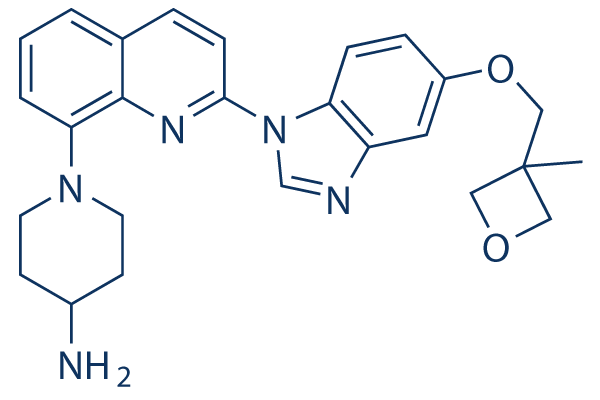
Estructura química
Peso molecular: 443.54
Control de calidad
| Dianas relacionadas | EGFR VEGFR JAK PDGFR FGFR Src HIF FLT HER2 Bcr-Abl |
|---|---|
| Otros FLT3 Inhibidores | UNC2025 Dovitinib (TKI-258) Dovitinib (TKI258) Lactate monohydrate Tandutinib (MLN518) KW-2449 ENMD-2076 AST-487 (NVP-AST487) TCS 359 G-749 AMG 925 |
Cultivo celular, tratamiento y concentración de trabajo
| Líneas celulares | Tipo de ensayo | Concentración | Tiempo de incubación | Formulación | Descripción de la actividad | PMID |
|---|---|---|---|---|---|---|
| A549 cells | Cell viability assay | 3.9-1000 nM | 72 h | a dose-dependent inhibition of cancer cell viability | 25328409 | |
| MV4-11 | Function assay | a decrease in mitochondrial matrix protein aconitase hydratase 2 (ACO2) | 25328409 | |||
| MV4-11 | Cytotoxicity assay | Cytotoxicity against human MV4-11 cells expressing FLT3 ITD mutant, IC50=0.0015μM | 31207462 | |||
| MOLM13 | Cytotoxicity assay | Cytotoxicity against human MOLM13 cells expressing FLT3 ITD mutant, IC50=0.0049μM | 31207462 | |||
| MV4-11 | Cytotoxicity assay | 72 hrs | Cytotoxicity in human MV4-11 cells assessed as inhibition of cellular viability incubated for 72 hrs by CellTiter-Blue assay, IC50=0.012μM | 30742435 | ||
| DAOY | qHTS assay | qHTS of pediatric cancer cell lines to identify multiple opportunities for drug repurposing: Primary screen for DAOY cells | 29435139 | |||
| SJ-GBM2 | qHTS assay | qHTS of pediatric cancer cell lines to identify multiple opportunities for drug repurposing: Primary screen for SJ-GBM2 cells | 29435139 | |||
| SK-N-MC | qHTS assay | qHTS of pediatric cancer cell lines to identify multiple opportunities for drug repurposing: Primary screen for SK-N-MC cells | 29435139 | |||
| BT-37 | qHTS assay | qHTS of pediatric cancer cell lines to identify multiple opportunities for drug repurposing: Primary screen for BT-37 cells | 29435139 | |||
| NB-EBc1 | qHTS assay | qHTS of pediatric cancer cell lines to identify multiple opportunities for drug repurposing: Primary screen for NB-EBc1 cells | 29435139 | |||
| U-2 OS | qHTS assay | qHTS of pediatric cancer cell lines to identify multiple opportunities for drug repurposing: Primary screen for U-2 OS cells | 29435139 | |||
| Saos-2 | qHTS assay | qHTS of pediatric cancer cell lines to identify multiple opportunities for drug repurposing: Primary screen for Saos-2 cells | 29435139 | |||
| LAN-5 | qHTS assay | qHTS of pediatric cancer cell lines to identify multiple opportunities for drug repurposing: Primary screen for LAN-5 cells | 29435139 | |||
| BT-12 | qHTS assay | qHTS of pediatric cancer cell lines to identify multiple opportunities for drug repurposing: Primary screen for BT-12 cells | 29435139 | |||
| Rh18 | qHTS assay | qHTS of pediatric cancer cell lines to identify multiple opportunities for drug repurposing: Primary screen for Rh18 cells | 29435139 | |||
| OHS-50 | qHTS assay | qHTS of pediatric cancer cell lines to identify multiple opportunities for drug repurposing: Primary screen for OHS-50 cells | 29435139 | |||
| RD | qHTS assay | qHTS of pediatric cancer cell lines to identify multiple opportunities for drug repurposing: Primary screen for RD cells | 29435139 | |||
| A673 | qHTS assay | qHTS of pediatric cancer cell lines to identify multiple opportunities for drug repurposing: Confirmatory screen for A673 cells) | 29435139 | |||
| DAOY | qHTS assay | qHTS of pediatric cancer cell lines to identify multiple opportunities for drug repurposing: Confirmatory screen for DAOY cells | 29435139 | |||
| U-2 OS | qHTS assay | qHTS of pediatric cancer cell lines to identify multiple opportunities for drug repurposing: Confirmatory screen for U-2 OS cells | 29435139 | |||
| Rh41 | qHTS assay | qHTS of pediatric cancer cell lines to identify multiple opportunities for drug repurposing: Confirmatory screen for Rh41 cells | 29435139 | |||
| SK-N-SH | qHTS assay | qHTS of pediatric cancer cell lines to identify multiple opportunities for drug repurposing: Confirmatory screen for SK-N-SH cells | 29435139 | |||
| MV4-11 | Cytotoxicity assay | 0.5 to 5000 nM | 2 to 8 hrs | Cytotoxicity in human MV4-11 cells assessed as inhibition of cellular viability at 0.5 to 5000 nM incubated for 2 to 8 hrs followed by compound washout by CellTiter-Glo luminescent assay | 30742435 | |
| Haga clic para ver más datos experimentales de líneas celulares | ||||||
Información química, almacenamiento y estabilidad
| Peso molecular | 443.54 | Fórmula | C26H29N5O2 |
Almacenamiento (Desde la fecha de recepción) | |
|---|---|---|---|---|---|
| Nº CAS | 670220-88-9 | Descargar SDF | Almacenamiento de soluciones madre |
|
|
| Sinónimos | CP-868596, ARO 002 | Smiles | CC1(COC1)COC2=CC3=C(C=C2)N(C=N3)C4=NC5=C(C=CC=C5N6CCC(CC6)N)C=C4 | ||
Solubilidad
|
In vitro |
DMSO
: 88 mg/mL
(198.4 mM)
Ethanol : 88 mg/mL Water : Insoluble |
Calculadora de Molaridad
|
In vivo |
|||||
Calculadora de formulación in vivo (Solución clara)
Paso 1: Introduzca la información a continuación (Recomendado: Un animal adicional para tener en cuenta la pérdida durante el experimento)
Paso 2: Introduzca la formulación in vivo (Esto es solo la calculadora, no la formulación. Por favor, contáctenos primero si no hay una formulación in vivo en la sección de Solubilidad.)
Resultados del cálculo:
Concentración de trabajo: mg/ml;
Método para preparar el líquido maestro de DMSO: mg fármaco predissuelto en μL DMSO ( Concentración del líquido maestro mg/mL, Por favor, contáctenos primero si la concentración excede la solubilidad del DMSO del lote del fármaco. )
Método para preparar la formulación in vivo: Tomar μL DMSO líquido maestro, luego añadirμL PEG300, mezclar y clarificar, luego añadirμL Tween 80, mezclar y clarificar, luego añadir μL ddH2O, mezclar y clarificar.
Método para preparar la formulación in vivo: Tomar μL DMSO líquido maestro, luego añadir μL Aceite de maíz, mezclar y clarificar.
Nota: 1. Por favor, asegúrese de que el líquido esté claro antes de añadir el siguiente disolvente.
2. Asegúrese de añadir el (los) disolvente(s) en orden. Debe asegurarse de que la solución obtenida, en la adición anterior, sea una solución clara antes de proceder a añadir el siguiente disolvente. Se pueden utilizar métodos físicos como el vórtice, el ultrasonido o el baño de agua caliente para ayudar a la disolución.
Mecanismo de acción
| Targets/IC50/Ki |
FLT3
(CHO cells) 0.74 nM(Kd)
PDGFRα
(CHO cells) 2.1 nM(Kd)
PDGFRβ
(CHO cells) 3.2 nM(Kd)
|
|---|---|
| In vitro |
Crenolanib es significativamente más potente en la inhibición de la actividad quinasa de las quinasas PDGFRα resistentes (D842I, D842V, D842Y, D1842-843IM y deleción I843). Este compuesto es más potente contra D842V en el sistema modelo isogénico, con una IC50 de aproximadamente 10 nM. Inhibe la actividad quinasa del oncogén de fusión en la línea celular EOL-1, que se deriva de un paciente con leucemia eosinofílica crónica y expresa la quinasa de fusión FIP1L1-PDGFRα constitutivamente activada, con una IC50 = 21 nM. Este químico también inhibe la proliferación de células EOL-1 con una IC50 = 0,2 pM. Inhibe la activación de quinasas mutantes V561D o D842V expresadas en células BaF3 con una IC50 de 85 nM o 272 nM, respectivamente. Este compuesto inhibe la activación de PDGFRα en la línea celular de cáncer de pulmón de células no pequeñas H1703 que tiene una amplificación de 24 veces de la región 4q12 que contiene el locus PDGFRα, con una IC50 de 26 nM. Es un TKI de PDGFR altamente potente y selectivo, biodisponible por vía oral. Este compuesto de bencimidazol tiene IC50 de 0,9 nM y 1,8 nM para PDGFRA y PDGFRB, respectivamente. |
| Ensayo de quinasa |
Evaluación bioquímica de la actividad quinasa de PDGFRα
|
|
Las células de ovario de hámster chino (CHO) se transfectan transitoriamente con constructos PDGFRα mutados o de tipo salvaje y se tratan con diversas concentraciones de Crenolanib. Los experimentos que involucran ADN recombinante se realizan utilizando condiciones de nivel de bioseguridad 2 de acuerdo con las directrices. Los lisados de proteínas de las líneas celulares se preparan y se someten a inmunoprecipitación utilizando anticuerpos anti-PDGFRα seguidos de inmunotransferencia secuencial para PDGFRα. La densitometría se realiza para cuantificar el efecto del fármaco utilizando el software Photoshop, con el nivel de fosfor-PDGFRα normalizado a la proteína total. Los resultados experimentales de densitometría y proliferación se analizan utilizando el software Calcusyn 2.1 para determinar matemáticamente los valores de IC50. La prueba de suma de rangos de Wilcoxon se utiliza para comparar los valores de IC50 de este compuesto para una mutación dada.
|
|
| In vivo |
Este compuesto, un inhibidor de PDGFR, suprime la proliferación de células de cáncer de pulmón e inhibe el crecimiento tumoral in vivo |
Referencias |
|
Aplicaciones
| Métodos | Biomarcadores | Imágenes | PMID |
|---|---|---|---|
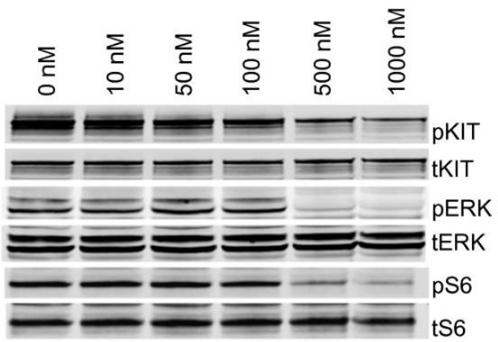
| Western blot | pKIT / KIT pFLT3 / FLT3 / pERK / ERK / pS6 / S6 pAKT / AKT / pMAPK / MAPK / pSTAT5 / STAT5 |
|
24623852 |
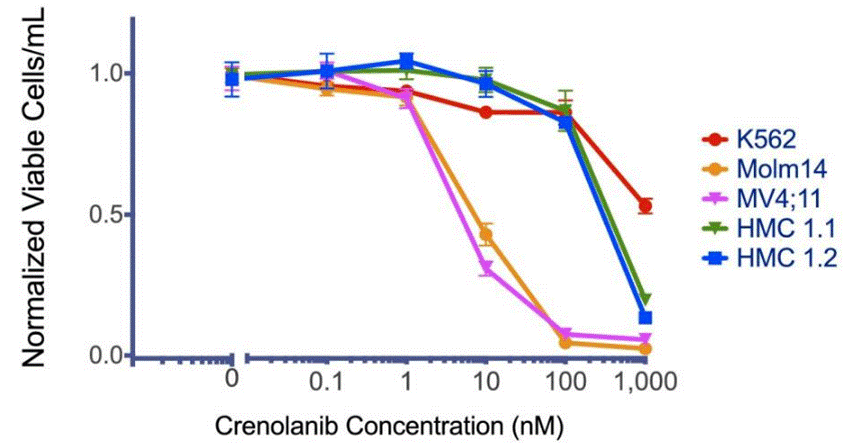
| Growth inhibition assay | Cell viability |
|
24623852 |
Información del ensayo clínico
(datos de https://clinicaltrials.gov, actualizado el 2024-05-22)
| Número NCT | Reclutamiento | Condiciones | Patrocinador/Colaboradores | Fecha de inicio | Fases |
|---|---|---|---|---|---|
| NCT00949624 | Completed | Advanced Solid Tumors |
Arog Pharmaceuticals Inc. |
December 2005 | Phase 1 |
Soporte técnico
Tel: +1-832-582-8158 Ext:3
Si tiene alguna otra consulta, por favor deje un mensaje.

Los productos son solo para uso de investigación. No para uso humano. No vendemos a pacientes.
©Copyright 2013 Selleck Chemicals. Todos los derechos reservados.