
solo para uso en investigación
GSK461364 PLK inhibidor
Cat. No.S2193
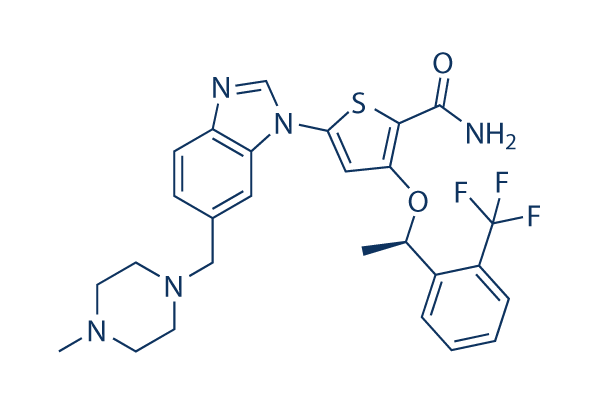
Estructura química
Peso molecular: 543.6
Control de calidad
| Dianas relacionadas | CDK HSP PD-1/PD-L1 ROCK Wee1 DNA/RNA Synthesis Microtubule Associated Ras KRas Aurora Kinase |
|---|---|
| Otros PLK Inhibidores | Volasertib (BI6727) BI 2536 Rigosertib (ON-01910) Onvansertib (NMS-1286937, NMS-P937) CFI-400945 HMN-214 Ro3280 SBE 13 HCl MLN0905 Centrinone (LCR-263) |
Cultivo celular, tratamiento y concentración de trabajo
| Líneas celulares | Tipo de ensayo | Concentración | Tiempo de incubación | Formulación | Descripción de la actividad | PMID |
|---|---|---|---|---|---|---|
| human MV4-11 cells | Cytotoxicity assay | 24 h | Cytotoxicity against human MV4-11 cells after 24 hrs by CellTiter-Blue assay, GI50=0.679 μM | 26191363 | ||
| HEK293T | Antiproliferative assay | 72 hrs | Antiproliferative activity against HEK293T cells measured after 72 hrs by CellTiter-Blue assay, IC50=0.001μM | 28792760 | ||
| MDA-MB-231 | Antiproliferative assay | 72 hrs | Antiproliferative activity against human MDA-MB-231 cells measured after 72 hrs by CellTiter-Blue assay, IC50=0.001μM | 28792760 | ||
| MM1S | Antiproliferative assay | 72 hrs | Antiproliferative activity against human MM1S cells measured after 72 hrs by CellTiter-Blue assay, IC50=0.001μM | 28792760 | ||
| MDA-MB-23 | Function assay | 6 hrs | Inhibition of PLK1 in human MDA-MB-23 cells assessed as decrease in TCTP phosphorylation after 6 hrs by Western blot method, IC50<0.1μM | 28792760 | ||
| HEK293T | Function assay | 6 hrs | Inhibition of PLK1 in HEK293T cells assessed as decrease in TCTP phosphorylation after 6 hrs by Western blot method, IC50<0.1μM | 28792760 | ||
| TC32 | qHTS assay | qHTS of pediatric cancer cell lines to identify multiple opportunities for drug repurposing: Primary screen for TC32 cells | 29435139 | |||
| SJ-GBM2 | qHTS assay | qHTS of pediatric cancer cell lines to identify multiple opportunities for drug repurposing: Primary screen for SJ-GBM2 cells | 29435139 | |||
| A673 | qHTS assay | qHTS of pediatric cancer cell lines to identify multiple opportunities for drug repurposing: Primary screen for A673 cells | 29435139 | |||
| SK-N-MC | qHTS assay | qHTS of pediatric cancer cell lines to identify multiple opportunities for drug repurposing: Primary screen for SK-N-MC cells | 29435139 | |||
| BT-37 | qHTS assay | qHTS of pediatric cancer cell lines to identify multiple opportunities for drug repurposing: Primary screen for BT-37 cells | 29435139 | |||
| NB-EBc1 | qHTS assay | qHTS of pediatric cancer cell lines to identify multiple opportunities for drug repurposing: Primary screen for NB-EBc1 cells | 29435139 | |||
| U-2 OS | qHTS assay | qHTS of pediatric cancer cell lines to identify multiple opportunities for drug repurposing: Primary screen for U-2 OS cells | 29435139 | |||
| SK-N-SH | qHTS assay | qHTS of pediatric cancer cell lines to identify multiple opportunities for drug repurposing: Primary screen for SK-N-SH cells | 29435139 | |||
| NB1643 | qHTS assay | qHTS of pediatric cancer cell lines to identify multiple opportunities for drug repurposing: Primary screen for NB1643 cells | 29435139 | |||
| LAN-5 | qHTS assay | qHTS of pediatric cancer cell lines to identify multiple opportunities for drug repurposing: Primary screen for LAN-5 cells | 29435139 | |||
| BT-12 | qHTS assay | qHTS of pediatric cancer cell lines to identify multiple opportunities for drug repurposing: Primary screen for BT-12 cells | 29435139 | |||
| Rh18 | qHTS assay | qHTS of pediatric cancer cell lines to identify multiple opportunities for drug repurposing: Primary screen for Rh18 cells | 29435139 | |||
| OHS-50 | qHTS assay | qHTS of pediatric cancer cell lines to identify multiple opportunities for drug repurposing: Primary screen for OHS-50 cells | 29435139 | |||
| NB1643 | qHTS assay | qHTS of pediatric cancer cell lines to identify multiple opportunities for drug repurposing: Confirmatory screen for NB1643 cells | 29435139 | |||
| A673 | qHTS assay | qHTS of pediatric cancer cell lines to identify multiple opportunities for drug repurposing: Confirmatory screen for A673 cells) | 29435139 | |||
| SK-N-MC | qHTS assay | qHTS of pediatric cancer cell lines to identify multiple opportunities for drug repurposing: Confirmatory screen for SK-N-MC cells | 29435139 | |||
| BT-12 | qHTS assay | qHTS of pediatric cancer cell lines to identify multiple opportunities for drug repurposing: Confirmatory screen for BT-12 cells | 29435139 | |||
| LAN-5 | qHTS assay | qHTS of pediatric cancer cell lines to identify multiple opportunities for drug repurposing: Confirmatory screen for LAN-5 cells | 29435139 | |||
| NB-EBc1 | qHTS assay | qHTS of pediatric cancer cell lines to identify multiple opportunities for drug repurposing: Confirmatory screen for NB-EBc1 cells | 29435139 | |||
| SJ-GBM2 | qHTS assay | qHTS of pediatric cancer cell lines to identify multiple opportunities for drug repurposing: Confirmatory screen for SJ-GBM2 cells | 29435139 | |||
| BT-37 | qHTS assay | qHTS of pediatric cancer cell lines to identify multiple opportunities for drug repurposing: Confirmatory screen for BT-37 cells | 29435139 | |||
| TC32 | qHTS assay | qHTS of pediatric cancer cell lines to identify multiple opportunities for drug repurposing: Confirmatory screen for TC32 cells | 29435139 | |||
| MG 63 (6-TG R) | qHTS assay | qHTS of pediatric cancer cell lines to identify multiple opportunities for drug repurposing: Confirmatory screen for MG 63 (6-TG R) cells | 29435139 | |||
| fibroblast cells | qHTS assay | qHTS of pediatric cancer cell lines to identify multiple opportunities for drug repurposing: Confirmatory screen for control Hh wild type fibroblast cells | 29435139 | |||
| Rh41 | qHTS assay | qHTS of pediatric cancer cell lines to identify multiple opportunities for drug repurposing: Confirmatory screen for Rh41 cells | 29435139 | |||
| Rh18 | qHTS assay | qHTS of pediatric cancer cell lines to identify multiple opportunities for drug repurposing: Confirmatory screen for Rh18 cells | 29435139 | |||
| Rh30 | qHTS assay | qHTS of pediatric cancer cell lines to identify multiple opportunities for drug repurposing: Confirmatory screen for Rh30 cells | 29435139 | |||
| OHS-50 | qHTS assay | qHTS of pediatric cancer cell lines to identify multiple opportunities for drug repurposing: Confirmatory screen for OHS-50 cells | 29435139 | |||
| SK-N-SH | qHTS assay | qHTS of pediatric cancer cell lines to identify multiple opportunities for drug repurposing: Confirmatory screen for SK-N-SH cells | 29435139 | |||
| Haga clic para ver más datos experimentales de líneas celulares | ||||||
Información química, almacenamiento y estabilidad
| Peso molecular | 543.6 | Fórmula | C27H28F3N5O2S |
Almacenamiento (Desde la fecha de recepción) | |
|---|---|---|---|---|---|
| Nº CAS | 929095-18-1 | Descargar SDF | Almacenamiento de soluciones madre |
|
|
| Sinónimos | GSK461364A | Smiles | CC(C1=CC=CC=C1C(F)(F)F)OC2=C(SC(=C2)N3C=NC4=C3C=C(C=C4)CN5CCN(CC5)C)C(=O)N | ||
Solubilidad
|
In vitro |
Ethanol : 30 mg/mL
DMSO
: 10 mg/mL
(18.39 mM)
Water : Insoluble |
Calculadora de Molaridad
|
In vivo |
|||||
Calculadora de formulación in vivo (Solución clara)
Paso 1: Introduzca la información a continuación (Recomendado: Un animal adicional para tener en cuenta la pérdida durante el experimento)
Paso 2: Introduzca la formulación in vivo (Esto es solo la calculadora, no la formulación. Por favor, contáctenos primero si no hay una formulación in vivo en la sección de Solubilidad.)
Resultados del cálculo:
Concentración de trabajo: mg/ml;
Método para preparar el líquido maestro de DMSO: mg fármaco predissuelto en μL DMSO ( Concentración del líquido maestro mg/mL, Por favor, contáctenos primero si la concentración excede la solubilidad del DMSO del lote del fármaco. )
Método para preparar la formulación in vivo: Tomar μL DMSO líquido maestro, luego añadirμL PEG300, mezclar y clarificar, luego añadirμL Tween 80, mezclar y clarificar, luego añadir μL ddH2O, mezclar y clarificar.
Método para preparar la formulación in vivo: Tomar μL DMSO líquido maestro, luego añadir μL Aceite de maíz, mezclar y clarificar.
Nota: 1. Por favor, asegúrese de que el líquido esté claro antes de añadir el siguiente disolvente.
2. Asegúrese de añadir el (los) disolvente(s) en orden. Debe asegurarse de que la solución obtenida, en la adición anterior, sea una solución clara antes de proceder a añadir el siguiente disolvente. Se pueden utilizar métodos físicos como el vórtice, el ultrasonido o el baño de agua caliente para ayudar a la disolución.
Mecanismo de acción
| Características |
Demonstrates >390-fold selectivity for Plk1 relative to Plk2 and Plk3.
|
|---|---|
| Targets/IC50/Ki |
PLK1
(Cell-free assay) 2.2 nM(Ki)
|
| In vitro |
GSK461364 inhibe la proliferación de líneas celulares cancerosas de múltiples orígenes con toxicidad mínima en células humanas no divididas. El silenciamiento de ARN de p53 WT aumenta la actividad antiproliferativa de este compuesto. Dado que muchas terapias contra el cáncer tienden a ser más efectivas en pacientes con p53 WT, la mayor sensibilidad de los tumores deficientes en p53 a este químico podría ofrecer una oportunidad para tratar tumores que son refractarios a otras quimioterapias, así como una terapia de primera línea para estos genotipos. Este compuesto es una amida de tiofeno que inhibe la enzima Plk1 purificada in vitro con un Ki de 2 nM y tiene una selectividad >100 veces mayor para Plk1 en comparación con Plk2 y Plk3. Es un potente inhibidor de la proliferación celular que causa una inhibición del crecimiento del 50% (GI50) por debajo de 100 nM en la mayoría de las líneas celulares probadas con toxicidad limitada contra las células humanas no proliferantes. La inhibición de la progresión del Cell Cycle depende de la concentración, con un retraso inicial en la fase G2 a altas concentraciones de este agente y una detención en la fase M a concentraciones más bajas. Actualmente, se encuentra en un ensayo de escalada de dosis por primera vez en humanos. Las líneas celulares con mutaciones en el gen TP53 tendieron a ser más sensibles a este compuesto, y la inhibición de la respuesta p53 mediante silenciamiento de ARN confiere una mayor sensibilidad en algunas células p53 de tipo salvaje (WT). Además, estas líneas celulares más sensibles también tienen niveles aumentados de inestabilidad cromosómica, una característica asociada con las mutaciones de TP53. En pruebas preclínicas, este químico muestra actividad antiproliferativa contra múltiples (>120) líneas celulares tumorales e inhibe potentemente la proliferación de más del 83% y 91% de estas líneas celulares, con valores de IC50 inferiores a 50 y 100 nM, respectivamente. |
| Ensayo de quinasa |
Ensayos enzimáticos
|
|
Las reacciones de quinasa se realizan en un volumen final de ensayo de 10 μL utilizando el kit de ensayo Z-Lyte (péptido Ser/Thr 16). Brevemente, las reacciones contienen 50 mM HEPES (pH 7.5), 10 mM MgCl2, 1 mM EGTA, 1 mM DTT, 0.01% Brij 35, 0.01 mg/mL caseína, 200 μM ATP, 200 μM péptido Polo Box (NH2-MAGPMQS[pT]PLNGAKK-OH) y 6 nM Plk1 recombinante (H6-tev-PLK 1-603). Plk1 se preincubó durante 60 minutos con 0 a 1 μM GSK461364. Las reacciones se inician luego con la adición de 2 μM de péptido. Después de 15 minutos a 23 °C, las reacciones se inactivan y se procesan de acuerdo con el protocolo Z'-Lyte y se leen en un lector de placas EnVision. Los valores de fluorescencia brutos se convierten en concentración de producto formado utilizando estándares de sustrato y producto. Debido a que la potencia de inhibición de este compuesto se observa que varía en función de la concentración de ATP de una manera consistente con un modo de inhibición competitivo de ATP, se determina un límite superior para el Ki para este químico.
|
|
| In vivo |
La inhibición del crecimiento en cultivos celulares por GSK461364 puede ser citostática o citotóxica, pero conduce a la regresión tumoral en modelos de tumores de xenoinjerto bajo una programación de dosis adecuada. Este compuesto muestra una clara actividad antitumoral en modelos de xenoinjertos de tumores humanos. Muestra una detención mitótica dosis-dependiente en xenoinjertos de ratón, lo que se correlaciona con los efectos sobre el crecimiento tumoral. La administración intraperitoneal de este químico provoca la regresión o el retraso del crecimiento tumoral en diferentes modelos de xenoinjertos, incluidos los xenoinjertos de Colo205. La supresión de Plk1 in vivo mediante el uso de este agente resulta en una detención mitótica con figuras mitóticas aberrantes que consisten en husos mitóticos monopolares o colapsados. |
Referencias |
|
Aplicaciones
| Métodos | Biomarcadores | Imágenes | PMID |
|---|---|---|---|
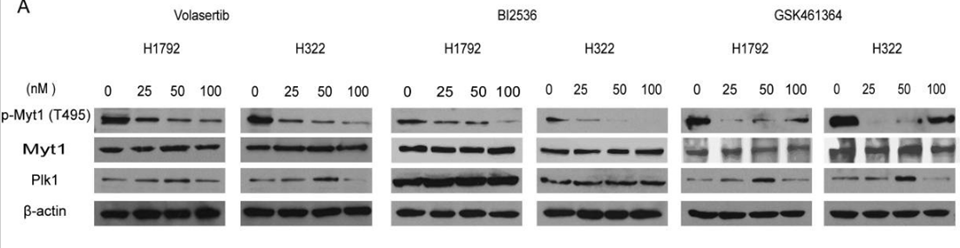
| Western blot | p-Myt1 / Myt1 / Plk1 |
|
26597303 |
Información del ensayo clínico
(datos de https://clinicaltrials.gov, actualizado el 2024-05-22)
| Número NCT | Reclutamiento | Condiciones | Patrocinador/Colaboradores | Fecha de inicio | Fases |
|---|---|---|---|---|---|
| NCT00536835 | Completed | Lymphoma Non-Hodgkin |
GlaxoSmithKline |
August 16 2007 | Phase 1 |
Soporte técnico
Tel: +1-832-582-8158 Ext:3
Si tiene alguna otra consulta, por favor deje un mensaje.
Preguntas frecuentes
Pregunta 1:
I would like to know whether the recommended in vivo formulation will be suitable for i.p. injections of it.
Respuesta:
It is a suspension in 1% DMSO+30% polyethylene glycol+1% Tween 80 at 30mg/ml, and is fine for oral gavage.

Los productos son solo para uso de investigación. No para uso humano. No vendemos a pacientes.
©Copyright 2013 Selleck Chemicals. Todos los derechos reservados.