
solo para uso en investigación
BMS-536924 IGF-1R inhibidor
Cat. No.S1012
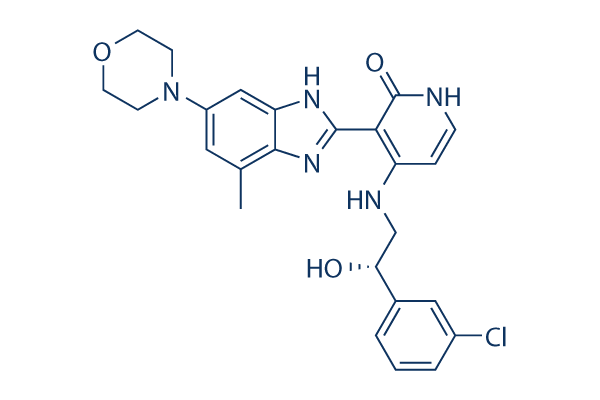
Estructura química
Peso molecular: 479.96
Control de calidad
| Dianas relacionadas | EGFR VEGFR PDGFR FGFR c-Met Src MEK CSF-1R FLT3 HER2 |
|---|---|
| Otros IGF-1R Inhibidores | Linsitinib (OSI-906) NVP-AEW541 BMS-754807 Picropodophyllin (AXL1717) GSK1904529A AG-1024 NVP-ADW742 NT157 PQ 401 MSDC-0160 |
Información química, almacenamiento y estabilidad
| Peso molecular | 479.96 | Fórmula | C25H26ClN5O3 |
Almacenamiento (Desde la fecha de recepción) | |
|---|---|---|---|---|---|
| Nº CAS | 468740-43-4 | Descargar SDF | Almacenamiento de soluciones madre |
|
|
| Sinónimos | CS-0117 | Smiles | CC1=CC(=CC2=C1N=C(N2)C3=C(C=CNC3=O)NCC(C4=CC(=CC=C4)Cl)O)N5CCOCC5 | ||
Solubilidad
|
In vitro |
DMSO
: 96 mg/mL
(200.01 mM)
Water : Insoluble Ethanol : Insoluble |
Calculadora de Molaridad
|
In vivo |
|||||
Calculadora de formulación in vivo (Solución clara)
Paso 1: Introduzca la información a continuación (Recomendado: Un animal adicional para tener en cuenta la pérdida durante el experimento)
Paso 2: Introduzca la formulación in vivo (Esto es solo la calculadora, no la formulación. Por favor, contáctenos primero si no hay una formulación in vivo en la sección de Solubilidad.)
Resultados del cálculo:
Concentración de trabajo: mg/ml;
Método para preparar el líquido maestro de DMSO: mg fármaco predissuelto en μL DMSO ( Concentración del líquido maestro mg/mL, Por favor, contáctenos primero si la concentración excede la solubilidad del DMSO del lote del fármaco. )
Método para preparar la formulación in vivo: Tomar μL DMSO líquido maestro, luego añadirμL PEG300, mezclar y clarificar, luego añadirμL Tween 80, mezclar y clarificar, luego añadir μL ddH2O, mezclar y clarificar.
Método para preparar la formulación in vivo: Tomar μL DMSO líquido maestro, luego añadir μL Aceite de maíz, mezclar y clarificar.
Nota: 1. Por favor, asegúrese de que el líquido esté claro antes de añadir el siguiente disolvente.
2. Asegúrese de añadir el (los) disolvente(s) en orden. Debe asegurarse de que la solución obtenida, en la adición anterior, sea una solución clara antes de proceder a añadir el siguiente disolvente. Se pueden utilizar métodos físicos como el vórtice, el ultrasonido o el baño de agua caliente para ayudar a la disolución.
Mecanismo de acción
| Targets/IC50/Ki |
Insulin Receptor
73 nM
IGF-1R
100 nM
FAK
150 nM
MEK
182 nM
LCK
341 nM
VEGFR2
1.4 μM
EGF
1.6 μM
Met
4.87 μM
|
|---|---|
| In vitro |
BMS-536924 también inhibe FAK y Lck con una CI50 de 150 nM y 341 nM, respectivamente. Este compuesto inhibe la proliferación celular e interrumpe la fosforilación de Akt y MAPK. Inhibe la señalización de IGF-1R estimulada por IGF-I en células MCF10A y bloquea la actividad constitutiva de IGF-1R en CD8-IGF-1R-MCF10A. La preincubación de células MCF10A con 1 μM de este químico bloquea completamente la capacidad de IGF-I para estimular la fosforilación de IGF-1R. La estimulación con IGF-I da como resultado un aumento de la fosforilación de ERK1/2, GSK3β y Akt. Este compuesto inhibe esta fosforilación inducida por ligando. El tratamiento de las células CD8-IGF-1R-MCF10A con este inhibidor da como resultado una inhibición dosis-dependiente de la fosforilación con inhibición parcial a 0,01 μM y 0,1 μM, pero una inhibición completa del receptor a una concentración de 1 μM. La inhibición máxima de IGF-1R fosforilado se observa tan pronto como 10 minutos después de la incubación. Mantiene su capacidad para inhibir la fosforilación de IGF-1R hasta por 48 horas. La adición de este agente inhibe la fosforilación de Akt de forma dependiente del tiempo a partir de 1 hora. A las 48 horas, la activación de Akt está completamente bloqueada. El tratamiento con este compuesto muestra actividad antiproliferativa en un panel de líneas celulares cancerosas que incluyen las células TC32, HT1080/S, SK-LMS-1, H513 y CTR. pIGF-1R/pIR se activa tras la estimulación con IGF-I/insulina y la activación es inhibida por este químico con potencias similares en las líneas celulares Rh41 y Rh36. La expresión de la muerte celular programada 4 (PDCD4), la escisión de la poli(ADP-ribosa) polimerasa (PARP) y la caspasa-3 se regulan al alza en las células Rh41 tratadas con este inhibidor.
|
| Ensayo de quinasa |
Actividad de la vía IGF-I
|
|
1 × 10⁶ células pBabe-MCF10A se siembran en placas de 60 mm. Después de 24 horas, el medio se cambia a medio sin suero y se incuba durante la noche a 37 °C durante 24 horas. Luego, las células se preincuban con o sin 1 uM de BMS-536924 durante 1 hora en medio sin suero, seguido de la estimulación con IGF-I (50 ng/mL) durante 10 minutos. Las monocapas celulares se lavan dos veces con PBS y se cosechan para el análisis de inmunotransferencia.
|
|
| In vivo |
La administración oral de BMS-536924 a 100-300 mpk inhibe fuertemente el modelo tumoral IGR-1R Sal. También se observa eficacia en el modelo de carcinoma de colon humano Colo205 no modificado genéticamente. La administración oral de este compuesto con una pauta de una vez al día (100-300 mpk) o dos veces al día (50, 100 mpk) demuestra actividad antitumoral en este modelo tumoral. La prueba de tolerancia oral a la glucosa (OGTT) muestra que 100 mpk (b.i.d.) provoca una elevación significativa de los niveles de glucosa después del desafío con glucosa. Los parámetros farmacocinéticos de este químico, administrado por vía oral en poli(etilenglicol) 400 y agua (80:20 v/v), se determinan en ratones, ratas, perros y monos. Se evidencia una buena biodisponibilidad en todas las especies. Se observa una farmacocinética no lineal significativa en roedores con dosis p.o. crecientes. Este compuesto reduce el volumen de los xenoinjertos tumorales de células CD8-IGF-1R-MCF10A después de dos semanas de tratamiento (100 mg/kg) al 76%. La administración oral de 70 mg/kg de este químico inhibe significativamente el crecimiento tumoral (células TGBC-1TKB) inoculadas en ratones nude. Regula al alza la apoptosis en los tumores de xenoinjertos. El tratamiento no tiene efectos adversos sobre el peso corporal de los ratones ni los niveles de glucosa en el momento de la muerte, lo que sugiere una toxicidad tolerable.
|
Referencias |
|
Soporte técnico
Tel: +1-832-582-8158 Ext:3
Si tiene alguna otra consulta, por favor deje un mensaje.
Preguntas frecuentes
Pregunta 1:
What are the differences between it and S1034?
Respuesta:
The most remarkable difference between these two IGF-IR inhibitors is that S1012 is an ATP-competitive inhibitor. You will get more information about the differences between IR inhibitors in this reference: http://www.sciencedirect.com/science/article/pii/S1359644605035129.

Los productos son solo para uso de investigación. No para uso humano. No vendemos a pacientes.
©Copyright 2013 Selleck Chemicals. Todos los derechos reservados.