
solo para uso en investigación
Piceatannol Syk inhibidor
Cat. No.S3026
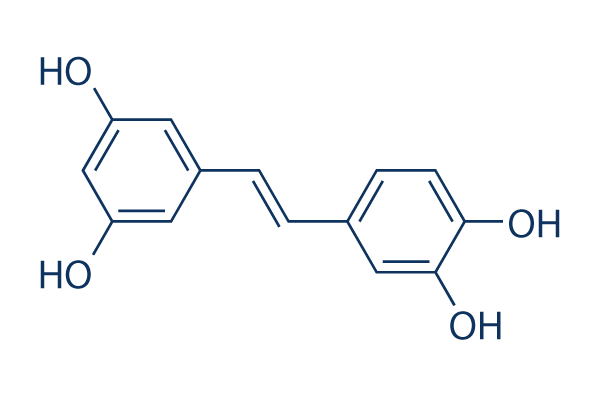
Estructura química
Peso molecular: 244.24
Control de calidad
| Dianas relacionadas | EGFR VEGFR JAK PDGFR FGFR Src HIF FLT FLT3 HER2 |
|---|---|
| Otros Syk Inhibidores | R406 R406 (free base) PRT062607 (P505-15) HCl Entospletinib (GS-9973) BAY 61-3606 dihydrochloride PRT-060318 2HCl TAK-659 Hydrochloride Lanraplenib (GS-SYK) RO9021 R112 |
Cultivo celular, tratamiento y concentración de trabajo
| Líneas celulares | Tipo de ensayo | Concentración | Tiempo de incubación | Formulación | Descripción de la actividad | PMID |
|---|---|---|---|---|---|---|
| human lung mast cells | Function assay | Inhibition of SYK in human lung mast cells assessed as reduction in anti-IgE-stimulated histamine release, EC50=25 μM | ||||
| human A2780 cells | Proliferation assay | 2 days | Antiproliferative activity against human A2780 cells after 2 days by Alamar Blue assay, IC50=41 μM | |||
| mouse 3T3L1 cells | Function assay | 10 to 50 μM | 48 h | Reduction in triglyceride level in mouse 3T3L1 cells at 10 to 50 uM after 48 hrs | ||
| Haga clic para ver más datos experimentales de líneas celulares | ||||||
Información química, almacenamiento y estabilidad
| Peso molecular | 244.24 | Fórmula | C14H12O4 |
Almacenamiento (Desde la fecha de recepción) | |
|---|---|---|---|---|---|
| Nº CAS | 10083-24-6 | Descargar SDF | Almacenamiento de soluciones madre |
|
|
| Sinónimos | Astringenin | Smiles | C1=CC(=C(C=C1C=CC2=CC(=CC(=C2)O)O)O)O | ||
Solubilidad
|
In vitro |
DMSO
: 48 mg/mL
(196.52 mM)
Ethanol : 48 mg/mL Water : Insoluble |
Calculadora de Molaridad
|
In vivo |
|||||
Calculadora de formulación in vivo (Solución clara)
Paso 1: Introduzca la información a continuación (Recomendado: Un animal adicional para tener en cuenta la pérdida durante el experimento)
Paso 2: Introduzca la formulación in vivo (Esto es solo la calculadora, no la formulación. Por favor, contáctenos primero si no hay una formulación in vivo en la sección de Solubilidad.)
Resultados del cálculo:
Concentración de trabajo: mg/ml;
Método para preparar el líquido maestro de DMSO: mg fármaco predissuelto en μL DMSO ( Concentración del líquido maestro mg/mL, Por favor, contáctenos primero si la concentración excede la solubilidad del DMSO del lote del fármaco. )
Método para preparar la formulación in vivo: Tomar μL DMSO líquido maestro, luego añadirμL PEG300, mezclar y clarificar, luego añadirμL Tween 80, mezclar y clarificar, luego añadir μL ddH2O, mezclar y clarificar.
Método para preparar la formulación in vivo: Tomar μL DMSO líquido maestro, luego añadir μL Aceite de maíz, mezclar y clarificar.
Nota: 1. Por favor, asegúrese de que el líquido esté claro antes de añadir el siguiente disolvente.
2. Asegúrese de añadir el (los) disolvente(s) en orden. Debe asegurarse de que la solución obtenida, en la adición anterior, sea una solución clara antes de proceder a añadir el siguiente disolvente. Se pueden utilizar métodos físicos como el vórtice, el ultrasonido o el baño de agua caliente para ayudar a la disolución.
Mecanismo de acción
| Targets/IC50/Ki |
Syk
(Cell-free assay) Lyn
(Cell-free assay) cAK
(Cell-free assay) 3 μM
PKC
(Cell-free assay) 8 μM
MLCK
(Cell-free assay) 12 μM
CDPK
(Cell-free assay) 19 μM
|
|---|---|
| In vitro |
El Piceatannol muestra una selectividad ~10 veces mayor por Syk que por Lyn. El tratamiento con este compuesto en células RBL-2H3 inhibe fuertemente la fosforilación estimulada por antígeno de Syk y de la mayoría de otras proteínas celulares, pero no de la subunidad β o γ del receptor, de manera dosis-dependiente. También es un potente inhibidor de la liberación de histamina en mastocitos. La inhibición selectiva de Syk por este químico bloquea las respuestas celulares descendentes mediadas por el receptor en los mastocitos, incluida la prevención de la síntesis de 1,4,5-IP3, la secreción y el rippling y la extensión de la membrana. Este compuesto también inhibe potentemente PKA, PKC, MLCK y CDPK con IC50 de 3 μM, 8 μM, 12 μM y 19 μM, respectivamente. Previene selectivamente la fosforilación de tirosina de STAT3 y -5 inducida por IFNα, pero no de STAT1 y -2, paralelamente a la pérdida de la fosforilación de tirosina de Jak1 e IFNAR1, pero no de Tyk2 e IFNAR2. Este químico induce potentemente la muerte celular apoptótica en células de linfoma de tipo Burkitt BJAB con una ED50 de 25 μM, a través de la activación de caspasa-3 y la transición de permeabilidad mitocondrial independiente de la vía de señalización CD95/Fas. Inhibe la activación de NF-κB inducida por TNF, H2O2, PMA, LPS, ácido okadaico y ceramida. Este compuesto suprime la expresión del gen reportero dependiente de NF-κB inducido por TNF y de la metaloproteasa de matriz-9, ciclooxigenasa-2 y ciclina D1, independientemente de la quinasa Syk, al bloquear la fosforilación de IκBα inducida por TNF, la fosforilación de p65, la translocación nuclear de p65 y la activación de la quinasa IκBα. Se une directamente a PI3K de manera competitiva con ATP, y suprime la actividad de PI3K con efectos antiateroscleróticos más eficazmente que el resveratrol. Este químico inhibe la proliferación celular de CaP dependiente de andrógenos (AD) e independiente de andrógenos (AI), lo que se acompaña de una expresión reducida de mTOR y sus efectores clave AKT y eIF4EBP-1.
|
| Ensayo de quinasa |
Ensayos de Proteína-Tirosina Kinasa In Vitro
|
|
La Syk recombinante se expresa en células St9 infectadas por baculovirus. Los ensayos de actividad de Syk recombinante se llevan a cabo utilizando el péptido angiotensina I como sustrato. Las actividades enzimáticas de la Syk recombinante se miden por la fosforilación del péptido angiotensina I en presencia de diversas concentraciones de este compuesto.
|
|
| In vivo |
La administración oral de Piceatannol induce una notable mejora de la alteración de la arquitectura colónica, una reducción significativa de la actividad de mieloperoxidasa (MPO) colónica y una disminución en la producción de mediadores inflamatorios como óxido nítrico (NO), prostaglandina (PG) E2 y citocinas proinflamatorias en ratones BALB/c con colitis inducida por sulfato sódico de dextrano (DSS). El tratamiento con este compuesto inhibe los aumentos en los niveles de glucosa en sangre en las etapas tempranas y mejora la tolerancia a la glucosa alterada en las etapas tardías en ratones db/db modelo de diabetes tipo 2.
|
Referencias |
|
Soporte técnico
Tel: +1-832-582-8158 Ext:3
Si tiene alguna otra consulta, por favor deje un mensaje.

Los productos son solo para uso de investigación. No para uso humano. No vendemos a pacientes.
©Copyright 2013 Selleck Chemicals. Todos los derechos reservados.