
solo para uso en investigación
ICG-001 Inhibidor de Wnt/β-catenina
Cat. No.S2662
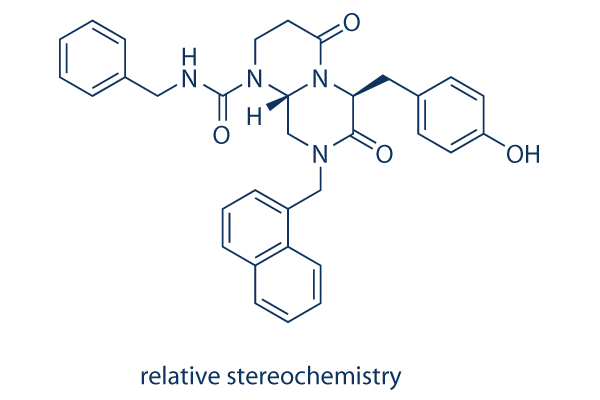
Estructura química
Peso molecular: 548.63
Control de calidad
Productos que se suelen utilizar junto con ICG-001
| Dianas relacionadas | JAK TGF-beta/Smad ERK GSK-3 ROCK Hedgehog/Smoothened PKA Secretase STAT Casein Kinase |
|---|---|
| Otros Wnt/beta-catenin Inhibidores | IWR-1-endo PRI-724 (Foscenvivint) IWP-2 Tegatrabetan (BC-2059) Isoquercitrin SKL2001 BML-284 Hydrochloride (Wnt agonist 1, AMBMP) PNU-74654 Salinomycin (Procoxacin) FH535 |
Cultivo celular, tratamiento y concentración de trabajo
| Líneas celulares | Tipo de ensayo | Concentración | Tiempo de incubación | Formulación | Descripción de la actividad | PMID |
|---|---|---|---|---|---|---|
| SH-SY5Y | Apoptosis Assay | 50 μm | 24 h | DMSO | blocks the protective effect of melatonin against PrP (106–126)-induced apoptotic signals | 25251028 |
| AsPC-1 | Growth Inhibition Assay | 1-20 μM | 2/4/6 d | inhibits the cell growth in a dose-dependent manner | 25082960 | |
| MiaPaCa-2 | Growth Inhibition Assay | 1-20 μM | 2/4/6 d | inhibits the cell growth in a dose-dependent manner | 25082960 | |
| PANC-1 | Growth Inhibition Assay | 1-20 μM | 2/4/6 d | inhibits the cell growth in a dose-dependent manner | 25082960 | |
| L3.6pl | Growth Inhibition Assay | 1-20 μM | 2/4/6 d | inhibits the cell growth in a dose-dependent manner | 25082960 | |
| SH-SY5Y | Apoptosis Assay | 10 μM | 24 h | inhibits the neuroprotective effects of hypoxia against PrP (106-126)-mediated neuronal cell death | 23900566 | |
| HKC-8 | Function Assay | 10 µM | 24 h | abolishes β-catenin–mediated RAS induction | 25012166 | |
| HK-2 | Function Assay | 10 µM | 3 h | reduced the expression of TGF-β1, α-SMA, and CTGF after treatment with HHE | 23690997 | |
| HepT1 | Apoptosis Assay | 0-100 μM | 24 h | IC50=34 μM | 23266718 | |
| HuH6 | Apoptosis Assay | 0-100 μM | 24 h | IC50=39 μM | 23266718 | |
| MCF7 | Function Assay | 5 μm | inhibits leptin-mediated increased expression of Snail, Slug, and Zeb2 | 22270359 | ||
| RLE-6TN | Function Assay | 2.5/5/7.5 μM | 48 h | inhibits TGF-β1-induced α-SMA induction and EMT | 22241478 | |
| HKC-8 | Function Assay | 5/10/20 μM | 48 h | blocks β-catenin-driven gene expression | 21816937 | |
| SW480 | Growth Inhibition Assay | 2-100 μM | IC50=5.8±0.68 μM | 15782138 | ||
| SW480 | Function assay | Inhibition of CBP binding to beta-casein in human SW480 cells by immunoblot analysis, IC50 = 1.3 μM. | 23232060 | |||
| A549 | Antiproliferative assay | 72 hrs | Antiproliferative activity against human A549 cells after 72 hrs by MTT assay, GI50 = 6.1 μM. | 24950489 | ||
| HepG2 | Antiproliferative assay | 72 hrs | Antiproliferative activity against human HepG2 cells after 72 hrs by MTT assay, GI50 = 12.7 μM. | 24950489 | ||
| LoVo | Antiproliferative assay | 72 hrs | Antiproliferative activity against human LoVo cells after 72 hrs by MTT assay, GI50 = 15.6 μM. | 24950489 | ||
| HT-29 | Antiproliferative assay | 72 hrs | Antiproliferative activity against human HT-29 cells after 72 hrs by MTT assay, GI50 = 17.2 μM. | 24950489 | ||
| HT29 | Function assay | 24 hrs | Inhibition of Wnt signaling in human HT29 cells assessed as inhibition of beta-catenin-mediated Tcf/Lef transcriptional activity after 24 hrs by dual luciferase reporter gene assay relative to control, IC50 = 18.7 μM. | 24950489 | ||
| TC32 | qHTS assay | qHTS of pediatric cancer cell lines to identify multiple opportunities for drug repurposing: Primary screen for TC32 cells | 29435139 | |||
| A673 | qHTS assay | qHTS of pediatric cancer cell lines to identify multiple opportunities for drug repurposing: Primary screen for A673 cells | 29435139 | |||
| DAOY | qHTS assay | qHTS of pediatric cancer cell lines to identify multiple opportunities for drug repurposing: Primary screen for DAOY cells | 29435139 | |||
| BT-37 | qHTS assay | qHTS of pediatric cancer cell lines to identify multiple opportunities for drug repurposing: Primary screen for BT-37 cells | 29435139 | |||
| RD | qHTS assay | qHTS of pediatric cancer cell lines to identify multiple opportunities for drug repurposing: Primary screen for RD cells | 29435139 | |||
| MG 63 (6-TG R) | qHTS assay | qHTS of pediatric cancer cell lines to identify multiple opportunities for drug repurposing: Primary screen for MG 63 (6-TG R) cells | 29435139 | |||
| NB1643 | qHTS assay | qHTS of pediatric cancer cell lines to identify multiple opportunities for drug repurposing: Primary screen for NB1643 cells | 29435139 | |||
| OHS-50 | qHTS assay | qHTS of pediatric cancer cell lines to identify multiple opportunities for drug repurposing: Primary screen for OHS-50 cells | 29435139 | |||
| SJ-GBM2 | qHTS assay | qHTS of pediatric cancer cell lines to identify multiple opportunities for drug repurposing: Primary screen for SJ-GBM2 cells | 29435139 | |||
| SK-N-MC | qHTS assay | qHTS of pediatric cancer cell lines to identify multiple opportunities for drug repurposing: Primary screen for SK-N-MC cells | 29435139 | |||
| NB-EBc1 | qHTS assay | qHTS of pediatric cancer cell lines to identify multiple opportunities for drug repurposing: Primary screen for NB-EBc1 cells | 29435139 | |||
| LAN-5 | qHTS assay | qHTS of pediatric cancer cell lines to identify multiple opportunities for drug repurposing: Primary screen for LAN-5 cells | 29435139 | |||
| LoVo | Cytotoxicity assay | 10 uM | 72 hrs | Cytotoxicity against Wnt/beta-catenin signalling dependent human LoVo cells assessed as cell viability at 10 uM after 72 hrs by ATPlite assay | ChEMBL | |
| NCI-H1703 | Function assay | 10 uM | 24 hrs | Inhibition of TNIK in human NCI-H1703 cells transfected with lentiviral vector 7TFP assessed as reduction of GSK3 inhibitor X activated TNIK-mediated Wnt/TCF/beta-catenin-dependent transcription at 10 uM after 24 hrs by luciferase reporter assay | ChEMBL | |
| HCT116 | Cytotoxicity assay | 10 uM | 72 hrs | Cytotoxicity against Wnt/beta-catenin signalling dependent human HCT116 cells assessed as cell viability at 10 uM after 72 hrs by ATPlite assay | ChEMBL | |
| Haga clic para ver más datos experimentales de líneas celulares | ||||||
Información química, almacenamiento y estabilidad
| Peso molecular | 548.63 | Fórmula | C33H32N4O4 |
Almacenamiento (Desde la fecha de recepción) | |
|---|---|---|---|---|---|
| Nº CAS | 780757-88-2 (relative stereochemistry); 847591-62-2 (absolute stereochemistry) | Descargar SDF | Almacenamiento de soluciones madre |
|
|
Solubilidad
|
In vitro |
DMSO
: 30 mg/mL
(54.68 mM)
Water : Insoluble Ethanol : Insoluble |
Calculadora de Molaridad
|
In vivo |
|||||
Calculadora de formulación in vivo (Solución clara)
Paso 1: Introduzca la información a continuación (Recomendado: Un animal adicional para tener en cuenta la pérdida durante el experimento)
Paso 2: Introduzca la formulación in vivo (Esto es solo la calculadora, no la formulación. Por favor, contáctenos primero si no hay una formulación in vivo en la sección de Solubilidad.)
Resultados del cálculo:
Concentración de trabajo: mg/ml;
Método para preparar el líquido maestro de DMSO: mg fármaco predissuelto en μL DMSO ( Concentración del líquido maestro mg/mL, Por favor, contáctenos primero si la concentración excede la solubilidad del DMSO del lote del fármaco. )
Método para preparar la formulación in vivo: Tomar μL DMSO líquido maestro, luego añadirμL PEG300, mezclar y clarificar, luego añadirμL Tween 80, mezclar y clarificar, luego añadir μL ddH2O, mezclar y clarificar.
Método para preparar la formulación in vivo: Tomar μL DMSO líquido maestro, luego añadir μL Aceite de maíz, mezclar y clarificar.
Nota: 1. Por favor, asegúrese de que el líquido esté claro antes de añadir el siguiente disolvente.
2. Asegúrese de añadir el (los) disolvente(s) en orden. Debe asegurarse de que la solución obtenida, en la adición anterior, sea una solución clara antes de proceder a añadir el siguiente disolvente. Se pueden utilizar métodos físicos como el vórtice, el ultrasonido o el baño de agua caliente para ayudar a la disolución.
Mecanismo de acción
| Targets/IC50/Ki |
CBP
(Cell-free assay) 3 μM
|
|---|---|
| In vitro |
ICG-001 no tiene efecto sobre el constructo reportero relacionado, FOPFLASH, que contiene sitios TCF mutados. Después del tratamiento con 25 μM de este compuesto durante 8 horas, las células SW480 reducen los niveles de estado estacionario de ARN y proteína de Survivina y Ciclina D1, los cuales pueden ser regulados al alza por β-catenina. Este compuesto induce selectivamente la apoptosis en células transformadas pero no en células normales de colon, reduce el crecimiento in vitro de células de carcinoma de colon. Puede rescatar fenotípicamente la diferenciación neuronal inducida por el factor de crecimiento nervioso (NGF) normal y el crecimiento de neuritas en las células mutantes de presenilina-1, enfatizando la importancia de la vía de señalización TCF/β-catenina en el crecimiento de neuritas y la diferenciación neuronal. Un estudio reciente demuestra que 5 μM de esta sustancia química inhibe la EMT, la invasión y la formación de tumoresferas inducidas por leptina en células MCF7. |
| Ensayo de quinasa |
Ensayo de Luciferasa Dual como Reportero
|
|
El sistema de ensayo de reportero de luciferasa dual (DLR) proporciona un medio eficiente para realizar ensayos de doble reportero. En el ensayo DLRTM, las actividades de las luciferasas de luciérnaga (Photinus pyralis) y Renilla (Renilla reniformis, también conocida como pluma de mar) se miden secuencialmente a partir de una única muestra. El reportero de luciferasa de luciérnaga se mide primero añadiendo el reactivo de ensayo de luciferasa II (LAR II) para generar una señal luminiscente de tipo “brillo”. Después de cuantificar la luminiscencia de la luciérnaga, esta reacción se extingue y la reacción de la luciferasa de Renilla se inicia añadiendo simultáneamente el reactivo Stop & Glo® al mismo tubo. El reactivo Stop & Glo® también produce una señal de tipo “brillo” de la luciferasa de Renilla, que disminuye lentamente durante la medición. En el sistema de ensayo DLRTM, ambos reporteros producen ensayos lineales con sensibilidades subattomol (<10-18) y sin actividad endógena de ninguno de los reporteros en las células huésped experimentales. Además, el formato integrado del ensayo DLRTM proporciona una cuantificación rápida de ambos reporteros, ya sea en células transfectadas o en reacciones de transcripción/traducción sin células.
|
|
| In vivo |
La administración de un análogo hidrosoluble de ICG-001 durante 9 semanas reduce la formación de pólipos de colon e intestino delgado en un 42%, tan eficazmente como el agente antiinflamatorio no esteroideo, que ha demostrado consistentemente su eficacia en este modelo. No se detecta toxicidad manifiesta durante el curso del tratamiento. En el modelo de xenoinjerto de ratón nude SW620 de regresión tumoral, 150 mg/kg, i.v. de este compuesto demuestra una reducción dramática en el volumen tumoral durante el curso de tratamiento de 19 días, sin mortalidad ni pérdida de peso. Este químico (5 mg/kg por día) inhibe significativamente la señalización de beta-catenina y atenúa la fibrosis pulmonar inducida por bleomicina en ratones, mientras que simultáneamente preserva el epitelio. |
Referencias |
|
Aplicaciones
| Métodos | Biomarcadores | Imágenes | PMID |
|---|---|---|---|
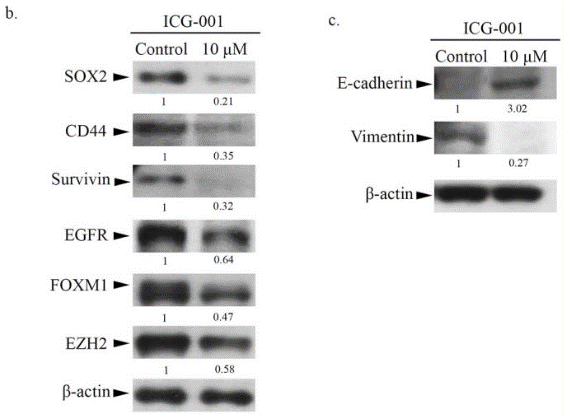
| Western blot | SOX-2 / CD44 / Survivin / EGFR / FOXM1 / EZH2 / Vimentin pβ-catenin beta-catenin / F-actin ABC / Beta-catenin / E-cadherin / N-cadherin / MMP-9 / c-MYC / Actin / Histone H3 CCNB1 / Cyclin D1 |
|
25897700 |
Soporte técnico
Tel: +1-832-582-8158 Ext:3
Si tiene alguna otra consulta, por favor deje un mensaje.
Preguntas frecuentes
Pregunta 1:
If the compound is stored in DMSO at -80, how long would it be stable? For cell culture, how long should I change for the fresh medium with it?
Respuesta:
It in DMSO solution can be stored at 4 degree for 1 week and -20 degree for 1 month. The best storage condition is solid powder, even at -80 the solution is not stable enough for long term storage. For cell culture, you need change medium every 48h.

Los productos son solo para uso de investigación. No para uso humano. No vendemos a pacientes.
©Copyright 2013 Selleck Chemicals. Todos los derechos reservados.