Wnt proteins form a family of highly conserved secreted signaling molecules that regulate cell-to-cell interactions during embryogenesis. Wnt signalling pathway plays a key role in the development of CSC(Cancer stem cell) and it may be a significant step in the development of a large number of tomours. As currently understood, Wnt proteins bind to receptors of the Frizzled and LRP families on the cell surface. [show the full text]

Wnt/beta-catenin Inhibitors/Activators
Otro Stem Cells & Wnt Inhibidores
Productos selectivos de isoformas
- Inhibidores destacados
- Inhibidores (34)
- Moduladores (3)
- Agonistas (4)
- Activadores (11)
- Antagonistas (4)
| Nº Cat. | Nombre del producto | Información | Citas de uso del producto | Validaciones del producto |
|---|---|---|---|---|
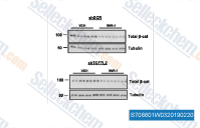
| S7086 | IWR-1-endo | IWR-1-endo (endo-IWR 1, IWR-1) es un inhibidor de la vía Wnt con una IC50 de 180 nM en células L que expresan Wnt3A, induce los niveles de proteína Axin2 y promueve la fosforilación de β-catenina al estabilizar los complejos de destrucción andamiados por Axin. |
|
|
| S8968 | PRI-724 (Foscenvivint) | Foscenvivint (PRI-724) es un potente y específico inhibidor que interrumpe la interacción de la β-catenina y la CBP. |
|
|
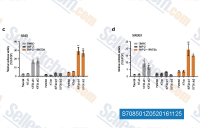
| S7085 | IWP-2 | IWP-2 es un inhibidor del procesamiento y la secreción de Wnt con una IC50 de 27 nM en un ensayo sin células, un bloqueo selectivo de la palmitoilación de Wnt mediada por Porcn, no afecta a Wnt/β-catenina en general y no muestra ningún efecto contra las respuestas celulares estimuladas por Wnt. IWP-2 inhibe específicamente CK1δ. |
|
|
| S0733 | Tegatrabetan (BC-2059) | Tegatrabetan (BC-2059, Tegavivint), un antagonista de la β-Catenina, interrumpe la unión de la β-catenina con la proteína de andamiaje transducina β-like 1 (TBL1) y la degradación proteasómica, lo que lleva a una disminución de los niveles nucleares de β-catenina. |
|
|
| S3842 | Isoquercitrin | La Isoquercitrin (Hirsutrin, 3-Glucosylquercetin, Quercetin 3-o-glucopyranoside), un compuesto flavonoide con actividad anticancerígena aislado de Bidens bipinnata L, es un inhibidor de Wnt/beta-catenin que actúa aguas abajo de la translocación nuclear de la beta-catenin. |
|
|
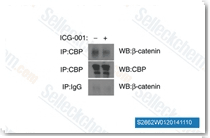
| S2662 | ICG-001 | ICG-001 antagoniza la transcripción mediada por Wnt/β-catenina/TCF y se une específicamente a la proteína de unión a CREB (CBP) con un IC50 de 3 μM, pero no es el coactivador transcripcional relacionado p300. ICG-001 induce la apoptosis. |
|
|
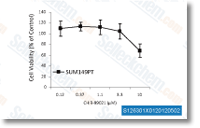
| S1263 | CHIR-99021 (Laduviglusib) | Laduviglusib (CHIR-99021, CT99021) es un inhibidor de GSK-3α y GSK-3β con valores de IC50 de 10 nM y 6.7 nM, respectivamente. No exhibe reactividad cruzada contra las quinasas dependientes de ciclina (CDK) y muestra una selectividad 350 veces mayor hacia GSK-3β en comparación con las CDK. Este compuesto funciona como un activador de Wnt/β-catenin e induce la autophagy. |
|
|
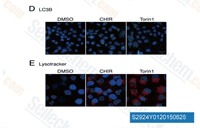
| S2924 | Laduviglusib (CHIR-99021) Hydrochloride | Laduviglusib (CHIR-99021; CT99021) HCl es el clorhidrato de CHIR-99021, que es un inhibidor de GSK-3α/β con una IC50 de 10 nM/6.7 nM; CHIR-99021 muestra una selectividad más de 500 veces mayor por GSK-3 frente a sus homólogos más cercanos Cdc2 y ERK2. CHIR-99021 es un potente activador farmacológico de la vía de señalización Wnt/beta-catenin. CHIR-99021 rescata significativamente la autophagy inducida por la luz y aumenta las proteínas GR, RORα y las relacionadas con la autofagia. |
|
|
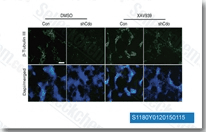
| S1180 | XAV-939 | XAV-939 (NVP-XAV939) inhibe selectivamente la transcripción mediada por Wnt/β-catenina a través de la inhibición de tankyrase1/2 con una IC50 de 11 nM/4 nM en ensayos sin células, regula los niveles de axina y no afecta CRE, NF-κB o TGF-β. |
|
|
| S5992 | Heparan Sulfate | Heparan sulfate (HS, Heparitin sulfate, Alpha-idosane, HHS 5, N-Acetylheparan Sulfate, Suleparoid, Tavidan), un constituyente de los proteoglicanos HS (HSPG), es un polisacárido lineal presente en la superficie celular. Heparan sulfate influye en la afinidad de unión de las células del epitelio intestinal (IEC) a Wnt, promoviendo así la activación de la señalización canónica de Wnt y facilitando la regeneración de las criptas del intestino delgado después de una lesión epitelial. |
|
|
The Wnt/β-catenin signalling pathway is an important mechanism of study for researchers of human diseases as it plays a role in oncology when overactivated, however, reduced signalling of this pathway also results in abnormal bone development and neurodegenerative illnesses. Depending on the indication of use, development of inhibitors or activators of the Wnt/β-catenin signalling pathway is an important area of focus.
Normally, regulation of the Wnt/β-catenin signalling pathway occurs by a large protein assembly called the β-catenin destruction complex that maintains low concentrations of β-catenin in the cytoplasm, and consequently in the nucleus. The β-catenin destruction complex is comprised of glycogen synthase kinase 3 (GSK3α/ GSK3β), casein kinase Iα (CKIα), Axin1/Axin2 scaffolding, and adenomatous polyposis coli (APC) – a tumor suppressor protein. Recruitment of β-catenin to the destruction complex leads to the phosphorylation of β-catenin N-terminus residues by CKIα and GSK3, following which ubiquitination and degradation events occur. Sequestering β-catenin at several N-terminal serine and threonine residues to the β-catenin destruction complex are Axin and APC. Similarly, it is believed these constituents of the β-catenin destruction complex regulate β-catenin efflux from the nucleus. The low concentration of β-catenin in the cell restricts β-catenin to the essential role of cadherin-mediated cell adhesion. An additional mechanism controlling the expression of Wnt signalling in the cell involves the inhibition of Wnt specific gene transcription by the T-cell factor (TCF) family of proteins.[1]
Activation of the Wnt/β-catenin signalling pathway is signified by the formation of a “Wnt signalosome” – a large protein complex that develops following the recognition of Wnt protein on the cell surface by a set of proteins called the seven-pass transmembrane Frizzled (Fz) family and its co-receptor, low density lipoprotein receptor related protein (LRP5/LRP6).ii The Wnt signalosome inhibits the activity of the β-catenin destruction complex by recruiting several components of the destruction complex to the membrane. As a consequence, the buildup of β-catenin’s unphosphorylated form results in the cytoplasm and subsequently in the nucleus. It is in the nucleus where rising concentrations of β-catenin combine with TCF proteins to transform this protein from an inhibitory protein to an activator of Wnt-signalling pathway by encouraging the transcription of the Wnt-responsive gene.[1]
Among cancer research, Wnt/β-catenin signalling is an area of focus since loss-of-function mutations in the APC gene results in β-catenin stabilization. Deletions within a chromosomal region containing the APC gene is understood to be associated with a hereditary disease known as familial adenomatous polyposis that yield intestinal polyps in large numbers that ultimately gives rise to tumors. Alternatively, mutations that promote gain-of-function of the APC gene inhibit the β-catenin destruction complex from limiting β-catenin concentrations in the cell. Additionally, some cancers have been correlated to a loss of Axin1 or Axin2 function. Overexpression of the Wnt/ β-catenin signalling pathway results in the constitutive activation of c-myc, and is most commonly linked to colorectal cancer.[2]
Since the Wnt/β-catenin signalling pathway plays a critical role in cancer, clinical research has yielded several new targets that may positively influence Wnt/β-catenin signalling where its absence is related to disease. Potential new drug targets include two lipid kinases that were found with the accumulation of β-catenin among HEK293T cells transfected with short inhibitory RNAs (siRNAs) targeting human kinases, these include: (1) phosphatidylinositol 4-kinase type IIα (PI4KIIα), and (2) phosphatidylinositol-4-phosphate 5-kinase type Iβ (PIP5Kiβ). Additionally, three human homologs of Drosophila PAR-1 can also provide useful drug targets as these elements activate Wnt/β-catenin signalling pathway as well.[2]
There are many enzymes involved in the Wnt/β-catenin signalling pathway and knowing whether activation or repression is best suited will determine the molecular strategy to explore for therapeutic benefit.

Los productos son solo para uso de investigación. No para uso humano. No vendemos a pacientes.
©Copyright 2013 Selleck Chemicals. Todos los derechos reservados.