
solo para uso en investigación
R788 (Fostamatinib) Disodium Syk inhibidor
Cat. No.S2206
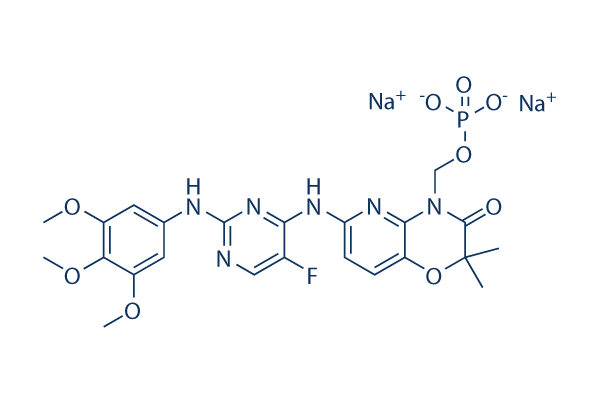
Estructura química
Peso molecular: 624.42
Control de calidad
| Dianas relacionadas | EGFR VEGFR JAK PDGFR FGFR Src HIF FLT FLT3 HER2 |
|---|---|
| Otros Syk Inhibidores | R406 R406 (free base) PRT062607 (P505-15) HCl Entospletinib (GS-9973) Piceatannol BAY 61-3606 dihydrochloride PRT-060318 2HCl TAK-659 Hydrochloride Lanraplenib (GS-SYK) RO9021 |
Cultivo celular, tratamiento y concentración de trabajo
| Líneas celulares | Tipo de ensayo | Concentración | Tiempo de incubación | Formulación | Descripción de la actividad | PMID |
|---|---|---|---|---|---|---|
| Ramos | Function assay | Inhibition of SYK in human Ramos cells, IC50 = 0.267 μM. | 23350847 | |||
| SJ-GBM2 | qHTS assay | qHTS of pediatric cancer cell lines to identify multiple opportunities for drug repurposing: Primary screen for SJ-GBM2 cells | 29435139 | |||
| A673 | qHTS assay | qHTS of pediatric cancer cell lines to identify multiple opportunities for drug repurposing: Primary screen for A673 cells | 29435139 | |||
| SK-N-MC | qHTS assay | qHTS of pediatric cancer cell lines to identify multiple opportunities for drug repurposing: Primary screen for SK-N-MC cells | 29435139 | |||
| NB-EBc1 | qHTS assay | qHTS of pediatric cancer cell lines to identify multiple opportunities for drug repurposing: Primary screen for NB-EBc1 cells | 29435139 | |||
| U-2 OS | qHTS assay | qHTS of pediatric cancer cell lines to identify multiple opportunities for drug repurposing: Primary screen for U-2 OS cells | 29435139 | |||
| Saos-2 | qHTS assay | qHTS of pediatric cancer cell lines to identify multiple opportunities for drug repurposing: Primary screen for Saos-2 cells | 29435139 | |||
| SK-N-SH | qHTS assay | qHTS of pediatric cancer cell lines to identify multiple opportunities for drug repurposing: Primary screen for SK-N-SH cells | 29435139 | |||
| NB1643 | qHTS assay | qHTS of pediatric cancer cell lines to identify multiple opportunities for drug repurposing: Primary screen for NB1643 cells | 29435139 | |||
| LAN-5 | qHTS assay | qHTS of pediatric cancer cell lines to identify multiple opportunities for drug repurposing: Primary screen for LAN-5 cells | 29435139 | |||
| Rh18 | qHTS assay | qHTS of pediatric cancer cell lines to identify multiple opportunities for drug repurposing: Primary screen for Rh18 cells | 29435139 | |||
| OHS-50 | qHTS assay | qHTS of pediatric cancer cell lines to identify multiple opportunities for drug repurposing: Primary screen for OHS-50 cells | 29435139 | |||
| RD | qHTS assay | qHTS of pediatric cancer cell lines to identify multiple opportunities for drug repurposing: Primary screen for RD cells | 29435139 | |||
| MG 63 (6-TG R) | qHTS assay | qHTS of pediatric cancer cell lines to identify multiple opportunities for drug repurposing: Primary screen for MG 63 (6-TG R) cells | 29435139 | |||
| Rh41 | qHTS assay | qHTS of pediatric cancer cell lines to identify multiple opportunities for drug repurposing: Primary screen for Rh41 cells | 29435139 | |||
| NB1643 | qHTS assay | qHTS of pediatric cancer cell lines to identify multiple opportunities for drug repurposing: Confirmatory screen for NB1643 cells | 29435139 | |||
| A673 | qHTS assay | qHTS of pediatric cancer cell lines to identify multiple opportunities for drug repurposing: Confirmatory screen for A673 cells) | 29435139 | |||
| SK-N-MC | qHTS assay | qHTS of pediatric cancer cell lines to identify multiple opportunities for drug repurposing: Confirmatory screen for SK-N-MC cells | 29435139 | |||
| LAN-5 | qHTS assay | qHTS of pediatric cancer cell lines to identify multiple opportunities for drug repurposing: Confirmatory screen for LAN-5 cells | 29435139 | |||
| DAOY | qHTS assay | qHTS of pediatric cancer cell lines to identify multiple opportunities for drug repurposing: Confirmatory screen for DAOY cells | 29435139 | |||
| BT-37 | qHTS assay | qHTS of pediatric cancer cell lines to identify multiple opportunities for drug repurposing: Confirmatory screen for BT-37 cells | 29435139 | |||
| TC32 | qHTS assay | qHTS of pediatric cancer cell lines to identify multiple opportunities for drug repurposing: Confirmatory screen for TC32 cells | 29435139 | |||
| MG 63 (6-TG R) | qHTS assay | qHTS of pediatric cancer cell lines to identify multiple opportunities for drug repurposing: Confirmatory screen for MG 63 (6-TG R) cells | 29435139 | |||
| U-2 OS | qHTS assay | qHTS of pediatric cancer cell lines to identify multiple opportunities for drug repurposing: Confirmatory screen for U-2 OS cells | 29435139 | |||
| Rh41 | qHTS assay | qHTS of pediatric cancer cell lines to identify multiple opportunities for drug repurposing: Confirmatory screen for Rh41 cells | 29435139 | |||
| RD | qHTS assay | qHTS of pediatric cancer cell lines to identify multiple opportunities for drug repurposing: Confirmatory screen for RD cells | 29435139 | |||
| Rh30 | qHTS assay | qHTS of pediatric cancer cell lines to identify multiple opportunities for drug repurposing: Confirmatory screen for Rh30 cells | 29435139 | |||
| Saos-2 | qHTS assay | qHTS of pediatric cancer cell lines to identify multiple opportunities for drug repurposing: Confirmatory screen for Saos-2 cells | 29435139 | |||
| OHS-50 | qHTS assay | qHTS of pediatric cancer cell lines to identify multiple opportunities for drug repurposing: Confirmatory screen for OHS-50 cells | 29435139 | |||
| SK-N-SH | qHTS assay | qHTS of pediatric cancer cell lines to identify multiple opportunities for drug repurposing: Confirmatory screen for SK-N-SH cells | 29435139 | |||
| Haga clic para ver más datos experimentales de líneas celulares | ||||||
Información química, almacenamiento y estabilidad
| Peso molecular | 624.42 | Fórmula | C23H24FN6O9P.2Na |
Almacenamiento (Desde la fecha de recepción) | |
|---|---|---|---|---|---|
| Nº CAS | 1025687-58-4 | Descargar SDF | Almacenamiento de soluciones madre |
|
|
| Sinónimos | Tamatinib Fosdium | Smiles | CC1(C(=O)N(C2=C(O1)C=CC(=N2)NC3=NC(=NC=C3F)NC4=CC(=C(C(=C4)OC)OC)OC)COP(=O)([O-])[O-])C.[Na+].[Na+] | ||
Solubilidad
|
In vitro |
DMSO
: 12 mg/mL
(19.21 mM)
Water : Insoluble Ethanol : Insoluble |
Calculadora de Molaridad
|
In vivo |
|||||
Calculadora de formulación in vivo (Solución clara)
Paso 1: Introduzca la información a continuación (Recomendado: Un animal adicional para tener en cuenta la pérdida durante el experimento)
Paso 2: Introduzca la formulación in vivo (Esto es solo la calculadora, no la formulación. Por favor, contáctenos primero si no hay una formulación in vivo en la sección de Solubilidad.)
Resultados del cálculo:
Concentración de trabajo: mg/ml;
Método para preparar el líquido maestro de DMSO: mg fármaco predissuelto en μL DMSO ( Concentración del líquido maestro mg/mL, Por favor, contáctenos primero si la concentración excede la solubilidad del DMSO del lote del fármaco. )
Método para preparar la formulación in vivo: Tomar μL DMSO líquido maestro, luego añadirμL PEG300, mezclar y clarificar, luego añadirμL Tween 80, mezclar y clarificar, luego añadir μL ddH2O, mezclar y clarificar.
Método para preparar la formulación in vivo: Tomar μL DMSO líquido maestro, luego añadir μL Aceite de maíz, mezclar y clarificar.
Nota: 1. Por favor, asegúrese de que el líquido esté claro antes de añadir el siguiente disolvente.
2. Asegúrese de añadir el (los) disolvente(s) en orden. Debe asegurarse de que la solución obtenida, en la adición anterior, sea una solución clara antes de proceder a añadir el siguiente disolvente. Se pueden utilizar métodos físicos como el vórtice, el ultrasonido o el baño de agua caliente para ayudar a la disolución.
Mecanismo de acción
| Características |
Clinically used oral formulation of R406.
|
|---|---|
| Targets/IC50/Ki |
Syk
(Cell-free assay) 41 nM
|
| In vitro |
R935788 es un profármaco de metilenofosfato de R406, que puede convertirse rápidamente en R406 in vivo. R406 (forma activa in vitro de R935788) inhibe selectivamente la señalización dependiente de Syk con valores de EC50 que oscilan entre 33 nM y 171 nM, de forma más potente que las vías independientes de Syk en diferentes células. R406 inhibe la proliferación celular de una variedad de líneas celulares de linfoma difuso de células B grandes (DLBCL) con valores de EC50 que oscilan entre 0,8 μM y 8,1 μM. El tratamiento con R406 reduce la fosforilación basal de BLNK, Akt, la glucógeno sintasa quinasa-3 (GSK-3), el factor de transcripción forkhead box O (FOXO) y ERK no solo en células con niveles altos (TCL-002) sino también en células con niveles bajos de Syk fosforilada (TCL1-551). Además, R406 inhibe completamente la señal Bcr inducida por anti-IgM en las leucemias TCL1. A pesar de los niveles más altos de Syk constitutivamente activa en las leucemias TCL1, R406 no es selectivamente citotóxico para las células leucémicas.
|
| Ensayo de quinasa |
Ensayos de quinasas de polarización de fluorescencia in vitro
|
|
R406 (forma activa in vitro de R935788) se diluye en serie en DMSO y luego se diluye al 1% de DMSO en tampón de quinasa (20 mM HEPES, pH 7,4, 5 mM MgCl2, 2 mM MnCl2, 1 mM DTT, 0,1 mg/mL de BGG acetilado). Se añaden ATP y sustrato en tampón de quinasa a temperatura ambiente, lo que resulta en una concentración final de DMSO del 0,2%. Las reacciones de quinasa se realizan en un volumen final de 20 μL que contiene 5 μM de sustrato peptídico HS1 y 4 μM de ATP y se inician con la adición de 0,125 ng de Syk en tampón de quinasa. La reacción se deja proceder durante 440 minutos a temperatura ambiente. La reacción se detiene con la adición de 20 μL de mezcla de extinción de PTK que contiene EDTA/anticuerpo anti-fosfotirosina (1× final)/trazador de fosfopéptido fluorescente (0,5× final) diluido en tampón de dilución FP. La placa se incuba durante 30 minutos en la oscuridad a temperatura ambiente y luego se lee en un lector de placas de polarización de fluorescencia Polarion. Los datos se convierten para determinar la cantidad de fosfopéptido presente utilizando una curva de calibración generada por competición con el fosfopéptido competidor proporcionado en el kit de ensayo de tirosina quinasa. Para la determinación de la IC50, R406 se prueba a once concentraciones por duplicado y el ajuste de la curva se realiza mediante análisis de regresión no lineal utilizando el software Prism GraphPad.
|
|
| In vivo |
Dado que la semivida plasmática de R406 en ratones es inferior a 2 horas, R935788 se administra en 3 dosis divididas a intervalos de 3 horas para proporcionar una inhibición continua de Syk durante cada día de tratamiento, imitando la semivida plasmática más prolongada en humanos (15 horas). A pesar del efecto citotóxico relativamente modesto in vitro, R935788 inhibe significativamente la proliferación y supervivencia de las células leucémicas in vivo, lo que se asocia con el bloqueo de la señalización del receptor de células B (Bcr) dependiente de antígeno en lugar de la inhibición de la actividad constitutiva de Syk. El tratamiento con R935788 a 80 mg/kg/día durante 18-21 días inhibe potentemente el crecimiento tumoral de TCL1-002, TCL1-551 y TCL1-870 en ratones con células leucémicas CD5+/B220+ indetectables el último día de tratamiento, prolonga significativamente la supervivencia de los ratones tratados con una mediana de supervivencia aumentada de 45/46 días a 170/172 días, y erradica completamente las células malignas en una proporción sustancial de ratones después de un período de seguimiento de 6 meses sin afectar la producción de linfocitos B normales. El tratamiento con R935788 también induce una migración temprana y transitoria de las células B normales y malignas del bazo y los ganglios linfáticos a la sangre periférica, lo que posteriormente es seguido por una inhibición selectiva del crecimiento de la población de células B malignas. Además, R935788 también es eficaz contra las leucemias TCL1 que se desarrollan espontáneamente en ratones transgénicos Eμ-TCL1.
|
Referencias |
|
Aplicaciones
| Métodos | Biomarcadores | Imágenes | PMID |
|---|---|---|---|
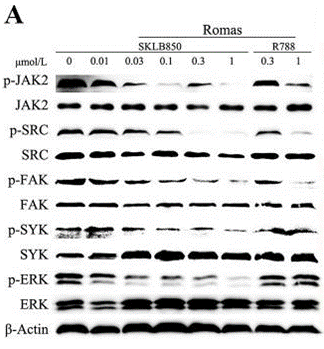
| Western blot | p-JAK2 / JAK2 / p-SRC / SRC / p-FAK / FAK / p-SYK / SYK / p-ERK / ERK p-SYK(525-526) / t-SYK / p-SYK(323) / p-BTK / t-BTK p-MEK / MEK / p-ERK / ERK / p-AKT / AKT |
|
29340070 |
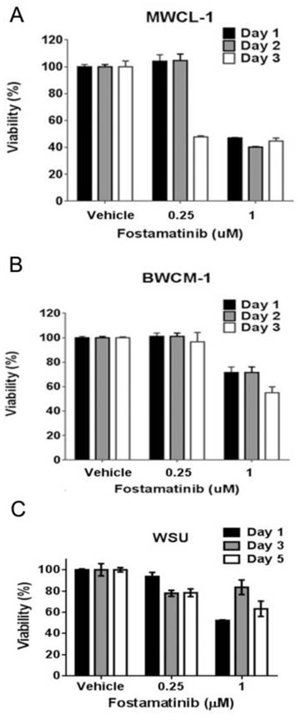
| Growth inhibition assay | Cell viability |
|
25748087 |
Información del ensayo clínico
(datos de https://clinicaltrials.gov, actualizado el 2024-05-22)
| Número NCT | Reclutamiento | Condiciones | Patrocinador/Colaboradores | Fecha de inicio | Fases |
|---|---|---|---|---|---|
| NCT05904093 | Not yet recruiting | Sickle Cell Disease|Hb-SS Disease|Hemoglobin S|Disease Sickle Cell Anemia|Sickle Cell Disorders|Hemoglobin Beta Thalassemia Disease |
National Heart Lung and Blood Institute (NHLBI)|National Institutes of Health Clinical Center (CC) |
May 15 2024 | Phase 1 |
| NCT05509582 | Enrolling by invitation | Immune Mediated Anemia|Immune Mediated Thrombocytopenia|Chronic GVHD |
National Heart Lung and Blood Institute (NHLBI)|National Institutes of Health Clinical Center (CC) |
May 15 2024 | Phase 2 |
| NCT06071520 | Completed | Primary Immune Thrombocytopenia |
Fundación Pública Andaluza para la gestión de la Investigación en Sevilla |
March 1 2023 | -- |
| NCT05613296 | Not yet recruiting | ITP - Immune Thrombocytopenia|Chronic ITP|Refractory ITP |
Gruppo Italiano Malattie EMatologiche dell''Adulto |
February 2023 | -- |
| NCT04543279 | Terminated | Myelofibrosis|Thrombocytopenia |
Washington University School of Medicine|Rigel Pharmaceuticals |
May 3 2021 | Phase 2 |
| NCT04904276 | Terminated | ITP|Immune Thrombocytopenia |
Rigel Pharmaceuticals |
May 18 2021 | -- |
Soporte técnico
Tel: +1-832-582-8158 Ext:3
Si tiene alguna otra consulta, por favor deje un mensaje.
Preguntas frecuentes
Pregunta 1:
What’s the difference between S2625 and S2206?
Respuesta:
The differences between S2625 and S2206: 1. S2206 is more stable than S2625; 2. The water solubility of S2206 is better than S2625; 3. The absorption of S2206 is harder than S2625, so you need to test the suitable dosage if you use it in animal assays; 4. The potency of S2206 and S2625 is similar.

Los productos son solo para uso de investigación. No para uso humano. No vendemos a pacientes.
©Copyright 2013 Selleck Chemicals. Todos los derechos reservados.