
solo para uso en investigación
Belnacasan (VX-765) Inhibidor de Caspase-1
Cat. No.S2228
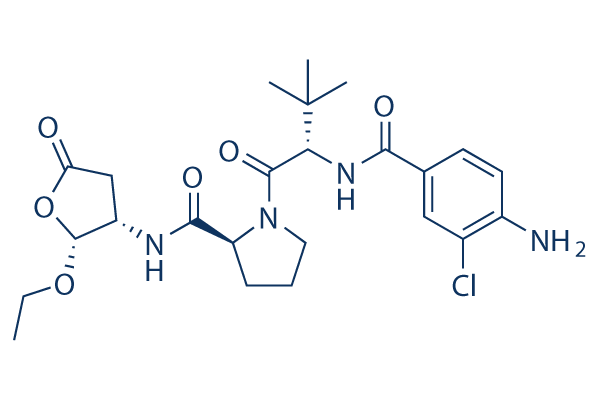
Estructura química
Peso molecular: 509
Control de calidad
| Dianas relacionadas | Bcl-2 PD-1/PD-L1 Ferroptosis p53 Apoptosis related Synthetic Lethality STAT TNF-alpha Ras KRas |
|---|---|
| Otros Caspase Inhibidores | Emricasan (IDN-6556) Z-VAD-FMK Q-VD-Oph Z-DEVD-FMK Z-IETD-FMK Ac-DEVD-CHO Z-LEHD-FMK TFA Z-VAD(OH)-FMK PAC-1 Z-YVAD-FMK |
Información química, almacenamiento y estabilidad
| Peso molecular | 509 | Fórmula | C24H33ClN4O6 |
Almacenamiento (Desde la fecha de recepción) | |
|---|---|---|---|---|---|
| Nº CAS | 273404-37-8 | Descargar SDF | Almacenamiento de soluciones madre |
|
|
| Sinónimos | N/A | Smiles | CCOC1C(CC(=O)O1)NC(=O)C2CCCN2C(=O)C(C(C)(C)C)NC(=O)C3=CC(=C(C=C3)N)Cl | ||
Solubilidad
|
In vitro |
DMSO
: 100 mg/mL
(196.46 mM)
Ethanol : 100 mg/mL Water : Insoluble |
Calculadora de Molaridad
|
In vivo |
|||||
Calculadora de formulación in vivo (Solución clara)
Paso 1: Introduzca la información a continuación (Recomendado: Un animal adicional para tener en cuenta la pérdida durante el experimento)
Paso 2: Introduzca la formulación in vivo (Esto es solo la calculadora, no la formulación. Por favor, contáctenos primero si no hay una formulación in vivo en la sección de Solubilidad.)
Resultados del cálculo:
Concentración de trabajo: mg/ml;
Método para preparar el líquido maestro de DMSO: mg fármaco predissuelto en μL DMSO ( Concentración del líquido maestro mg/mL, Por favor, contáctenos primero si la concentración excede la solubilidad del DMSO del lote del fármaco. )
Método para preparar la formulación in vivo: Tomar μL DMSO líquido maestro, luego añadirμL PEG300, mezclar y clarificar, luego añadirμL Tween 80, mezclar y clarificar, luego añadir μL ddH2O, mezclar y clarificar.
Método para preparar la formulación in vivo: Tomar μL DMSO líquido maestro, luego añadir μL Aceite de maíz, mezclar y clarificar.
Nota: 1. Por favor, asegúrese de que el líquido esté claro antes de añadir el siguiente disolvente.
2. Asegúrese de añadir el (los) disolvente(s) en orden. Debe asegurarse de que la solución obtenida, en la adición anterior, sea una solución clara antes de proceder a añadir el siguiente disolvente. Se pueden utilizar métodos físicos como el vórtice, el ultrasonido o el baño de agua caliente para ayudar a la disolución.
Mecanismo de acción
| Características |
A potent and selective inhibitor of interleukin-converting enzyme/caspase-1.
|
|---|---|
| Targets/IC50/Ki |
Caspase-4
(Cell-free assay) <0.6 nM(Ki)
Caspase-1
(Cell-free assay) 0.8 nM(Ki)
|
| In vitro |
Belnacasan (VX-765) es un profármaco de VRT-043198 que se absorbe por vía oral y que exhibe una potente inhibición contra ICE/caspase-1 y caspase-4 con una Ki de 0,8 nM y menos de 0,6 nM, respectivamente. Este compuesto también inhibe la liberación de IL-1β de PBMCs y sangre total con una IC50 de 0,67 μM y 1,9 μM, respectivamente. |
| Ensayo de quinasa |
Ensayos enzimáticos de proteasas
|
|
La inhibición enzimática de Belnacasan (VX-765) se evalúa mediante el seguimiento de la velocidad de hidrólisis de un sustrato apropiado marcado con p-nitroanilina o aminometil cumarina (AMC) de la siguiente manera: ICE/caspase-1, suc-YVAD-p-nitroanilida; caspase-4, Ac-WEHD-AMC; caspase-6, Ac-VEID-AMC; caspase-3, -7, -8 y -9, Ac-DEVD-AMC; y granzima B, Ac-IEPD-AMC. Las enzimas y los sustratos se incuban en un tampón de reacción [10 mM Tris, pH 7,5, 0,1 % (p/v) CHAPS, 1 mM ditiotreitol y 5 % (v/v) dimetil sulfóxido] durante 10 minutos a 37 °C. Se añade glicerol al tampón al 8 % (v/v) para caspase-3, -6 y -9 y granzima B para mejorar la estabilidad de las enzimas. La velocidad de hidrólisis del sustrato se monitoriza utilizando un fluorómetro.
|
|
| In vivo |
En el modelo murino de artritis inducida por colágeno, Belnacasan (VX-765) (200 mg/kg) inhibe la producción de IL-1β inducida por LPS en aproximadamente un 60 %, y resulta en una reducción dosis-dependiente y estadísticamente significativa de las puntuaciones de inflamación y una protección eficaz contra los cambios articulares. In vivo, bloquea la epileptogénesis por kindling en ratas al prevenir el aumento de IL-1β en los astrocitos del prosencéfalo sin un efecto significativo en la duración de la postdescarga. En el modelo murino de convulsiones agudas, este compuesto (50 mg/kg-200 mg/kg) produce un efecto anticonvulsivo al retrasar el tiempo hasta el inicio de la primera convulsión y disminuir el número de convulsiones, así como su duración total en un promedio del 50 % y 64 %. En ratas adultas con epilepsia de ausencia genética (GAERS), después de la tercera inyección del fármaco, reduce significativamente la duración acumulada y el número de descargas de punta-onda (SWDs) en un 55 % en promedio al bloquear selectivamente la biosíntesis de IL-1β. |
Referencias |
|
Aplicaciones
| Métodos | Biomarcadores | Imágenes | PMID |
|---|---|---|---|
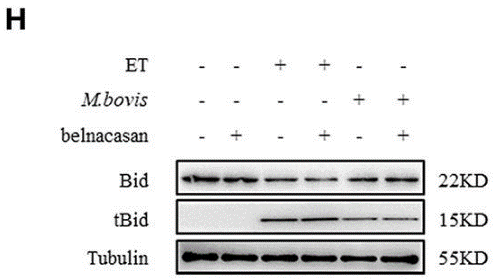
| Western blot | Bid / tBid / Tubulin Cyto c / Tubulin Bax / Bcl-2 / caspase-3 / caspase-1 / caspase-11 / GSDMD-N / GAPDH |
|
30846986 |
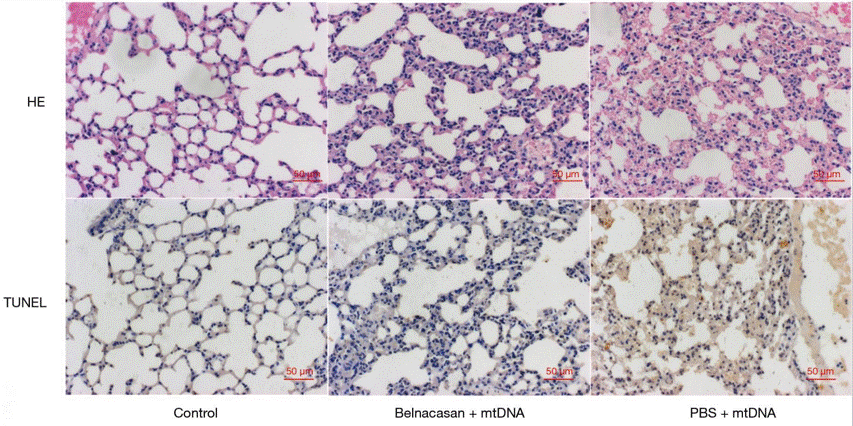
| IHC | HE staining / TUNEL |
|
31903272 |
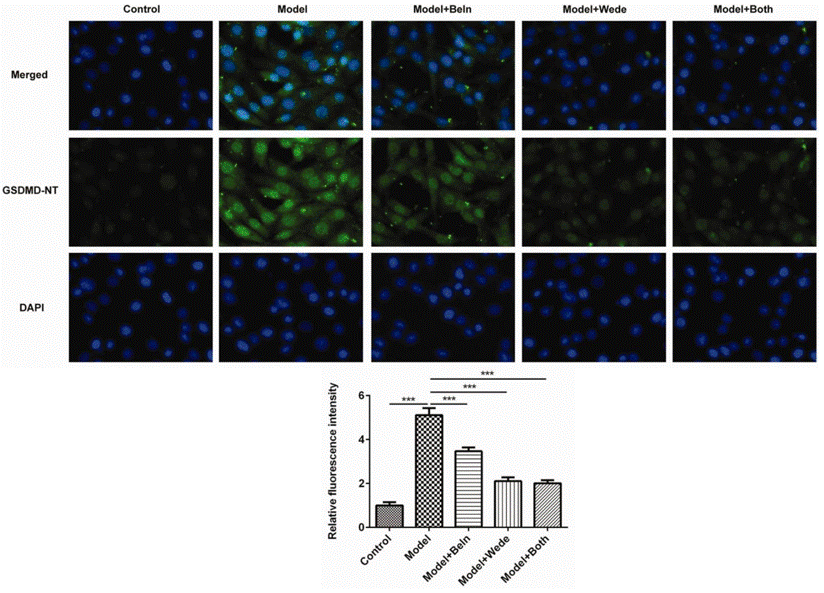
| Immunofluorescence | GSDMD-NT |
|
32865056 |
Información del ensayo clínico
(datos de https://clinicaltrials.gov, actualizado el 2024-05-22)
| Número NCT | Reclutamiento | Condiciones | Patrocinador/Colaboradores | Fecha de inicio | Fases |
|---|---|---|---|---|---|
| NCT01501383 | Terminated | Epilepsy |
Vertex Pharmaceuticals Incorporated |
December 2011 | Phase 2 |
Soporte técnico
Tel: +1-832-582-8158 Ext:3
Si tiene alguna otra consulta, por favor deje un mensaje.
Preguntas frecuentes
Pregunta 1:
The recommended dose is 100mg/kg p.o. in 25% cremophor EL in water. Is it directly soluble at 10mg/ml in 25% cremophor in water? How to formulate this compound for in vivo use in mice?
Respuesta:
You can prepare 25% cremophor EL in water first and then directly resuspend it in the vehicle. The powder may not be fully dissolved, but the suspension is stable and can be used for gavage feeding.

Los productos son solo para uso de investigación. No para uso humano. No vendemos a pacientes.
©Copyright 2013 Selleck Chemicals. Todos los derechos reservados.