
solo para uso en investigación
Dexrazoxane HCl Topoisomerase Inhibidor
Cat. No.: S1222
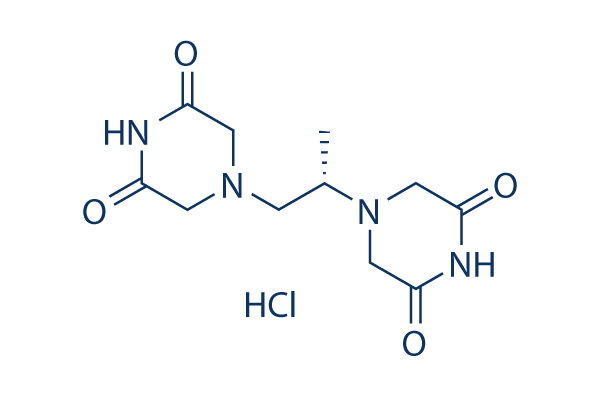
Estructura química
Peso molecular: 304.73
Control de calidad (Quality Control)
- Citado en Nature Medicine por su calidad de primer nivel
- COA
- Ficha técnica
- SDS
- Citado en Nature Medicine por su calidad de primer nivel
- COA
- NMR
- Ficha técnica
- SDS
- Citado en Nature Medicine por su calidad de primer nivel
- COA
- NMR
- Ficha técnica
- SDS
| Dianas relacionadas | HDAC PARP ATM/ATR DNA-PK WRN DNA/RNA Synthesis PPAR Sirtuin Casein Kinase eIF |
|---|---|
| Otros Topoisomerase Inhibidores | Camptothecin (CPT) Betulinic acid (S)-10-Hydroxycamptothecin Beta-Lapachone Ellagic acid Amonafide Voreloxin (SNS-595) hydrochloride Hydroxy Camptothecine Cu(II)-Elesclomol 7-Ethylcamptothecin |
Información química, almacenamiento y estabilidad (Chemical Information, Storage & Stability)
| Peso molecular | 304.73 | Fórmula | C11H16N4O4.HCl |
Almacenamiento (Desde la fecha de recepción) | 3 years -20°C powder (seal) |
|---|---|---|---|---|---|
| Nº CAS | 149003-01-0 | Descargar SDF | Almacenamiento de soluciones madre | Las soluciones son inestables. Preparar frescas o comprar tamaños pequeños preenvasados. Reenvasar al recibirlas. | |
| Sinónimos | ADR-529 HCl, ICRF-187 HCl | Smiles | CC(CN1CC(=O)NC(=O)C1)N2CC(=O)NC(=O)C2.Cl | ||
Solubilidad (Solubility)
|
In vitro |
DMSO
: 61 mg/mL
(200.17 mM)
Water : 61 mg/mL Ethanol : Insoluble |
Calculadora de Molaridad
|
In vivo |
|||||
Calculadora de formulación in vivo (Solución clara)
Paso 1: Introduzca la información a continuación (Recomendado: Un animal adicional para tener en cuenta la pérdida durante el experimento)
Paso 2: Introduzca la formulación in vivo (Esto es solo la calculadora, no la formulación. Por favor, contáctenos primero si no hay una formulación in vivo en la sección de Solubilidad.)
Resultados del cálculo:
Concentración de trabajo: mg/ml;
Método para preparar el líquido maestro de DMSO: mg fármaco predissuelto en μL DMSO ( Concentración del líquido maestro mg/mL, Por favor, contáctenos primero si la concentración excede la solubilidad del DMSO del lote del fármaco. )
Método para preparar la formulación in vivo: Tomar μL DMSO líquido maestro, luego añadirμL PEG300, mezclar y clarificar, luego añadirμL Tween 80, mezclar y clarificar, luego añadir μL ddH2O, mezclar y clarificar.
Método para preparar la formulación in vivo: Tomar μL DMSO líquido maestro, luego añadir μL Aceite de maíz, mezclar y clarificar.
Nota: 1. Por favor, asegúrese de que el líquido esté claro antes de añadir el siguiente disolvente.
2. Asegúrese de añadir el (los) disolvente(s) en orden. Debe asegurarse de que la solución obtenida, en la adición anterior, sea una solución clara antes de proceder a añadir el siguiente disolvente. Se pueden utilizar métodos físicos como el vórtice, el ultrasonido o el baño de agua caliente para ayudar a la disolución.
Mecanismo de acción (Mechanism of Action)
| Targets/IC50/Ki |
Topo II
(Cell-free assay) |
|---|---|
| In vitro |
Dexrazoxane (10 mM), known clinically to limit anthracycline cardiac toxicity, prevents daunorubicin-induced myocyte apoptosis, but not necrosis induced by higher anthracycline concentrations in rat cardiac myocytes. Dexrazoxane presumably exerts its cardioprotective effects by either binding free or loosely bound iron, or iron complexed to doxorubicin, thus preventing or reducing site-specific oxygen radical production that damages cellular components. Dexrazoxane specifically abolishes the DNA damage signal gamma-H2AX induced by doxorubicin, but not camptothecin or hydrogen peroxide, in H9C2 cardiomyocytes. Dexrazoxane also induces rapid degradation of Top2beta, which paralleles the reduction of doxorubicin-induced DNA damage. Dexrazoxane antagonizes doxorubicin-induced DNA damage through its interference with Top2beta, which could implicate Top2beta in doxorubicin cardiotoxicity. Dexrazoxane is hydrolyzed to its active form intracellularly and binds iron to prevent the formation of superhydroxide radicals, thus preventing mitochondrial destruction. |
| In vivo |
Dexrazoxane combined with doxorubicin, daunorubicin, or idarubicin reduces the tissue lesions in B6D2F1 mice (expressed as area under the curve of wound size times duration) by 96%, 70%, and 87%, respectively. Dexrazoxane combined with doxorubicin, daunorubicin, or idarubicin results in a statistically significant reduction in the fraction of mice with wounds as well as the duration of wounds. |
Referencias |
|
Aplicaciones (Applications)
| Métodos | Biomarcadores | Imágenes | PMID |
|---|---|---|---|
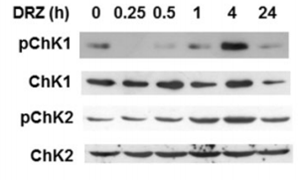
| Western blot | p-Chk1 / Chk1 / p-Chk2 / ChK2 ATF3 / TOP2A TOPOIIα / TOPOIIβ / TOPO I / PABP2 |
|
25521189 |
Información del ensayo clínico (Clinical Trial Information)
(datos de https://clinicaltrials.gov, actualizado el 2026-07-27)
| Número NCT | Reclutamiento | Condiciones | Patrocinador/Colaboradores | Fecha de inicio | Fases |
|---|---|---|---|---|---|
| NCT07654426 | RECRUITING | Diffuse Large B-cell Lymphoma (DLBCL); Cardiotoxicity; Lymphoma |
Beth Israel Deaconess Medical Center |
2026-08-31 | PHASE2 |
| NCT03126916 | RECRUITING | Ganglioneuroblastoma; Ganglioneuroblastoma, Nodular; Neuroblastoma |
Children's Oncology Group |
2018-05-14 | PHASE3 |
| NCT04293562 | RECRUITING | Acute Myeloid Leukemia |
Children's Oncology Group |
2020-07-21 | PHASE3 |
| NCT06647953 | RECRUITING | Pleuropulmonary Blastoma |
Children's Oncology Group |
2025-03-21 | PHASE3 |
| NCT06220032 | RECRUITING | DLBCL - Diffuse Large B Cell Lymphoma |
Stichting Hemato-Oncologie voor Volwassenen Nederland |
2024-08-15 | PHASE3 |
| NCT05292664 | RECRUITING | Myelodysplastic Syndromes, de Novo; Myelodysplastic Syndromes, Secondary; Myelodysplastic Syndromes, Previously Treated; Treatment-Related Acute Myeloid Leukemia; Therapy-Related Myelodysplastic Syndrome; Acute Lymphoblastic Leukemia, in Relapse; Acute Lymphoblastic Leukemia With Failed Remission; Lymphoblastic Lymphoma, in Relapse; Lymphoblastic Lymphoma, Refractory; Acute Leukemia of Ambiguous Lineage in Relapse; Acute Leukemia of Ambiguous Lineage |
Andrew E. Place, MD |
2023-03-29 | PHASE1 |

Los productos son solo para uso de investigación. No para uso humano. No vendemos a pacientes.
©Copyright 2013 Selleck Chemicals. Todos los derechos reservados.