
solo para uso en investigación
URB597 FAAH inhibidor
Cat. No.S2631
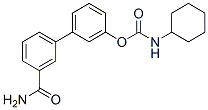
Estructura química
Peso molecular: 338.4
Control de calidad
- Citado en Nature Medicine por su máxima calidad
- COA
- NMR
- HPLC
- SDS
- Hoja de datos
| Dianas relacionadas | Dehydrogenase HSP Transferase P450 (e.g. CYP17) PDE phosphatase PPAR Vitamin Carbohydrate Metabolism Mitochondrial Metabolism |
|---|---|
| Otros FAAH Inhibidores | Biochanin A PF-3845 PF-04457845 JNJ-42165279 JNJ-1661010 LY-2183240 FAAH-IN-2 BIA 10-2474 JZL195 URB937 |
Información química, almacenamiento y estabilidad
| Peso molecular | 338.4 | Fórmula | C20H22N2O3 |
Almacenamiento (Desde la fecha de recepción) | |
|---|---|---|---|---|---|
| Nº CAS | 546141-08-6 | Descargar SDF | Almacenamiento de soluciones madre |
|
|
| Sinónimos | KDS-4103 | Smiles | C1CCC(CC1)NC(=O)OC2=CC=CC(=C2)C3=CC(=CC=C3)C(=O)N | ||
Solubilidad
|
In vitro |
DMSO
: 68 mg/mL
(200.94 mM)
Ethanol : 4 mg/mL Water : Insoluble |
Calculadora de Molaridad
|
In vivo |
|||||
Calculadora de formulación in vivo (Solución clara)
Paso 1: Introduzca la información a continuación (Recomendado: Un animal adicional para tener en cuenta la pérdida durante el experimento)
Paso 2: Introduzca la formulación in vivo (Esto es solo la calculadora, no la formulación. Por favor, contáctenos primero si no hay una formulación in vivo en la sección de Solubilidad.)
Resultados del cálculo:
Concentración de trabajo: mg/ml;
Método para preparar el líquido maestro de DMSO: mg fármaco predissuelto en μL DMSO ( Concentración del líquido maestro mg/mL, Por favor, contáctenos primero si la concentración excede la solubilidad del DMSO del lote del fármaco. )
Método para preparar la formulación in vivo: Tomar μL DMSO líquido maestro, luego añadirμL PEG300, mezclar y clarificar, luego añadirμL Tween 80, mezclar y clarificar, luego añadir μL ddH2O, mezclar y clarificar.
Método para preparar la formulación in vivo: Tomar μL DMSO líquido maestro, luego añadir μL Aceite de maíz, mezclar y clarificar.
Nota: 1. Por favor, asegúrese de que el líquido esté claro antes de añadir el siguiente disolvente.
2. Asegúrese de añadir el (los) disolvente(s) en orden. Debe asegurarse de que la solución obtenida, en la adición anterior, sea una solución clara antes de proceder a añadir el siguiente disolvente. Se pueden utilizar métodos físicos como el vórtice, el ultrasonido o el baño de agua caliente para ayudar a la disolución.
Mecanismo de acción
| Targets/IC50/Ki |
FAAH
4.6 nM
|
|---|---|
| In vitro |
URB597 se une en el bolsillo hidrofóbico y el núcleo catalítico de FAAH que conecta los residuos del sitio activo con la superficie de la membrana de FAAH. Este compuesto inhibe la actividad de FAAH en microsomas de hígado humano con una IC50 de 3 nM. Reduce la expresión de las enzimas inducidas por LPS, ciclooxigenasa 2 (COX-2) y óxido nítrico sintasa inducible (iNOS; NOS2) en células microgliales primarias de rata, con una reducción concomitante en la liberación de los mediadores inflamatorios prostaglandina E2 (PGE2) y (NO) óxido nítrico. Esta sustancia química provoca la entrada de Ca2+ en células HEK293-F que expresan transitoriamente el gen TRPA1 humano o de rata. También activa la entrada de Ca2+ en neuronas DRG de rata que expresan nativamente los canales TRPA1.
|
| In vivo |
URB597 inhibe la hidrólisis de [3H]anandamida en membranas cerebrales de rata con un aumento paralelo en el contenido de anandamida, OEA y PEA cerebral por inhibición de FAAH. Este compuesto potencia el efecto de hipotermia inducido por etanolamida al inhibir FAAH. Cuando se administra por vía intraperitoneal (0,3 mg/kg) reduce la alodinia y la hiperalgesia a través de la analgesia mediada por los receptores cannabinoides CB1 y CB2 en ratas con dolor inflamatorio. Este químico reduce la disminución del aumento de peso corporal y la ingesta de sacarosa inducida por el estrés crónico leve en ratas a través de la inhibición de la actividad de FAAH cerebral. Podría revertir la mayoría de los síntomas depresivos inducidos por la exposición adolescente al THC en ratas hembra.
|
Referencias |
|
Soporte técnico
Tel: +1-832-582-8158 Ext:3
Si tiene alguna otra consulta, por favor deje un mensaje.

Los productos son solo para uso de investigación. No para uso humano. No vendemos a pacientes.
©Copyright 2013 Selleck Chemicals. Todos los derechos reservados.