
solo para uso en investigación
Selisistat (EX-527) inhibidor de SIRT1
Cat. No.: S1541
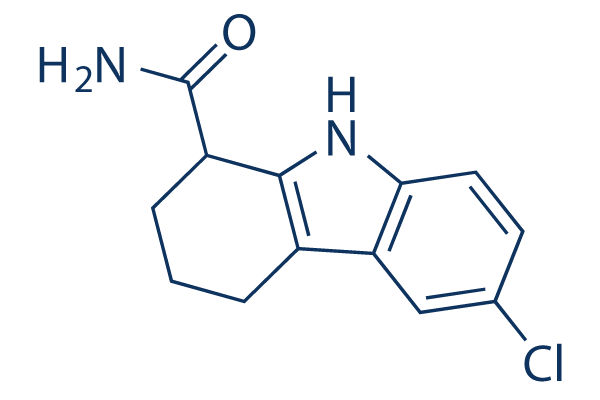
Estructura química
Peso molecular: 248.71
Control de calidad (Quality Control)
| Dianas relacionadas | HDAC JAK BET Histone Methyltransferase PKC PARP HIF PRMT EZH2 AMPK |
|---|---|
| Otros Sirtuin Inhibidores | SRT 1720 Hydrochloride Sirtinol Fisetin 3-TYP AGK2 SRT2104 (GSK2245840) OSS_128167 SirReal2 SRT2183 Thiomyristoyl |
Cultivo celular, tratamiento y concentración de trabajo
(Cell Culture, Treatment & Working Concentration)
| Líneas celulares | Tipo de ensayo | Concentración | Tiempo de incubación | Formulación | Descripción de la actividad | PMID |
|---|---|---|---|---|---|---|
| Platelets | Apoptosis Assay | 10/50 μM | 10 min | DMSO | increases ROS level in a dose-dependent manner | 25829495 |
| HEK 293 | Growth Inhibition Assay | 24 h | IC50=97.7 ± 8.1 μM | 24998427 | ||
| HeLa | Growth Inhibition Assay | 24 h | IC50=37.9 ± 1.8 μM | 24998427 | ||
| HEK 293 | Growth Inhibition Assay | 48 h | IC50=69.0 ± 0.7 μM | 24998427 | ||
| HeLa | Growth Inhibition Assay | 48 h | IC50=8.9 ± 1.9 μM | 24998427 | ||
| RMECs | Apoptosis Assay | 10 μM | 24 h | attenuates the anti-apoptotic effect of Des-G | 24486147 | |
| HUVECs | Apoptosis Assay | 10 μM | 24 h | bolishes the protective effect of resveratrol in cell viability | 23358928 | |
| K562 | Function Assay | 0.1-1 μM | 2 h | stimulates Nrf2-dependent gene transcription | 21196497 | |
| INS-1E | Function Assay | 1 μm | 24 h | prevents resveratrol-induced up-regulation of Glut2, glucokinase,Pdx-1, and Tfam | 21163946 | |
| MCF-7 | Growth Inhibition Assay | 0-100 μM | 24/48/72 h | DMSO | represses cell proliferation at the concentration ≥100 μM | 20371709 |
| NCI-H460 | Function Assay | 1 μm | 6 h | DMSO | produces a concentration-dependent increase in the amount of acetylated p53 | 16354677 |
| 293T | Function assay | Inhibition of human recombinant GST-tagged SIRT1 expressed in 293T cells by Fluor de Lys fluorescence assay, IC50 = 0.038 μM. | 21306906 | |||
| Escherichia coli cells | Function assay | Inhibition of human recombinant SIRT1 expressed in Escherichia coli cells using acetylated Lys side chain amino acids 379-382 (Arg-His-Lys-Lys(Ac)) p53 conjugated with aminomethylcoumarin as substrate by fluorescence assay, IC50 = 0.16 μM. | 22931526 | |||
| BL21 (DE3) | Function assay | Inhibition of full length human SIRT1 expressed in Escherichia coli BL21 (DE3) cells using fluorogenic 7-amino-4-methylcoumarin (AMC)-labeled peptide by fluorescence assay, IC50 = 0.21 μM. | 25275824 | |||
| Namalwa cells | Function assay | 3 hrs | Inhibition of SIRT1-mediated endogenous p53 deacetylase activity in human Namalwa cells assessed as concentration required to enhance p53 deacetylation to twice the basal level after 3 hrs by ELISA, INH = 0.6 μM. | 25971769 | ||
| BL21 (DE3) | Function assay | Inhibition of full length human SIRT2 expressed in Escherichia coli BL21 (DE3) cells using fluorogenic 7-amino-4-methylcoumarin (AMC)-labeled peptide by fluorescence assay, IC50 = 1.94 μM. | 25275824 | |||
| Escherichia coli cells | Function assay | Inhibition of human recombinant SIRT2 expressed in Escherichia coli cells using acetylated Lys side chain amino acids 379-382 (Arg-His-Lys-Lys(Ac)) p53 conjugated with aminomethylcoumarin as substrate by fluorescence assay, IC50 = 48.5 μM. | 22931526 | |||
| A673 | qHTS assay | qHTS of pediatric cancer cell lines to identify multiple opportunities for drug repurposing: Primary screen for A673 cells | 29435139 | |||
| SK-N-MC | qHTS assay | qHTS of pediatric cancer cell lines to identify multiple opportunities for drug repurposing: Primary screen for SK-N-MC cells | 29435139 | |||
| Hs683 | Cell cycle assay | 24 to 48 hrs | Cell cycle arrest in human Hs683 cells assessed as accumulation at G1 phase at IC50 after 24 to 48 hrs by propidium iodide staining-based flow cytometry | 28475330 | ||
| HCT116 | Function assay | 10 uM | 8 hrs | Inhibition of SIRT1 in human HCT116 cells assessed as increase in acetylated p53 at 10 uM after 8 hrs by Western blot analysis | 22642300 | |
| NCI-H460 | Function assay | 6 hrs | Inhibition of SIRT-2 in human NCI-H460 cells assessed as inhibition of p53 deacetylation after 6 hrs by immunoprecipitation/immunoblotting analysis, IC50 = 1 μM. | ChEMBL | ||
| Haga clic para ver más datos experimentales de líneas celulares | ||||||
Información química, almacenamiento y estabilidad (Chemical Information, Storage & Stability)
| Peso molecular | 248.71 | Fórmula | C13H13ClN2O |
Almacenamiento (Desde la fecha de recepción) | |
|---|---|---|---|---|---|
| Nº CAS | 49843-98-3 | Descargar SDF | Almacenamiento de soluciones madre |
|
|
| Sinónimos | SEN0014196 | Smiles | C1CC(C2=C(C1)C3=C(N2)C=CC(=C3)Cl)C(=O)N | ||
Solubilidad (Solubility)
|
In vitro |
DMSO
: 300 mg/mL
(1206.22 mM)
Ethanol : 30 mg/mL Water : Insoluble |
Calculadora de Molaridad
|
In vivo |
|||||
Calculadora de formulación in vivo (Solución clara)
Paso 1: Introduzca la información a continuación (Recomendado: Un animal adicional para tener en cuenta la pérdida durante el experimento)
Paso 2: Introduzca la formulación in vivo (Esto es solo la calculadora, no la formulación. Por favor, contáctenos primero si no hay una formulación in vivo en la sección de Solubilidad.)
Resultados del cálculo:
Concentración de trabajo: mg/ml;
Método para preparar el líquido maestro de DMSO: mg fármaco predissuelto en μL DMSO ( Concentración del líquido maestro mg/mL, Por favor, contáctenos primero si la concentración excede la solubilidad del DMSO del lote del fármaco. )
Método para preparar la formulación in vivo: Tomar μL DMSO líquido maestro, luego añadirμL PEG300, mezclar y clarificar, luego añadirμL Tween 80, mezclar y clarificar, luego añadir μL ddH2O, mezclar y clarificar.
Método para preparar la formulación in vivo: Tomar μL DMSO líquido maestro, luego añadir μL Aceite de maíz, mezclar y clarificar.
Nota: 1. Por favor, asegúrese de que el líquido esté claro antes de añadir el siguiente disolvente.
2. Asegúrese de añadir el (los) disolvente(s) en orden. Debe asegurarse de que la solución obtenida, en la adición anterior, sea una solución clara antes de proceder a añadir el siguiente disolvente. Se pueden utilizar métodos físicos como el vórtice, el ultrasonido o el baño de agua caliente para ayudar a la disolución.
Mecanismo de acción (Mechanism of Action)
| Características |
Greater potency, specificity, stability, and lower toxicity than other inhibitors of SIRT1 catalytic activity identified to date.
|
|---|---|
| Targets/IC50/Ki |
SIRT1
(Cell-free assay) 38 nM
|
| In vitro |
Selisistat (EX 527) exhibits a potently inhibitory effect against SIRT1 deacetylase activity in a concentration-dependent manner with an IC50 of 38 nM, and displays much lower activity against SIRT2 and SIRT3 with IC50 values of 19.6 μM and 48.7 μM, respectively. It does not inhibit SIRT4-7 and class I/II HDAC activity at concentrations up to 100 μM. This compound alone (1 μM) has no detectable effect on the acetylation of p53 lysine 382 in NCI-H460 cells, but significantly increases the amount of acetylated p53 in NCI-H460 cells, human mammary epithelial cells, U-2 OS and MCF-7 cells subjected to genotoxic agents Hydrogen peroxide, which is more effective than that caused by Nicotinamide (5 mM). Surprisingly, it does not result in detectable effects on p53-controled gene expression, cell survival, or cell proliferation. It causes a 90% increase in cell number of HCT116 cells after 7 days in the condition of 0.1% serum but not 10% serum, suggesting that SIRT1 is a significant regulator of cell proliferation during growth factor deprivation conditions. Additionally, it abrogates resveratrol effects on glucose responses, and prevents resveratrol-induced up-regulation of Glut2, glucokinase, Pdx-1, and Tfam in INS-1E Cells, due to the opposite effect of EX 527 and resveratrol on SIRT1 deacetylase activity. |
| Ensayo de quinasa |
Inhibición de la actividad desacetilasa de GST-SIRT1
|
|
Las células 293T se transfectan transitoriamente con SIRT1 humano marcado con GST en el vector pDEST27 Gateway usando FuGENE-6. Después de 48 horas, las células se lisan con 50 mM Tris, pH 8,0, 120 mM NaCl, 1 mM EDTA y 0,5 % de Nonidet P-40, suplementado con tabletas de cóctel de inhibidores de proteasa Complete Mini. La GST-SIRT1 se purifica de los lisados y se lava extensamente en el tampón anterior. El ensayo de desacetilación se realiza con aproximadamente 30 ng de GST-SIRT1 en presencia de Selisistat (EX 527) (48 pM a 100 μM). La desacetilación se mide usando el kit Fluor de Lys empleando un péptido fluorogénico que abarca los residuos 379 a 382 de p53, acetilado en la lisina 382. El residuo de lisina acetilado se acopla a una porción de aminometilcumarina. El péptido es desacetilado por SIRT1, seguido de la adición de un revelador proteolítico que libera la aminometilcumarina fluorescente. Brevemente, las preparaciones enzimáticas se incuban con 170 μM de NAD+ y 100 μM de péptido fluorogénico p53 durante 45 minutos a 37 °C, seguido de incubación en el revelador durante 15 minutos a 37 °C. La fluorescencia se mide por excitación a 360 nm y emisión a 460 nm y la actividad enzimática se expresa en unidades de fluorescencia relativa.
|
|
| In vivo |
Administration of Selisistat (EX 527; ~10 μg) to rats increases hypothalamic acetyl-p53 levels by inhibiting hypothalamic SIRT1 activity. Co-administration of this compound with ghrelin markedly blunts the orexigenic action of ghrelin by decreasing the pAMPK levels, increasing the ACC levels, and abolishing the higher expression of the transcription factors FoxO1, pCREB, and Bsx and the neuropeptides NPY and AgRP in the hypothalamic arcuate nucleus. |
Referencias |
|
Aplicaciones (Applications)
| Métodos | Biomarcadores | Imágenes | PMID |
|---|---|---|---|
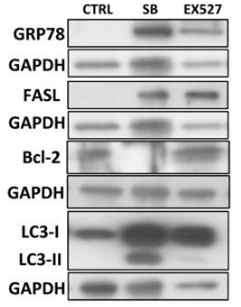
| Western blot | GRP78 / FASL / Bcl-2 / LC3 Ac-H3K9 / Fibronectin / Collagen 1 / α-SMA PCNA / Cyclin D1 / Cyclin E pEGFR / EGFR / pPDGFRβ / PDGFRβ pSTAT3 / STAT3 p27 FOXO3a / SIRT1 / Ac-p53 / p16(INK4a) |
|
29312612 |
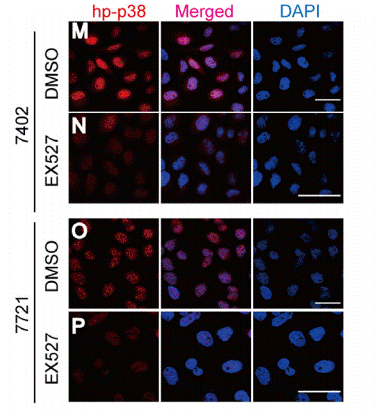
| Immunofluorescence | p-p38 |
|
26824501 |
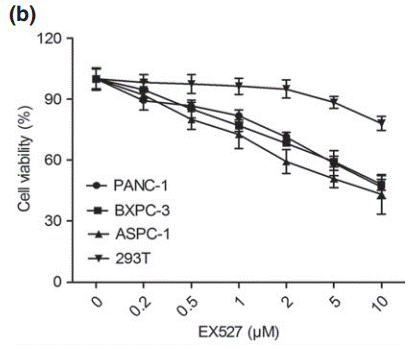
| Growth inhibition assay | Cell viability |
|
24484175 |
Información del ensayo clínico (Clinical Trial Information)
(datos de https://clinicaltrials.gov, actualizado el 2021-11-17)
| Número NCT | Reclutamiento | Condiciones | Patrocinador/Colaboradores | Fecha de inicio | Fases |
|---|---|---|---|---|---|
| NCT04184323 | WITHDRAWN | Endometriosis; Uterine Diseases; Endometrial Diseases; Infertility Unexplained; Infertility; Female, Nonimplantation |
Wake Forest University Health Sciences |
2022-01 | PHASE2 |
| NCT01485965 | Completed | Huntington''s Disease |
Siena Biotech S.p.A. |
2011-11 | Phase 1 |
| NCT01521832 | Completed | Huntington''s Disease |
Siena Biotech S.p.A. |
2009-10 | Phase 1 |
Preguntas frecuentes (Frequently Asked Questions)
Pregunta 1:
what is the extinction coefficient of it?
Respuesta:
Its extinction coefficient is 1421.650635.

Los productos son solo para uso de investigación. No para uso humano. No vendemos a pacientes.
©Copyright 2013 Selleck Chemicals. Todos los derechos reservados.