
solo para uso en investigación
Dacomitinib EGFR inhibidor
Cat. No.S2727
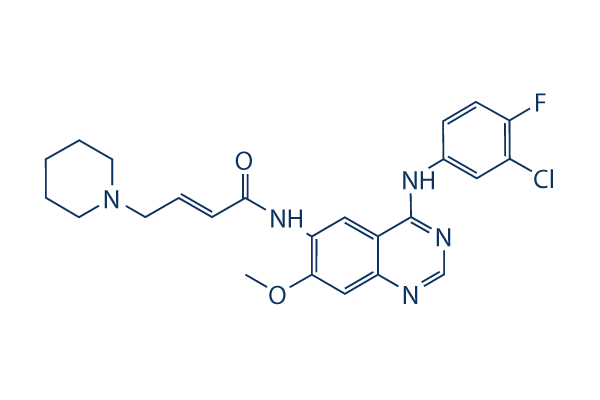
Estructura química
Peso molecular: 469.94
Control de calidad
| Dianas relacionadas | VEGFR PDGFR FGFR c-Met Src MEK CSF-1R FLT3 HER2 c-Kit |
|---|---|
| Otros EGFR Inhibidores | Lazertinib (YH25448) Icotinib Hydrochloride Sunvozertinib AG-490 AG-1478 Canertinib (CI-1033) WZ4002 Rociletinib (CO-1686) Poziotinib (NOV120101, HM781-36B) Genistein |
Cultivo celular, tratamiento y concentración de trabajo
| Líneas celulares | Tipo de ensayo | Concentración | Tiempo de incubación | Formulación | Descripción de la actividad | PMID |
|---|---|---|---|---|---|---|
| PC9 cells | Function assay | 2 h | Inhibition of EGFR exon 19 deletion activating mutant phosphorylation in human PC9 cells after 2 hrs by fluorescence assay, IC50=0.63 nM | 23930994 | ||
| human LoVo cells | Function assay | 2 h | Inhibition of wild type EGFR phosphorylation in human LoVo cells after 2 hrs by fluorescence assay, IC50=0.011 μM | 23930994 | ||
| human NCI-H1975 cells | Function assay | 2 h | Inhibition of EGFR L858R/T970M double mutant phosphorylation in human NCI-H1975 cells after 2 hrs by fluorescence assay, IC50=0.042 μM | 23930994 | ||
| human NCI-H1975 cells | Proliferation assay | Antiproliferative activity against human NCI-H1975 cells assessed as growth inhibition, GI50=0.1233 μM | 26310890 | |||
| Sf9 | Function assay | 6 mins | Irreversible inhibition of GST-tagged ERBB1 (unknown origin) (Met-668 to Ala-1211 residues) expressed in baculovirus infected Sf9 insect cells assessed as reduction in Glu/Tyr copolymer phosphorylation after 6 mins by ELISA, IC50 = 0.006 μM. | 27491023 | ||
| NIH/3T3 | Function assay | 2 hrs | Irreversible inhibition of full length human ERBB1 autophosphorylation transfected in EGF-stimulated mouse NIH/3T3 cells incubated for 2 hrs followed by stimulation with EGF for 10 mins, IC50 = 0.006 μM. | 27491023 | ||
| Sf9 | Function assay | 6 mins | Irreversible inhibition of GST-tagged ERBB2 (unknown origin) (Ile-675 to Val-1256 residues) expressed in baculovirus infected Sf9 insect cells assessed as reduction in Glu/Tyr copolymer phosphorylation after 6 mins by ELISA, IC50 = 0.046 μM. | 27491023 | ||
| Sf9 | Function assay | 6 mins | Irreversible inhibition of GST-tagged ERBB4 (unknown origin) (Gly-259 to Gly-690 residues) expressed in baculovirus infected Sf9 insect cells assessed as reduction in Glu/Tyr copolymer phosphorylation after 6 mins by ELISA, IC50 = 0.074 μM. | 27491023 | ||
| Sf9 | Function assay | 30 mins | Irreversible inhibition of human recombinant GST-tagged JAK3 expressed in baculovirus infected Sf9 insect cells assessed as reduction in polyglutamic acid-tyrosine phosphorylation after 30 mins by ELISA, IC50 = 3.57 μM. | 27491023 | ||
| NIH/3T3 | Function assay | 30 mg/kg | 2 days | In vivo inhibition of full length human ERBB1 autophosphorylation transfected in NIH/3T3 cells implanted in mouse at 30 mg/kg, po qd for 2 days measured 24 hrs post last dose by Western blot analysis | 27491023 | |
| insect cells | Function assay | Inhibition of GST-tagged human EGFR catalytic domain expressed in insect cells, IC50 = 0.006 μM. | 28754471 | |||
| NCI-H1819 | Antiproliferative assay | 72 hrs | Antiproliferative activity against human NCI-H1819 cells expressing wild type HER2 incubated for 72 hrs by MTS assay, IC50 = 0.029 μM. | 28754471 | ||
| insect cells | Function assay | Inhibition of GST-tagged human HER2 catalytic domain expressed in insect cells, IC50 = 0.0457 μM. | 28754471 | |||
| NCI-H1975 | Antiproliferative assay | 72 hrs | Antiproliferative activity against human NCI-H1975 cells expressing EGFR T790M/L858R mutant incubated for 72 hrs by MTS assay, IC50 = 0.44 μM. | 28754471 | ||
| Haga clic para ver más datos experimentales de líneas celulares | ||||||
Información química, almacenamiento y estabilidad
| Peso molecular | 469.94 | Fórmula | C24H25ClFN5O2 |
Almacenamiento (Desde la fecha de recepción) | |
|---|---|---|---|---|---|
| Nº CAS | 1110813-31-4 | Descargar SDF | Almacenamiento de soluciones madre |
|
|
| Sinónimos | PF299804,PF299 | Smiles | COC1=C(C=C2C(=C1)N=CN=C2NC3=CC(=C(C=C3)F)Cl)NC(=O)C=CCN4CCCCC4 | ||
Solubilidad
|
In vitro |
DMSO
: 49 mg/mL
(104.26 mM)
Ethanol : 15 mg/mL Water : Insoluble |
Calculadora de Molaridad
|
In vivo |
|||||
Calculadora de formulación in vivo (Solución clara)
Paso 1: Introduzca la información a continuación (Recomendado: Un animal adicional para tener en cuenta la pérdida durante el experimento)
Paso 2: Introduzca la formulación in vivo (Esto es solo la calculadora, no la formulación. Por favor, contáctenos primero si no hay una formulación in vivo en la sección de Solubilidad.)
Resultados del cálculo:
Concentración de trabajo: mg/ml;
Método para preparar el líquido maestro de DMSO: mg fármaco predissuelto en μL DMSO ( Concentración del líquido maestro mg/mL, Por favor, contáctenos primero si la concentración excede la solubilidad del DMSO del lote del fármaco. )
Método para preparar la formulación in vivo: Tomar μL DMSO líquido maestro, luego añadirμL PEG300, mezclar y clarificar, luego añadirμL Tween 80, mezclar y clarificar, luego añadir μL ddH2O, mezclar y clarificar.
Método para preparar la formulación in vivo: Tomar μL DMSO líquido maestro, luego añadir μL Aceite de maíz, mezclar y clarificar.
Nota: 1. Por favor, asegúrese de que el líquido esté claro antes de añadir el siguiente disolvente.
2. Asegúrese de añadir el (los) disolvente(s) en orden. Debe asegurarse de que la solución obtenida, en la adición anterior, sea una solución clara antes de proceder a añadir el siguiente disolvente. Se pueden utilizar métodos físicos como el vórtice, el ultrasonido o el baño de agua caliente para ayudar a la disolución.
Mecanismo de acción
| Targets/IC50/Ki |
EGFR
(Cell-free assay) 6.0 nM
ErbB2
(Cell-free assay) 45.7 nM
ErbB4
(Cell-free assay) 73.7 nM
|
|---|---|
| In vitro |
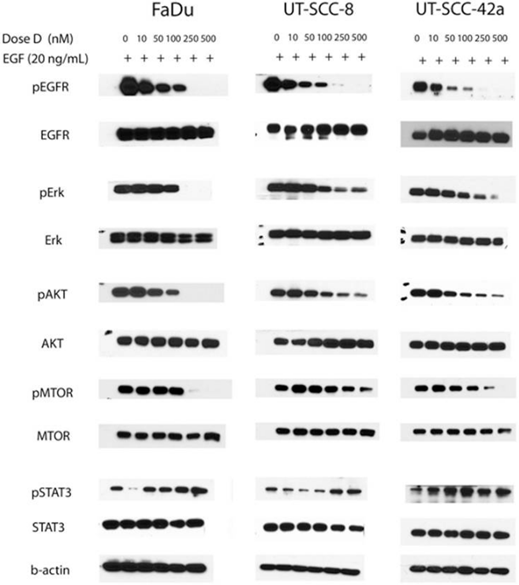
PF299804 es un inhibidor específico de la familia de quinasas ERBB. Este compuesto inhibe la señalización del EGFR e induce la apoptosis en la línea celular H3255 GR que contiene EGFR T790M. Es eficaz en líneas celulares de NSCLC sensibles y no sensibles. Este producto químico inhibe el crecimiento de células H3255 y HCC827 diseñadas para expresar EGFR T790M. Inhibe la fosforilación de EGFR en presencia de la mutación T790M. Se cree que este agente inhibe irreversiblemente la actividad de la tirosina quinasa ERBB mediante la unión al sitio de ATP y la modificación covalente de los residuos de cisteína nucleofílicos en los dominios catalíticos de los miembros de la familia ERBB. Muestra efectos significativos de inhibición del crecimiento en células de cáncer gástrico amplificadas para HER2 (SNU216, N87), y tiene valores de concentración inhibitoria del 50 % más bajos en comparación con otros inhibidores de la tirosina quinasa de EGFR, incluidos BIBW-2992 y CI-1033. Este inhibidor induce la apoptosis y la detención en G1 e inhibe la fosforilación de los receptores de la familia HER y las vías de señalización descendentes, incluidas STAT3, AKT y las quinasas reguladas por señales extracelulares (ERK) en células de cáncer gástrico amplificadas para HER2. También bloquea la formación de heterodímeros EGFR/HER2, HER2/HER3 y HER3/HER4, así como la asociación de HER3 con p85 α en células SNU216. Una investigación reciente utiliza cuarenta y siete líneas celulares de cáncer de mama humano y epiteliales mamarias inmortalizadas para evaluar los efectos de inhibición de este compuesto; los resultados indican que inhibe preferentemente el crecimiento de líneas celulares de cáncer de mama amplificadas para HER-2 en comparación con las líneas no amplificadas (RR = 3,39, p < 0,0001). Este producto químico reduce la fosforilación de HER2, EGFR, HER4, AKT y ERK en la mayoría de las líneas sensibles. Ejerce su efecto antiproliferativo a través de una detención combinada en G0/G1 y una inducción de apoptosis. |
| Ensayo de quinasa |
Ensayo de quinasa ERBB basado en ELISA
|
|
Las proteínas de fusión citoplasmáticas ERBB1, ERBB2 y ERBB4 se obtienen clonando la secuencia ERBB1 (Met-668 a Ala-1211), ERBB2 (Ile-675 a Val-1256) y ERBB4 (Gly-259 a Gly-690) en el vector baculoviral pFastBac mediante PCR. Las proteínas se expresan en células de insecto Sf9 infectadas con baculovirus como proteínas de fusión GST. Las proteínas se purifican por cromatografía de afinidad utilizando perlas de sefarosa de glutatión. La inhibición de la actividad de la tirosina quinasa ERBB se evalúa utilizando un ensayo de tirosina quinasa de receptor basado en ELISA. Las reacciones de quinasa (50 mM HEPES, pH 7,4, 125 mM NaCl, 10 mM MgCl2, 100 μM ortovanadato de sodio, 2 mM ditiotreitol, 20 μM ATP, este compuesto o control de vehículo, y 1-5 nM GST-erbB por 50 μL de mezcla de reacción) se realizan en placas de 96 pocillos recubiertas con 0,25 mg/mL de poli-Glu-Tyr. Las reacciones se incuban durante 6 minutos a temperatura ambiente mientras se agitan. Las reacciones de quinasa se detienen retirando la mezcla de reacción, y luego los pocillos se lavan con tampón de lavado (0,1 % Tween 20 en PBS). Los residuos de tirosina fosforilados se detectan añadiendo 0,2 μg/mL de anticuerpo antifosfotirosina (Oncogene Ab-4; 50 μL/pocillo) acoplado a peroxidasa de rábano picante (HRP) diluido en PBS que contiene 3 % de BSA y 0,05 % de Tween 20 durante 25 minutos mientras se agita a temperatura ambiente. El anticuerpo se retira y las placas se lavan en tampón de lavado. Se añade el sustrato HRP (SureBlue3,3
,5,5-tetrametilbencidina o TMB) (50 μL por pocillo) y se incuba durante 10-20 minutos mientras se agita a temperatura ambiente. La reacción de TMB se detiene con la adición de 50 μL de solución de parada (0,09 N H2SO4). La señal se cuantifica midiendo la absorbancia a 450 nm. Los valores de IC50 se determinan para este compuesto utilizando el método del efecto mediano.
|
|
| In vivo |
El PF299804 administrado por vía oral inhibe eficazmente el crecimiento de los xenoinjertos HCC827 Del/T790M. Una baja administración oral de este compuesto (15 mg/kg) provoca una actividad antitumoral significativa, incluyendo regresiones tumorales marcadas en una variedad de modelos de xenoinjertos tumorales humanos que expresan y/o sobreexpresan miembros de la familia ERBB o que contienen la doble mutación (L858R/T790M) en ERBB1 (EGFR). |
Referencias |
|
Aplicaciones
| Métodos | Biomarcadores | Imágenes | PMID |
|---|---|---|---|
| Western blot | pEGFR / EGFR / pERK / ERK / pAKT / AKT / p-mTOR / mTOR / pSTAT3 / STAT3 |
|
24853121 |
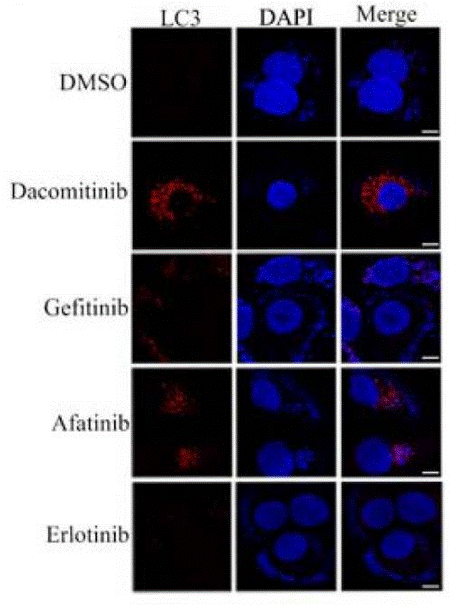
| Immunofluorescence | LC3 |
|
28366635 |
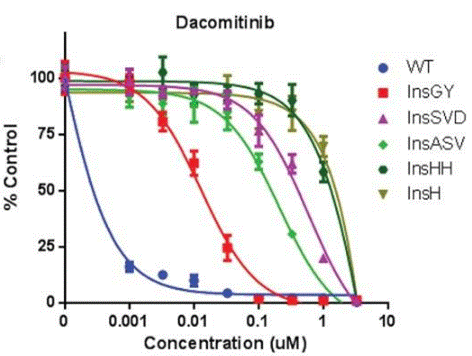
| Growth inhibition assay | Cell viability |
|
28363995 |
Información del ensayo clínico
(datos de https://clinicaltrials.gov, actualizado el 2024-05-22)
| Número NCT | Reclutamiento | Condiciones | Patrocinador/Colaboradores | Fecha de inicio | Fases |
|---|---|---|---|---|---|
| NCT06075615 | Not yet recruiting | Carcinoma Non-Small-Cell Lung |
Pfizer |
September 1 2024 | -- |
| NCT06321510 | Not yet recruiting | Lung Cancer |
Pfizer |
April 1 2024 | -- |
| NCT04609319 | Active not recruiting | Lung Cancer |
Pfizer |
January 23 2021 | -- |
| NCT03865446 | Completed | Severe Hepatic Impairment |
Pfizer |
April 5 2019 | Phase 1 |
| NCT02382796 | Completed | NSCLC |
Pfizer |
July 10 2015 | Phase 2 |
| NCT02268747 | Unknown status | Skin Squamous Cell Cancer |
Fondazione IRCCS Istituto Nazionale dei Tumori Milano |
November 2014 | Phase 2 |
Soporte técnico
Tel: +1-832-582-8158 Ext:3
Si tiene alguna otra consulta, por favor deje un mensaje.
Preguntas frecuentes
Pregunta 1:
I would like to know whether the in vivo formulation you recommend for it is suitable for oral administration?
Respuesta:
S2727 in 1% DMSO+30% polyethylene glycol+1% Tween 80 at 10mg/ml is a homogeneous suspension, and it was fine for oral gavage. When preparing the solution, please dissolve it in DMSO clearly first. If it dissolves not readily, please sonicate and warm it at about 45-50℃ for a while to help dissolving. Then add PEG 300 and Tween 80. After they mixed well, dilute with water. Then it will become a homogeneous suspension.

Los productos son solo para uso de investigación. No para uso humano. No vendemos a pacientes.
©Copyright 2013 Selleck Chemicals. Todos los derechos reservados.