
solo para uso en investigación
Novobiocin Sodium (Cathomycin, Albamycin) Inhibidor C-terminal de Hsp90
Cat. No.S2492
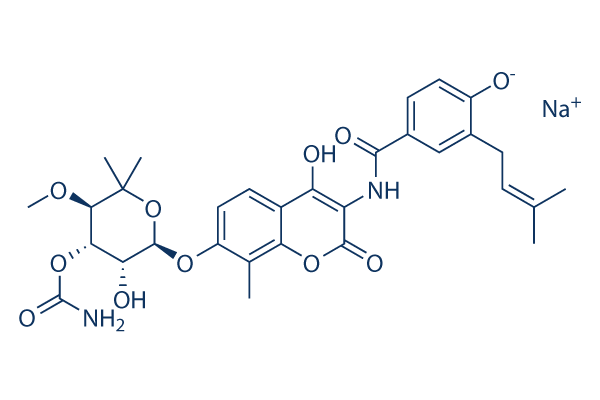
Estructura química
Peso molecular: 634.61
Control de calidad
Cultivo celular, tratamiento y concentración de trabajo
| Líneas celulares | Tipo de ensayo | Concentración | Tiempo de incubación | Formulación | Descripción de la actividad | PMID |
|---|---|---|---|---|---|---|
| MCF7-MX | Function assay | TP_TRANSPORTER: inhibition of mitoxantrone efflux in BCRP-expressing MCF7-MX cells, IC50=25μM | 16460798 | |||
| MELN | Function assay | 200 uM | 18 hrs | Inhibition of estradiol-induced ER-mediated transcription in MELN cells by measuring luciferase activity at 200 uM after 18 hrs | 17979263 | |
| SH-SY5Y | Neuroprotection assay | Neuroprotection against beta-amyloid peptide 1-42-induced toxicity in human SH-SY5Y cells assessed as lactate dehydrogenase release, EC50=0.04839μM | 19138859 | |||
| SH-SY5Y | Neuroprotection assay | 10 nM | Neuroprotection against beta-amyloid peptide 1-42-induced toxicity in retinoic acid-differentiated human SH-SY5Y cells assessed as lactate dehydrogenase release at 10 nM | 19138859 | ||
| SH-SY5Y | Neuroprotection assay | Neuroprotection against beta-amyloid peptide 1-42-induced toxicity in retinoic acid-differentiated human SH-SY5Y cells assessed as lactate dehydrogenase release | 19138859 | |||
| LNCaP-LN3 | Antiproliferative assay | Antiproliferative activity against human LNCaP-LN3 cells, IC50=1.05μM | 21129982 | |||
| yeast PP30 | Function assay | 100 uM | 3 hrs | Inhibition of human HSP90alpha expressed in yeast PP30 cells co-expressing HSF-lacZ reporter assessed as inhibition of heat stress-induced response at 100 uM after 3 hrs | 21129982 | |
| Sf9 | Function assay | Inhibition of Escherichia coli His6-tagged ParC/ParE expressed in baculovirus-infected Sf9 cells by gel electrophoresis, IC50=0.21μM | 21235241 | |||
| SKBR3 | Function assay | 1000 uM | 18 hrs | Inhibition of HSP90 in human SKBR3 cells assessed as aggregation of intracellular HER2 at 1000 uM after 18 hrs by DAPI staining-based immunofluorescence microscopic analysis | 23859777 | |
| BL21 (DE3) pLysS | Function assay | 100 mins | Inhibition of 6-His-tagged Mycobacterium smegmatis GyrB expressed in Escherichia coli BL21 (DE3) pLysS cells incubated for 100 mins in presence of ATP by malachite green dye based ATP assay, IC50=0.18μM | 25129171 | ||
| BL21 (DE3) pLysS | Function assay | 100 mins | Inhibition of Mycobacterium smegmatis GyrB ATPase activity expressed in Escherichia coli BL21 (DE3) pLysS cells after 100 mins by inorganic phosphate release detection based malachite green reagent assay, IC50=0.18μM | 25801151 | ||
| BL21 (DE3) pLysS | Function assay | 100 mins | Inhibition of Mycobacterium smegmatis DNA gyrase B expressed in Escherichia coli BL21 (DE3) pLysS cells assessed as reduction in ATPase activity incubated for 100 mins by inorganic phosphate detection assay, IC50=0.18μM | 26318054 | ||
| BL21 (DE3) pLysS | Function assay | 120 mins | Inhibition of Mycobacterium smegmatis 155 6His-tagged DNA gyrase B catalytic domain ATPase activity expressed in Escherichia coli BL21 (DE3) pLysS cells assessed as inorganic phosphate release after 120 mins in presence of ATP by malachite green dye based, IC50=0.046μM | 27371925 | ||
| Haga clic para ver más datos experimentales de líneas celulares | ||||||
Información química, almacenamiento y estabilidad
| Peso molecular | 634.61 | Fórmula | C31H35N2O11.Na |
Almacenamiento (Desde la fecha de recepción) | |
|---|---|---|---|---|---|
| Nº CAS | 1476-53-5 | Descargar SDF | Almacenamiento de soluciones madre |
|
|
| Sinónimos | Albamycin,Cathomycin,NSC 2382 | Smiles | CC1=C(C=CC2=C1OC(=O)C(=C2O)NC(=O)C3=CC(=C(C=C3)[O-])CC=C(C)C)OC4C(C(C(C(O4)(C)C)OC)OC(=O)N)O.[Na+] | ||
Solubilidad
|
In vitro |
DMSO
: 100 mg/mL
(157.57 mM)
Water : 100 mg/mL Ethanol : 100 mg/mL |
Calculadora de Molaridad
|
In vivo |
|||||
Calculadora de formulación in vivo (Solución clara)
Paso 1: Introduzca la información a continuación (Recomendado: Un animal adicional para tener en cuenta la pérdida durante el experimento)
Paso 2: Introduzca la formulación in vivo (Esto es solo la calculadora, no la formulación. Por favor, contáctenos primero si no hay una formulación in vivo en la sección de Solubilidad.)
Resultados del cálculo:
Concentración de trabajo: mg/ml;
Método para preparar el líquido maestro de DMSO: mg fármaco predissuelto en μL DMSO ( Concentración del líquido maestro mg/mL, Por favor, contáctenos primero si la concentración excede la solubilidad del DMSO del lote del fármaco. )
Método para preparar la formulación in vivo: Tomar μL DMSO líquido maestro, luego añadirμL PEG300, mezclar y clarificar, luego añadirμL Tween 80, mezclar y clarificar, luego añadir μL ddH2O, mezclar y clarificar.
Método para preparar la formulación in vivo: Tomar μL DMSO líquido maestro, luego añadir μL Aceite de maíz, mezclar y clarificar.
Nota: 1. Por favor, asegúrese de que el líquido esté claro antes de añadir el siguiente disolvente.
2. Asegúrese de añadir el (los) disolvente(s) en orden. Debe asegurarse de que la solución obtenida, en la adición anterior, sea una solución clara antes de proceder a añadir el siguiente disolvente. Se pueden utilizar métodos físicos como el vórtice, el ultrasonido o el baño de agua caliente para ayudar a la disolución.
Mecanismo de acción
| Targets/IC50/Ki |
Topoisomerase II
Topoisomerase IV
|
|---|---|
| In vitro |
Novobiocin también interactúa con HSP90, alterando la afinidad del chaperón por geldanamicina y radicicol y causando la depleción in vitro e in vivo de quinasas reguladoras clave dependientes de HSP90, incluyendo v-Src, Raf-1 y p185(ErbB2). Novobiocin interfiere con la asociación de los co-chaperones Hsc70 y p23 con HSP90. Novobiocin inhibe específicamente la maduración de la quinasa eIF2alpha regulada por hemo (HRI) de manera dependiente de la concentración. Novobiocin induce la disociación de HSP90 y Cdc37 de la HRI inmadura, mientras que los cochaperones de HSP90 p23, FKBP52 y la proteína fosfatasa 5 permanecieron asociados con la HRI inmadura. Novobiocin causa cambios morfológicos y bioquímicos que conducen a la inducción de la muerte celular, exhibiendo características de apoptosis metazoaria. Novobiocin, un inhibidor de HSP90, podría disminuir la expresión de SMYD3 e inhibir de manera dosis-dependiente la proliferación y migración de células de cáncer de mama humano MDA-MB-231. Novobiocin puede inhibir la migración de células de cáncer de mama y tal evento puede implicar la regulación a la baja de SMYD3. Novobiocin, un antibiótico aminocumarina, interfiere con la HSP90 y la expresión génica dependiente del factor inducible por hipoxia y, por lo tanto, compromete la supervivencia celular. Novobiocin (500 µM) resulta en un aumento significativo de [Ca(2+)]i, una disminución de la dispersión frontal, un aumento de la unión a anexina-V y mejora la formación de ceramida. Novobiocin estimula la eriptosis, un efecto debido al menos en parte a la entrada de Ca(2+) extracelular y la formación de ceramida. |
| In vivo |
Novobiocin sodium muestra actividad antiinfecciosa en ratones infectados con Streptococcus pneumoniae resistente a amoxicilina. |
Referencias |
|
Soporte técnico
Tel: +1-832-582-8158 Ext:3
Si tiene alguna otra consulta, por favor deje un mensaje.

Los productos son solo para uso de investigación. No para uso humano. No vendemos a pacientes.
©Copyright 2013 Selleck Chemicals. Todos los derechos reservados.