
solo para uso en investigación
Onalespib (AT13387) Inhibidor de HSP90
Cat. No.S1163
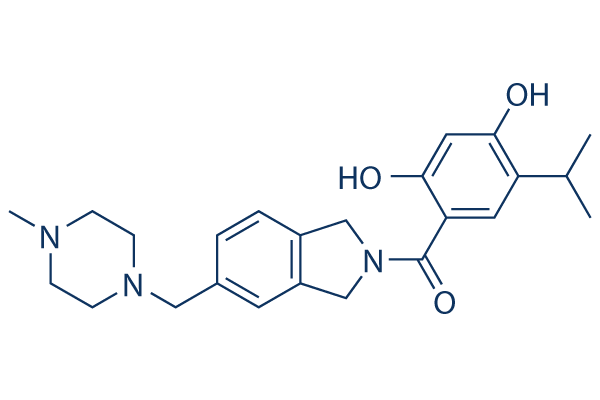
Estructura química
Peso molecular: 409.52
Control de calidad
Cultivo celular, tratamiento y concentración de trabajo
| Líneas celulares | Tipo de ensayo | Concentración | Tiempo de incubación | Formulación | Descripción de la actividad | PMID |
|---|---|---|---|---|---|---|
| human HCT116 cells | Cytotoxic assay | Cytotoxicity against human HCT116 cells by Alamar blue assay, IC50=0.048 μM | 20662534 | |||
| human HCT116 cells | Function assay | 10 nM | 18 h | Induction of apoptosis in human HCT116 cells assessed as upregulation of Hsp70 level at 10 nM after 18 hrs by immunoblotting | 20662534 | |
| human HCT116 cells | Function assay | 30 nM | 18 h | Induction of apoptosis in human HCT116 cells assessed as reduction of CDK4 level at 30 nM after 18 hrs by immunoblotting | 20662534 | |
| human HCT116 cells | Function assay | 30 nM | 18 h | Induction of apoptosis in human HCT116 cells assessed as reduction of Raf-1 level at 30 nM after 18 hrs by immunoblotting | 20662534 | |
| human HCT116 cells | Proliferation assay | 48 h | Antiproliferative activity against human HCT116 cells after 48 hrs by MTT assay, IC50=0.08 μM | 24763261 | ||
| human SKBR3 cells | Proliferation assay | 48 h | Antiproliferative activity against human SKBR3 cells after 48 hrs by MTT assay, IC50=0.14 μM | 24763261 | ||
| human MCF7 cells | Proliferation assay | 48 h | Antiproliferative activity against human MCF7 cells after 48 hrs by MTT assay, IC50=0.28 μM | 24763261 | ||
| human A231 cells | Proliferation assay | 48 h | Antiproliferative activity against human A231 cells after 48 hrs by MTT assay, IC50=1.01 μM | 24763261 | ||
| GIST430 | Cytotoxicity assay | 7 days | Cytotoxicity against imatinib-resistant human GIST430 cells assessed as decrease in cell viability after 7 days by alamar blue assay, IC50=0.034μM. | 26844689 | ||
| GIST48 | Cytotoxicity assay | 7 days | Cytotoxicity against imatinib-resistant human GIST48 cells assessed as decrease in cell viability after 7 days by alamar blue assay, IC50=0.055μM. | 26844689 | ||
| MCF7 | Antiproliferative assay | 72 hrs | Antiproliferative activity against human MCF7 cells incubated for 72 hrs by MTT assay, IC50=0.032μM. | 29028527 | ||
| SKBR3 | Antiproliferative assay | 72 hrs | Antiproliferative activity against human SKBR3 cells incubated for 72 hrs by MTT assay, IC50=0.045μM. | 29028527 | ||
| TC32 | qHTS assay | qHTS of pediatric cancer cell lines to identify multiple opportunities for drug repurposing: Primary screen for TC32 cells | 29435139 | |||
| DAOY | qHTS assay | qHTS of pediatric cancer cell lines to identify multiple opportunities for drug repurposing: Primary screen for DAOY cells | 29435139 | |||
| SJ-GBM2 | qHTS assay | qHTS of pediatric cancer cell lines to identify multiple opportunities for drug repurposing: Primary screen for SJ-GBM2 cells | 29435139 | |||
| A673 | qHTS assay | qHTS of pediatric cancer cell lines to identify multiple opportunities for drug repurposing: Primary screen for A673 cells | 29435139 | |||
| SK-N-MC | qHTS assay | qHTS of pediatric cancer cell lines to identify multiple opportunities for drug repurposing: Primary screen for SK-N-MC cells | 29435139 | |||
| NB-EBc1 | qHTS assay | qHTS of pediatric cancer cell lines to identify multiple opportunities for drug repurposing: Primary screen for NB-EBc1 cells | 29435139 | |||
| Saos-2 | qHTS assay | qHTS of pediatric cancer cell lines to identify multiple opportunities for drug repurposing: Primary screen for Saos-2 cells | 29435139 | |||
| SK-N-SH | qHTS assay | qHTS of pediatric cancer cell lines to identify multiple opportunities for drug repurposing: Primary screen for SK-N-SH cells | 29435139 | |||
| NB1643 | qHTS assay | qHTS of pediatric cancer cell lines to identify multiple opportunities for drug repurposing: Primary screen for NB1643 cells | 29435139 | |||
| LAN-5 | qHTS assay | qHTS of pediatric cancer cell lines to identify multiple opportunities for drug repurposing: Primary screen for LAN-5 cells | 29435139 | |||
| Rh18 | qHTS assay | qHTS of pediatric cancer cell lines to identify multiple opportunities for drug repurposing: Primary screen for Rh18 cells | 29435139 | |||
| OHS-50 | qHTS assay | qHTS of pediatric cancer cell lines to identify multiple opportunities for drug repurposing: Primary screen for OHS-50 cells | 29435139 | |||
| RD | qHTS assay | qHTS of pediatric cancer cell lines to identify multiple opportunities for drug repurposing: Primary screen for RD cells | 29435139 | |||
| NB1643 | qHTS assay | qHTS of pediatric cancer cell lines to identify multiple opportunities for drug repurposing: Confirmatory screen for NB1643 cells | 29435139 | |||
| A673 | qHTS assay | qHTS of pediatric cancer cell lines to identify multiple opportunities for drug repurposing: Confirmatory screen for A673 cells) | 29435139 | |||
| SK-N-MC | qHTS assay | qHTS of pediatric cancer cell lines to identify multiple opportunities for drug repurposing: Confirmatory screen for SK-N-MC cells | 29435139 | |||
| BT-12 | qHTS assay | qHTS of pediatric cancer cell lines to identify multiple opportunities for drug repurposing: Confirmatory screen for BT-12 cells | 29435139 | |||
| LAN-5 | qHTS assay | qHTS of pediatric cancer cell lines to identify multiple opportunities for drug repurposing: Confirmatory screen for LAN-5 cells | 29435139 | |||
| BT-37 | qHTS assay | qHTS of pediatric cancer cell lines to identify multiple opportunities for drug repurposing: Confirmatory screen for BT-37 cells | 29435139 | |||
| TC32 | qHTS assay | qHTS of pediatric cancer cell lines to identify multiple opportunities for drug repurposing: Confirmatory screen for TC32 cells | 29435139 | |||
| U-2 OS | qHTS assay | qHTS of pediatric cancer cell lines to identify multiple opportunities for drug repurposing: Confirmatory screen for U-2 OS cells | 29435139 | |||
| Rh41 | qHTS assay | qHTS of pediatric cancer cell lines to identify multiple opportunities for drug repurposing: Confirmatory screen for Rh41 cells | 29435139 | |||
| RD | qHTS assay | qHTS of pediatric cancer cell lines to identify multiple opportunities for drug repurposing: Confirmatory screen for RD cells | 29435139 | |||
| Rh18 | qHTS assay | qHTS of pediatric cancer cell lines to identify multiple opportunities for drug repurposing: Confirmatory screen for Rh18 cells | 29435139 | |||
| Rh30 | qHTS assay | qHTS of pediatric cancer cell lines to identify multiple opportunities for drug repurposing: Confirmatory screen for Rh30 cells | 29435139 | |||
| SK-N-SH | qHTS assay | qHTS of pediatric cancer cell lines to identify multiple opportunities for drug repurposing: Confirmatory screen for SK-N-SH cells | 29435139 | |||
| NCI-H3122 | Antiproliferative assay | 72 hrs | Antiproliferative activity against human NCI-H3122 cells after 72 hrs by SRB assay, IC50=0.052μM. | 29698859 | ||
| PANC1 | Function assay | 1 uM | 36 hrs | Inhibition of HSP90alpha in human PANC1 cells assessed as up-regulation of Hsp70 at 1 uM after 36 hrs by Western blot analysis | 30351001 | |
| PANC1 | Function assay | 1 uM | 36 hrs | Inhibition of HSP90alpha in human PANC1 cells assessed as akt degradation at 1 uM after 36 hrs by Western blot analysis | 30351001 | |
| MCF7 | Antiproliferative assay | 72 hrs | Antiproliferative activity against human MCF7 cells after 72 hrs by MTT assay, IC50=0.29μM. | 30784881 | ||
| NCI-H1299 | Antiproliferative assay | 72 hrs | Antiproliferative activity against human NCI-H1299 cells after 72 hrs by MTT assay, IC50=0.37μM. | 30784881 | ||
| A549 | Antiproliferative assay | 72 hrs | Antiproliferative activity against human A549 cells after 72 hrs by MTT assay, IC50=0.44μM. | 30784881 | ||
| Vero E6 | Function assay | 48 hrs | IC50 for antiviral activity against SARS-CoV-2 in the Vero E6 cell line at 48 h by immunofluorescence-based assay (detecting the viral NP protein in the nucleus of the Vero E6 cells), IC50=0.15488μM. | 32353859 | ||
| Haga clic para ver más datos experimentales de líneas celulares | ||||||
Información química, almacenamiento y estabilidad
| Peso molecular | 409.52 | Fórmula | C24H31N3O3 |
Almacenamiento (Desde la fecha de recepción) | |
|---|---|---|---|---|---|
| Nº CAS | 912999-49-6 | Descargar SDF | Almacenamiento de soluciones madre |
|
|
| Sinónimos | N/A | Smiles | CC(C)C1=CC(=C(C=C1O)O)C(=O)N2CC3=C(C2)C=C(C=C3)CN4CCN(CC4)C | ||
Solubilidad
|
In vitro |
DMSO
: 25 mg/mL
(61.04 mM)
Water : Insoluble Ethanol : Insoluble |
Calculadora de Molaridad
|
In vivo |
|||||
Calculadora de formulación in vivo (Solución clara)
Paso 1: Introduzca la información a continuación (Recomendado: Un animal adicional para tener en cuenta la pérdida durante el experimento)
Paso 2: Introduzca la formulación in vivo (Esto es solo la calculadora, no la formulación. Por favor, contáctenos primero si no hay una formulación in vivo en la sección de Solubilidad.)
Resultados del cálculo:
Concentración de trabajo: mg/ml;
Método para preparar el líquido maestro de DMSO: mg fármaco predissuelto en μL DMSO ( Concentración del líquido maestro mg/mL, Por favor, contáctenos primero si la concentración excede la solubilidad del DMSO del lote del fármaco. )
Método para preparar la formulación in vivo: Tomar μL DMSO líquido maestro, luego añadirμL PEG300, mezclar y clarificar, luego añadirμL Tween 80, mezclar y clarificar, luego añadir μL ddH2O, mezclar y clarificar.
Método para preparar la formulación in vivo: Tomar μL DMSO líquido maestro, luego añadir μL Aceite de maíz, mezclar y clarificar.
Nota: 1. Por favor, asegúrese de que el líquido esté claro antes de añadir el siguiente disolvente.
2. Asegúrese de añadir el (los) disolvente(s) en orden. Debe asegurarse de que la solución obtenida, en la adición anterior, sea una solución clara antes de proceder a añadir el siguiente disolvente. Se pueden utilizar métodos físicos como el vórtice, el ultrasonido o el baño de agua caliente para ayudar a la disolución.
Mecanismo de acción
| Targets/IC50/Ki |
HSP90
(Cell-free assay) 18 nM
|
|---|---|
| In vitro |
La Kd para la unión de Onalespib (AT13387) es de 0,7 nM. Esto se compara con una Kd de 6,7 nM para la unión de la ansamicina 17-AAG al mismo sitio. La estequiometría media de unión para este compuesto es de 1,03. También se investiga su inhibición de varias quinasas aisladas, incluyendo CDK1, CDK2, CDK4, FGFR3, PKB-b, JAK2, VEGFR2, PDGFRβ y Aurora B. Ninguna de las quinasas probadas se inhibe significativamente a concentraciones inferiores a 30 μM. Es un potente inhibidor de la proliferación y supervivencia de muchas líneas celulares diferentes (como la línea celular MES-SA) de una variedad de tipos de tumores diferentes. En un panel de 30 líneas celulares tumorales, inhibe potentemente la proliferación celular con valores de GI50 en el rango de 13 a 260 nM. El compuesto también inhibe la proliferación de la línea celular epitelial prostática humana no tumorigénica PNT2 con un valor de GI50 de 480 nM.
|
| Ensayo de quinasa |
Calorimetría isotérmica de competición de HSP90
|
|
Los valores de Kd para la unión de Onalespib (AT13387) a HSP90 se determinan mediante un formato de calorimetría isotérmica (ITC) de competición. Los experimentos de ITC se realizan en un Micro Cal VP-ITC a 25 °C en un tampón que comprende 25 mM Tris, 100 mM NaCl, 1 mM MgCl2 y 1 mM Tris(2-carboxi-etil)fosfina a pH 7,4 para mantener la mayor afinidad.
|
|
| In vivo |
Cuando se administra de forma intermitente, Onalespib (AT13387) podría tolerarse a dosis de hasta 70 mg/kg dos veces por semana o 90 mg/kg una vez por semana. La pérdida de peso corporal en ratones no supera el 20% antes de recuperarse en todos los casos excepto en uno, y la pérdida es mayor después de la segunda dosis. La inhibición del crecimiento tumoral es similar en NCI-H1975 para ambos regímenes de dosificación. El mantenimiento de los efectos antitumorales con un período tan prolongado sin tratamiento es consistente con la acción farmacodinámica prolongada de este compuesto observada para el EGFR mutante y otros biomarcadores in vitro e in vivo, y la retención prolongada del mismo en los tumores.
|
Referencias |
|
Aplicaciones
| Métodos | Biomarcadores | Imágenes | PMID |
|---|---|---|---|
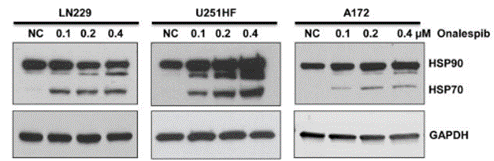
| Western blot | HSP90 / HSP70 EGFR / p-EGFR / AKT / p-AKT / ERK / p-ERK / S6 / p-S6 AXL / c-Myc / p-Mnk1 / Mnk1 / p-eIF4E / eIF4E |
|
28679777 |
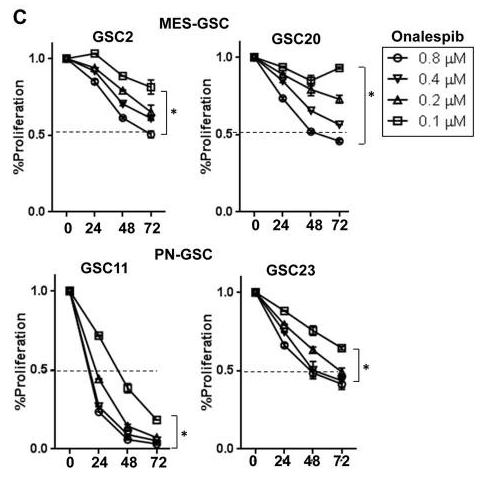
| Growth inhibition assay | Cell viability |
|
28679777 |
Información del ensayo clínico
(datos de https://clinicaltrials.gov, actualizado el 2024-05-22)
| Número NCT | Reclutamiento | Condiciones | Patrocinador/Colaboradores | Fecha de inicio | Fases |
|---|---|---|---|---|---|
| NCT02898207 | Completed | Metastatic High Grade Fallopian Tube Serous Adenocarcinoma|Metastatic Malignant Solid Neoplasm|Metastatic Primary Peritoneal Serous Adenocarcinoma|Metastatic Triple-Negative Breast Carcinoma|Platinum-Resistant Fallopian Tube Carcinoma|Platinum-Resistant Ovarian Carcinoma|Platinum-Resistant Primary Peritoneal Carcinoma|Recurrent Breast Carcinoma|Recurrent High Grade Fallopian Tube Serous Adenocarcinoma|Recurrent High Grade Ovarian Serous Adenocarcinoma|Recurrent Primary Peritoneal High Grade Serous Adenocarcinoma|Recurrent Triple-Negative Breast Carcinoma|Refractory Fallopian Tube Serous Adenocarcinoma|Refractory Ovarian Serous Adenocarcinoma|Refractory Primary Peritoneal Serous Adenocarcinoma|Refractory Triple-Negative Breast Carcinoma|Unresectable High Grade Fallopian Tube Serous Adenocarcinoma|Unresectable Malignant Solid Neoplasm|Unresectable Primary Peritoneal Serous Adenocarcinoma |
National Cancer Institute (NCI) |
May 19 2017 | Phase 1 |
Soporte técnico
Tel: +1-832-582-8158 Ext:3
Si tiene alguna otra consulta, por favor deje un mensaje.
Preguntas frecuentes
Pregunta 1:
How to prepare it for in vivo studies?
Respuesta:
It can be dissolved in 2% DMSO/30% PEG 300/ddH2O at 10 mg/ml as a clear solution. But after stayed for about 1 hour, the precipitation will goes out. So it is recommended to be prepared before use.

Los productos son solo para uso de investigación. No para uso humano. No vendemos a pacientes.
©Copyright 2013 Selleck Chemicals. Todos los derechos reservados.