
solo para uso en investigación
LDN-193189 Dihydrochloride Inhibidor de la señalización BMP
Cat. No.S7507
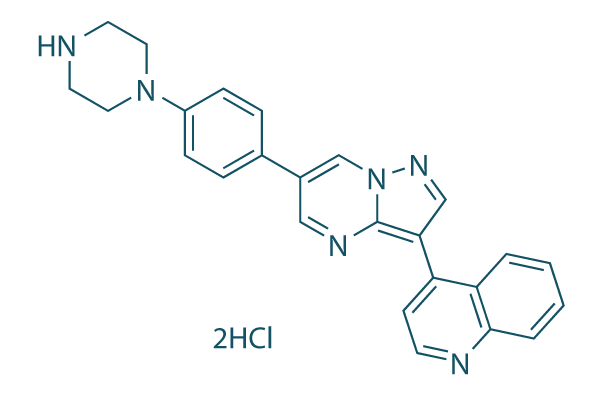
Estructura química
Peso molecular: 479.4
Control de calidad
Productos que se suelen utilizar junto con LDN-193189 Dihydrochloride
| Dianas relacionadas | PKC ROCK Bcr-Abl |
|---|---|
| Otros TGF-beta/Smad Inhibidores | RepSox (E-616452) Vactosertib (TEW-7197) LDN-193189 A-83-01 Galunisertib (LY2157299) SRI-011381 (C381) LY2109761 SIS3 Hydrochloride SB-525334 DMH1 |
Cultivo celular, tratamiento y concentración de trabajo
| Líneas celulares | Tipo de ensayo | Concentración | Tiempo de incubación | Formulación | Descripción de la actividad | PMID |
|---|---|---|---|---|---|---|
| EOC216 | Cell viability assay | 0.1, 1, 2, 5, 10 μM | 1, 3, 5, 7, 9 days | exhibited a dose dependent LDN-induced decrease in viability | 25227893 | |
| PC3 | Function assay | 500 nM | LDN-193189 repressed activation of Smad1/5/8, and also repressed P-Smad3 levels | 22452883 | ||
| C2C12 | Function assay | 0.5 μM | 1 day | LDN-193189 promotes myogenesis | 25368322 | |
| C2C12 | Function assay | 30 mins | Inhibition of BMP6-induced ALK2 transcriptional activity in mouse C2C12 cells expressing BRE-Luc after 30 mins by luciferase reporter gene assay, EC50 = 0.014 μM. | 30227946 | ||
| BT-12 | qHTS assay | qHTS of pediatric cancer cell lines to identify multiple opportunities for drug repurposing: Primary screen for BT-12 cells | 29435139 | |||
| fibroblast cells | qHTS assay | qHTS of pediatric cancer cell lines to identify multiple opportunities for drug repurposing: Primary screen for control Hh wild type fibroblast cells | 29435139 | |||
| Rh30 | qHTS assay | qHTS of pediatric cancer cell lines to identify multiple opportunities for drug repurposing: Primary screen for Rh30 cells | 29435139 | |||
| C2C12 | Function assay | 0.1 uM | Inhibition of ALK5 in mouse C2C12 cells assessed as decrease in TGFbeta1-induced Smad1/5 phosphorylation at 0.1 uM by Western blot method | 28103025 | ||
| Haga clic para ver más datos experimentales de líneas celulares | ||||||
Información química, almacenamiento y estabilidad
| Peso molecular | 479.4 | Fórmula | C25H24Cl2N6 |
Almacenamiento (Desde la fecha de recepción) | |
|---|---|---|---|---|---|
| Nº CAS | 1435934-00-1 | -- | Almacenamiento de soluciones madre |
|
|
| Sinónimos | DM-3189 2HCl | Smiles | C1CN(CCN1)C2=CC=C(C=C2)C3=CN4C(=C(C=N4)C5=CC=NC6=CC=CC=C56)N=C3.Cl.Cl | ||
Solubilidad
|
In vitro |
Water : 24 mg/mL
DMSO
: 12 mg/mL
(25.03 mM)
Ethanol : Insoluble |
Calculadora de Molaridad
|
In vivo |
|||||
Calculadora de formulación in vivo (Solución clara)
Paso 1: Introduzca la información a continuación (Recomendado: Un animal adicional para tener en cuenta la pérdida durante el experimento)
Paso 2: Introduzca la formulación in vivo (Esto es solo la calculadora, no la formulación. Por favor, contáctenos primero si no hay una formulación in vivo en la sección de Solubilidad.)
Resultados del cálculo:
Concentración de trabajo: mg/ml;
Método para preparar el líquido maestro de DMSO: mg fármaco predissuelto en μL DMSO ( Concentración del líquido maestro mg/mL, Por favor, contáctenos primero si la concentración excede la solubilidad del DMSO del lote del fármaco. )
Método para preparar la formulación in vivo: Tomar μL DMSO líquido maestro, luego añadirμL PEG300, mezclar y clarificar, luego añadirμL Tween 80, mezclar y clarificar, luego añadir μL ddH2O, mezclar y clarificar.
Método para preparar la formulación in vivo: Tomar μL DMSO líquido maestro, luego añadir μL Aceite de maíz, mezclar y clarificar.
Nota: 1. Por favor, asegúrese de que el líquido esté claro antes de añadir el siguiente disolvente.
2. Asegúrese de añadir el (los) disolvente(s) en orden. Debe asegurarse de que la solución obtenida, en la adición anterior, sea una solución clara antes de proceder a añadir el siguiente disolvente. Se pueden utilizar métodos físicos como el vórtice, el ultrasonido o el baño de agua caliente para ayudar a la disolución.
Mecanismo de acción
| Características |
Selective BMP type I receptor inhibitor.
|
|---|---|
| Targets/IC50/Ki |
ALK1
(Cell-free assay) 0.8 nM
ALK2
(Cell-free assay) 0.8 nM
ALK3
(Cell-free assay) 5.3 nM
ALK6
(Cell-free assay) 16.7 nM
|
| In vitro |
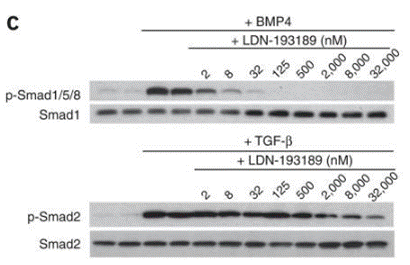
LDN193189 inhibe potentemente la activación de Smad1, Smad5 y Smad8 mediada por BMP4 con una IC50 de 5 nM, e inhibe eficientemente la actividad transcripcional de los receptores BMP tipo I ALK2 y ALK3 con una IC50 de 5 nM y 30 nM, respectivamente. Además, LDN193189 también muestra un efecto inhibidor sobre la actividad transcripcional inducida por las proteínas mutantes ALK2R206H o ALK2Q207D constitutivamente activas. Un estudio reciente muestra que LDN-193189 bloquea la producción de especies reactivas de oxígeno inducidas por LDL oxidado durante la aterogénesis en células endoteliales aórticas humanas. |
| Ensayo de quinasa |
Actividad de la fosfatasa alcalina
|
|
Las células C2C12 se siembran en placas de 96 pocillos a 2.000 células por pocillo en DMEM suplementado con 2% de FBS. Los pocillos se tratan por cuadruplicado con ligandos BMP y LDN-193189 o vehículo. Las células se recogen después de 6 días en cultivo en 50 μL de solución salina tamponada con Tris y 1% de Tritón X-100. Los lisados se añaden al reactivo de p-nitro-fenilfosfato en placas de 96 pocillos durante 1 hora y luego se evalúa la actividad de la fosfatasa alcalina (absorbancia a 405 nm). La viabilidad y cantidad celular se miden con Cell Titer Aqueous One (absorbancia a 490 nm), utilizando pocillos replicados tratados de forma idéntica a los utilizados para las mediciones de fosfatasa alcalina.
|
|
| In vivo |
En ratones transgénicos condicionales caALK2 con Ad.Cre en el día postnatal 7 (P7), LDN-193189 (3 mg/kg i.p.) provoca calcificaciones leves alrededor de la tibia y el peroné izquierdos, visibles por primera vez en P13, y previene las lesiones radiográficas en P15 sin causar pérdida de peso o retraso del crecimiento, fracturas espontáneas, disminución de la densidad ósea o anomalías de comportamiento. LDN193189 dorsaliza embriones de pez cebra al inhibir las vías de señalización inducidas por la proteína morfogenética ósea (BMP)6 sin efecto sobre el desarrollo vascular. En ratones portadores de tumores PCa-118b, el tratamiento con LDN-193189 atenúa el crecimiento tumoral y reduce la formación ósea en los tumores. En ratones deficientes en el receptor de LDL (LDLR-/-), LDN-193189 inhibe potentemente el desarrollo de ateromas. Además, LDN-193189 también exhibe efectos inhibidores sobre la inflamación vascular asociada, la actividad osteogénica y la calcificación. |
Referencias |
|
Aplicaciones
| Métodos | Biomarcadores | Imágenes | PMID |
|---|---|---|---|
| Western blot | pSmad Smad / ID1 / PARP / Cleaved PARP |
|
19029982 |
Soporte técnico
Tel: +1-832-582-8158 Ext:3
Si tiene alguna otra consulta, por favor deje un mensaje.

Los productos son solo para uso de investigación. No para uso humano. No vendemos a pacientes.
©Copyright 2013 Selleck Chemicals. Todos los derechos reservados.