
solo para uso en investigación
ARS-853 KRas inhibidor
Cat. No.S8156
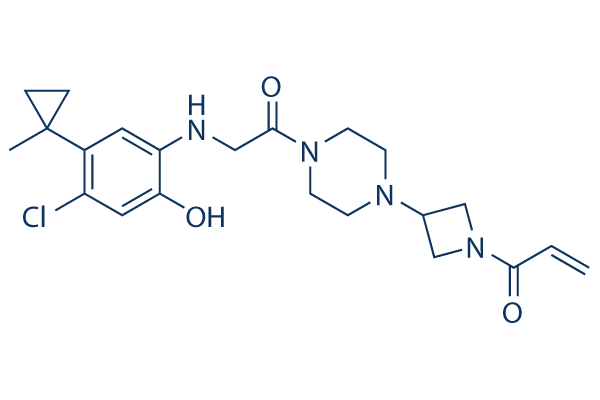
Estructura química
Peso molecular: 432.94
Control de calidad
| Dianas relacionadas | CDK HSP PD-1/PD-L1 ROCK Wee1 DNA/RNA Synthesis Microtubule Associated Ras Aurora Kinase Casein Kinase |
|---|---|
| Otros KRas Inhibidores | RMC-7977 Daraxonrasib (RMC-6236) MRTX1133 Zoldonrasib (RMC-9805) BI-2852 Adagrasib (MRTX849) HRS-4642 ARS-1620 BI-3406 BAY-293 |
Información química, almacenamiento y estabilidad
| Peso molecular | 432.94 | Fórmula | C22H29ClN4O3 |
Almacenamiento (Desde la fecha de recepción) | |
|---|---|---|---|---|---|
| Nº CAS | 1629268-00-3 | Descargar SDF | Almacenamiento de soluciones madre |
|
|
| Sinónimos | N/A | Smiles | CC1(CC1)C2=CC(=C(C=C2Cl)O)NCC(=O)N3CCN(CC3)C4CN(C4)C(=O)C=C | ||
Solubilidad
|
In vitro |
DMSO
: 86 mg/mL
(198.64 mM)
Ethanol : 7 mg/mL Water : Insoluble |
Calculadora de Molaridad
|
In vivo |
|||||
Calculadora de formulación in vivo (Solución clara)
Paso 1: Introduzca la información a continuación (Recomendado: Un animal adicional para tener en cuenta la pérdida durante el experimento)
Paso 2: Introduzca la formulación in vivo (Esto es solo la calculadora, no la formulación. Por favor, contáctenos primero si no hay una formulación in vivo en la sección de Solubilidad.)
Resultados del cálculo:
Concentración de trabajo: mg/ml;
Método para preparar el líquido maestro de DMSO: mg fármaco predissuelto en μL DMSO ( Concentración del líquido maestro mg/mL, Por favor, contáctenos primero si la concentración excede la solubilidad del DMSO del lote del fármaco. )
Método para preparar la formulación in vivo: Tomar μL DMSO líquido maestro, luego añadirμL PEG300, mezclar y clarificar, luego añadirμL Tween 80, mezclar y clarificar, luego añadir μL ddH2O, mezclar y clarificar.
Método para preparar la formulación in vivo: Tomar μL DMSO líquido maestro, luego añadir μL Aceite de maíz, mezclar y clarificar.
Nota: 1. Por favor, asegúrese de que el líquido esté claro antes de añadir el siguiente disolvente.
2. Asegúrese de añadir el (los) disolvente(s) en orden. Debe asegurarse de que la solución obtenida, en la adición anterior, sea una solución clara antes de proceder a añadir el siguiente disolvente. Se pueden utilizar métodos físicos como el vórtice, el ultrasonido o el baño de agua caliente para ayudar a la disolución.
Mecanismo de acción
| Targets/IC50/Ki |
K-Ras(G12C)
(in H358 cells) 2.5 μM
|
|---|---|
| In vitro |
El tratamiento de células KRASG12C con ARS-853 condujo a una inhibición dosis-dependiente y casi completa de la pulldown de KRAS mediada por CRAF-RBD (RBD) a partir de lisados, con una IC50 de aproximadamente 1 μmol/L. El tratamiento de células H358 con este compuesto resultó en una pérdida significativa de las interacciones KRAS–CRAF. De acuerdo con un estado inactivo de KRASG12C una vez unido a esta sustancia química, la señalización aguas abajo a través de las vías MAPK (incluyendo pMEK, pERK y pRSK) y PI3K (pAKT) fue inhibida por ella en células H358 y otras líneas celulares KRASG12C. La inhibición de la pulldown de RAF-RBD y la señalización aguas abajo de KRAS se mantuvo durante un período de 72 horas, acompañada de un arresto del ciclo celular en G1, pérdida de la expresión de Ciclina D1 y Rb, y un aumento del inhibidor del ciclo celular p27 KIP1. Además, se observaron características de apoptosis, incluyendo PARP escindida y aumentos en el ADN subdiploide, en células H358 después del tratamiento con este compuesto. No se observaron efectos sobre la unión de RAF-RBD o la señalización aguas abajo en células A549 (KRASG12S), y los efectos inhibidores de este en células H358 pudieron ser rescatados por la expresión ectópica de KRASG12V. KRASG12C es el objetivo covalente más potente de esta sustancia química entre más de 2.700 proteínas celulares y consistentemente encontramos que no ejerce efectos sobre la señalización o el crecimiento celular en células no KRASG12C a concentraciones hasta 10 veces mayores que su potencia en KRASG12C. Reacciona solo con el estado inactivo (unido a GDP), pero no con el estado activo (unido a GTP), de KRAS. Este compuesto redujo los niveles de KRAS-GTP y la fosforilación de ERK en células de riñón embrionario humano 293 (HEK293) o células H358 diseñadas para expresar KRASG12C pero no en aquellas que expresaban KRASG12C/A59G. Atrapa KRASG12C en una conformación unida a GDP al disminuir su afinidad por los factores de intercambio de nucleótidos.
|
Referencias |
|
Soporte técnico
Tel: +1-832-582-8158 Ext:3
Si tiene alguna otra consulta, por favor deje un mensaje.

Los productos son solo para uso de investigación. No para uso humano. No vendemos a pacientes.
©Copyright 2013 Selleck Chemicals. Todos los derechos reservados.