
solo para uso en investigación
SU11274 c-Met inhibidor
Cat. No.S1080
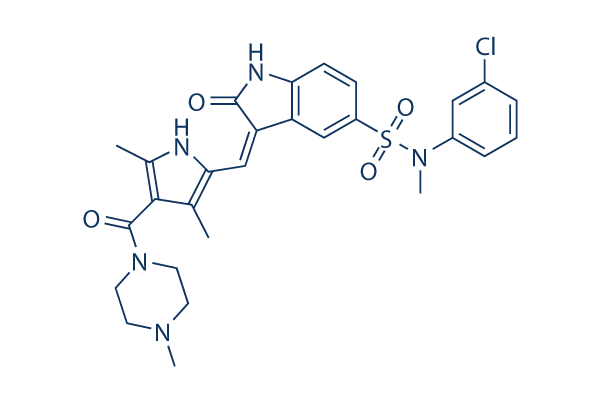
Estructura química
Peso molecular: 568.09
Control de calidad
| Dianas relacionadas | EGFR VEGFR PDGFR FGFR Src MEK CSF-1R FLT3 HER2 c-Kit |
|---|---|
| Otros c-Met Inhibidores | Tepotinib Dihexa SGX-523 PHA-665752 Foretinib BMS-777607 JNJ-38877605 Tivantinib PF-04217903 Savolitinib (AZD6094) |
Cultivo celular, tratamiento y concentración de trabajo
| Líneas celulares | Tipo de ensayo | Concentración | Tiempo de incubación | Formulación | Descripción de la actividad | PMID |
|---|---|---|---|---|---|---|
| A549 cells | Function assay | Inhibition of human recombinant c-MET kinase in A549 cells assessed as inhibition of HGF-induced cell growth, IC50=0.01 μM | ||||
| human MDCK cells | Function assay | 24 h | Inhibition of Met-mediated scattering in HGF-stimulated human MDCK cells pre-incubated overnight prior to HGF stimulation for 24 hrs measured after 24 to 48 hrs, IC50=0.152 μM | |||
| mouse BAF3 cells | Proliferation assay | 72 h | Antiproliferative activity against mouse BAF3 cells expressing TPR-Met after 72 hrs in absence of IL-3, IC50=0.53 μM | |||
| human SNU5 cells | Proliferation assay | 72 h | Antiproliferative activity against human SNU5 cells after 72 hrs, IC50=0.8 μM | |||
| human MKN45 cells | Proliferation assay | 72 h | Antiproliferative activity against human MKN45 cells after 72 hrs, IC50=1.3 μM | |||
| human HepG2 cells | Function assay | Inhibition of Met-mediated tumorigenesis in HGF-stimulated human HepG2 cells assessed as impairment in anchorage-independent growth by soft agar growth assay, IC50=1.561 μM | ||||
| mouse NIH/3T3 cells | Proliferation assay | 72 h | Antiproliferative activity against mouse NIH/3T3 cells expressing TPR-Met after 72 hrs, IC50=2 μM | |||
| human MCF7 cells | Proliferation assay | 72 h | Antiproliferative activity against human MCF7 cells after 72 hrs, IC50=6.2 μM | |||
| human SNU1 cells | Proliferation assay | 72 h | Antiproliferative activity against human SNU1 cells after 72 hrs, IC50=7 μM | |||
| human NCI-H1993 cells | Proliferation assay | 72 h | Antiproliferative activity against human NCI-H1993 cells after 72 hrs, IC50=7.3 μM | |||
| human MDA-MB-231 cells | Proliferation assay | 72 h | Antiproliferative activity against human MDA-MB-231 cells after 72 hrs | |||
| human NCI-H441 cells | Proliferation assay | 72 h | Antiproliferative activity against human NCI-H441 cells after 72 hrs | |||
| human BxPC3 cells | Proliferation assay | 72 h | Antiproliferative activity against human BxPC3 cells after 72 hrs | |||
| DLD1 cells | Function assay | 2.5 μM | Inhibition of human p38-alpha phosphorylation in DLD1 cells at 2.5 μM | |||
| DLD1 cells | Function assay | 2.5 μM | 16 h | Inhibition of human MET receptor in DLD1 cells at 2.5 uM after 16 hrs by Western blot | ||
| Haga clic para ver más datos experimentales de líneas celulares | ||||||
Información química, almacenamiento y estabilidad
| Peso molecular | 568.09 | Fórmula | C28H30CIN5O4S |
Almacenamiento (Desde la fecha de recepción) | |
|---|---|---|---|---|---|
| Nº CAS | 658084-23-2 | Descargar SDF | Almacenamiento de soluciones madre |
|
|
| Sinónimos | PKI-SU11274 | Smiles | CC1=C(NC(=C1C(=O)N2CCN(CC2)C)C)C=C3C4=C(C=CC(=C4)S(=O)(=O)N(C)C5=CC(=CC=C5)Cl)NC3=O | ||
Solubilidad
|
In vitro |
DMSO
: 92 mg/mL
(161.94 mM)
Ethanol : 2 mg/mL Water : Insoluble |
Calculadora de Molaridad
|
In vivo |
|||||
Calculadora de formulación in vivo (Solución clara)
Paso 1: Introduzca la información a continuación (Recomendado: Un animal adicional para tener en cuenta la pérdida durante el experimento)
Paso 2: Introduzca la formulación in vivo (Esto es solo la calculadora, no la formulación. Por favor, contáctenos primero si no hay una formulación in vivo en la sección de Solubilidad.)
Resultados del cálculo:
Concentración de trabajo: mg/ml;
Método para preparar el líquido maestro de DMSO: mg fármaco predissuelto en μL DMSO ( Concentración del líquido maestro mg/mL, Por favor, contáctenos primero si la concentración excede la solubilidad del DMSO del lote del fármaco. )
Método para preparar la formulación in vivo: Tomar μL DMSO líquido maestro, luego añadirμL PEG300, mezclar y clarificar, luego añadirμL Tween 80, mezclar y clarificar, luego añadir μL ddH2O, mezclar y clarificar.
Método para preparar la formulación in vivo: Tomar μL DMSO líquido maestro, luego añadir μL Aceite de maíz, mezclar y clarificar.
Nota: 1. Por favor, asegúrese de que el líquido esté claro antes de añadir el siguiente disolvente.
2. Asegúrese de añadir el (los) disolvente(s) en orden. Debe asegurarse de que la solución obtenida, en la adición anterior, sea una solución clara antes de proceder a añadir el siguiente disolvente. Se pueden utilizar métodos físicos como el vórtice, el ultrasonido o el baño de agua caliente para ayudar a la disolución.
Mecanismo de acción
| Targets/IC50/Ki |
Met
(Cell-free assay) 0.01 μM
|
|---|---|
| In vitro |
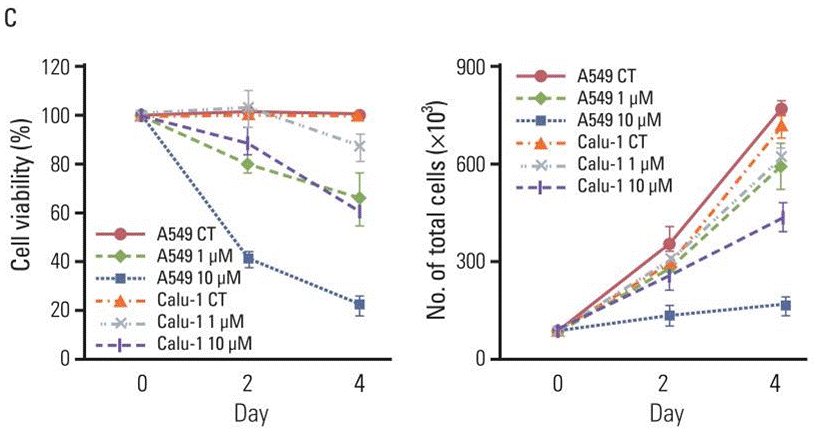
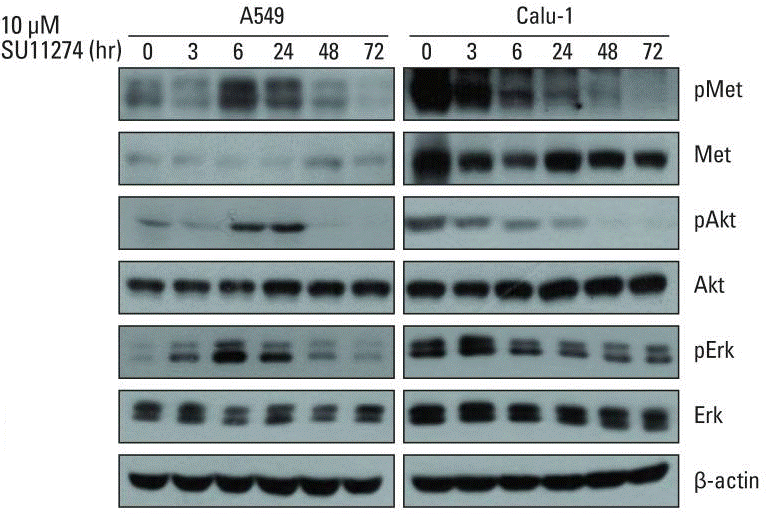
SU11274 exhibe una selectividad más de 50 veces mayor para Met en comparación con Flk y más de 500 veces mayor en comparación con otras Protein Tyrosine Kinase como FGFR-1, c-src, PDGFbR y EGFR. Este compuesto inhibe la fosforilación de reguladores clave de la vía PI3K, incluidos AKT, FKHR o GSK3β. El tratamiento con este químico inhibe el crecimiento de células BaF3 transformadas con TPR-MET de manera dependiente de la dosis con una IC50 de <3 μM en ausencia de interleucina 3, sin inhibición del crecimiento de células BaF3 transformadas por otras Protein Tyrosine Kinase oncogénicas, incluidas BCR-ABL, TEL-JAK2, TEL-ABL y TEL-PDGFβR. Además del crecimiento celular, el tratamiento con este compuesto inhibe significativamente la migración de las células BaF3. TPR-MET en un 44,8% y un 80% a 1 μM y 5 μM, respectivamente. Inhibe la fosforilación de Met dependiente de HGF, así como la proliferación y motilidad celular dependientes de HGF con una IC50 de 1-1,5 μM. En las células H69 y H345 que tienen un receptor Met funcional, este inhibidor inhibe el crecimiento celular inducido por HGF con una IC50 de 3,4 μM y 6,5 μM, respectivamente. Induce la detención del ciclo celular en G1 con un aumento de las células en fase G1 del 42,4% al 70,6% a 5 μM, e induce la apoptosis dependiente de caspasa en un 24% a 1 μM. Este compuesto inhibe la viabilidad celular en células de cáncer de pulmón no microcítico (NSCLC) que expresan c-Met con valores de IC50 de 0,8-4,4 μM, y anula la fosforilación de c-Met y su señalización descendente inducida por el factor de crecimiento de hepatocitos.
|
| Ensayo de quinasa |
Ensayo de la quinasa Met in vitro
|
|
Se construye una proteína quimérica que contiene el dominio citoplasmático de c-Met humano fusionado a la glutatión S-transferasa (GST) y se expresa en células SF9. La proteína de fusión GST de la quinasa c-Met se utiliza para un ensayo bioquímico de Met basado en ELISA usando el copolímero aleatorio poli(Glu:Tyr) (4:1) inmovilizado en placas de microtitulación como sustrato. El valor de IC50 se determina con varias concentraciones de SU11274 en un tampón que contiene 5 μM de ATP y 10 mM de MnCl2, 50 mM de HEPES (pH 7,5), 25 mM de NaCl, 0,01% de BSA y 0,1 mM de ortovanadato de Na. La reacción de la quinasa se realiza durante 5 minutos a temperatura ambiente. La extensión de la fosforilación del sustrato se mide utilizando anticuerpos anti-pTyr conjugados con peroxidasa de rábano picante.
|
Referencias |
|
Aplicaciones
| Métodos | Biomarcadores | Imágenes | PMID |
|---|---|---|---|
| Growth inhibition assay | Cell viability |
|
23341789 |
| Western blot | p-Met / Met / p-AKT / AKT / p-ERK / ERK PUMA / Bcl-2 / Bax |
|
23341789 |
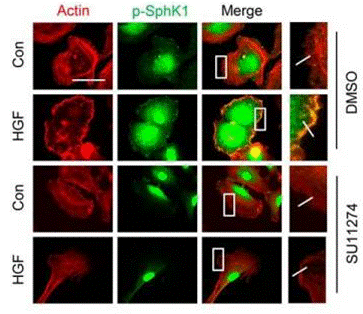
| Immunofluorescence | p-SphK1 |
|
27864331 |
Soporte técnico
Tel: +1-832-582-8158 Ext:3
Si tiene alguna otra consulta, por favor deje un mensaje.
Preguntas frecuentes
Pregunta 1:
What is the solubility of this compound in acetone?
Respuesta:
The solubility of S1080 in acetone is 7 mg/mL.

Los productos son solo para uso de investigación. No para uso humano. No vendemos a pacientes.
©Copyright 2013 Selleck Chemicals. Todos los derechos reservados.