
solo para uso en investigación
KU-60019 Inhibidor de ATM
Cat. No.S1570
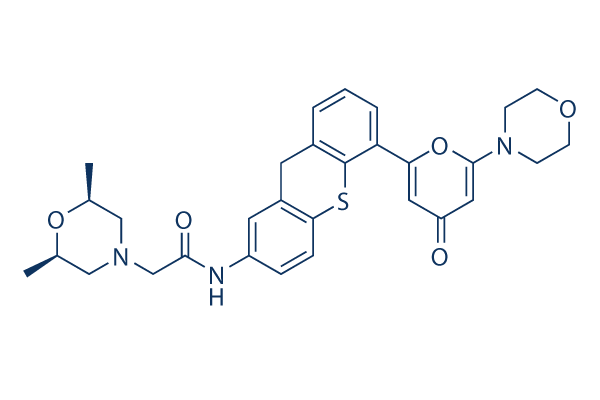
Estructura química
Peso molecular: 547.67
Control de calidad
| Dianas relacionadas | HDAC PARP DNA-PK WRN DNA/RNA Synthesis Topoisomerase PPAR Sirtuin Casein Kinase eIF |
|---|---|
| Otros ATM/ATR Inhibidores | Ceralasertib (AZD6738) AZD1390 Berzosertib (VE-822) Lartesertib (M4076) Camonsertib (RP-3500) KU-55933 VE-821 AZ20 AZD0156 Mirin |
Cultivo celular, tratamiento y concentración de trabajo
| Líneas celulares | Tipo de ensayo | Concentración | Tiempo de incubación | Formulación | Descripción de la actividad | PMID |
|---|---|---|---|---|---|---|
| BAECs | Function Assay | 10 μM | 1 h | DMSO | abolishes the phosphorylation of ATM-Ser1981 | 25498542 |
| BAECs | Function Assay | 10 μM | 1 h | DMSO | inhibits the increase in NOS activity | 25498542 |
| U1242 | Kinase Assay | 3 μM | 0.5 h | DMSO | inhibits the ATM kinase | 23620409 |
| U87 | Kinase Assay | 3 μM | 0.5 h | DMSO | inhibits the ATM kinase | 23620409 |
| U1242 | Apoptosis Assay | 3 μM | 1 h | DMSO | radiosensitizes human glioma cells | 23620409 |
| U87 | Apoptosis Assay | 3 μM | 1 h | DMSO | radiosensitizes human glioma cells | 23620409 |
| U1242 | Kinase Assay | 0.01-3 μM | 1 h | DMSO | blocks ATM kinase activity at low concentrations | 22370485 |
| glioma | Function assay | Inhibition of ATM kinase in human glioma cells, IC50 = 0.006 μM. | 25387153 | |||
| A673 | qHTS assay | qHTS of pediatric cancer cell lines to identify multiple opportunities for drug repurposing: Primary screen for A673 cells | 29435139 | |||
| Saos-2 | qHTS assay | qHTS of pediatric cancer cell lines to identify multiple opportunities for drug repurposing: Primary screen for Saos-2 cells | 29435139 | |||
| OHS-50 | qHTS assay | qHTS of pediatric cancer cell lines to identify multiple opportunities for drug repurposing: Primary screen for OHS-50 cells | 29435139 | |||
| SJ-GBM2 | qHTS assay | qHTS of pediatric cancer cell lines to identify multiple opportunities for drug repurposing: Primary screen for SJ-GBM2 cells | 29435139 | |||
| SK-N-MC | qHTS assay | qHTS of pediatric cancer cell lines to identify multiple opportunities for drug repurposing: Primary screen for SK-N-MC cells | 29435139 | |||
| NB-EBc1 | qHTS assay | qHTS of pediatric cancer cell lines to identify multiple opportunities for drug repurposing: Primary screen for NB-EBc1 cells | 29435139 | |||
| LAN-5 | qHTS assay | qHTS of pediatric cancer cell lines to identify multiple opportunities for drug repurposing: Primary screen for LAN-5 cells | 29435139 | |||
| Rh18 | qHTS assay | qHTS of pediatric cancer cell lines to identify multiple opportunities for drug repurposing: Primary screen for Rh18 cells | 29435139 | |||
| Haga clic para ver más datos experimentales de líneas celulares | ||||||
Información química, almacenamiento y estabilidad
| Peso molecular | 547.67 | Fórmula | C30H33N3O5S |
Almacenamiento (Desde la fecha de recepción) | |
|---|---|---|---|---|---|
| Nº CAS | 925701-49-1 | Descargar SDF | Almacenamiento de soluciones madre |
|
|
| Sinónimos | N/A | Smiles | CC1CN(CC(O1)C)CC(=O)NC2=CC3=C(C=C2)SC4=C(C3)C=CC=C4C5=CC(=O)C=C(O5)N6CCOCC6 | ||
Solubilidad
|
In vitro |
DMSO
: 100 mg/mL
(182.59 mM)
Water : Insoluble Ethanol : Insoluble |
Calculadora de Molaridad
|
In vivo |
|||||
Calculadora de formulación in vivo (Solución clara)
Paso 1: Introduzca la información a continuación (Recomendado: Un animal adicional para tener en cuenta la pérdida durante el experimento)
Paso 2: Introduzca la formulación in vivo (Esto es solo la calculadora, no la formulación. Por favor, contáctenos primero si no hay una formulación in vivo en la sección de Solubilidad.)
Resultados del cálculo:
Concentración de trabajo: mg/ml;
Método para preparar el líquido maestro de DMSO: mg fármaco predissuelto en μL DMSO ( Concentración del líquido maestro mg/mL, Por favor, contáctenos primero si la concentración excede la solubilidad del DMSO del lote del fármaco. )
Método para preparar la formulación in vivo: Tomar μL DMSO líquido maestro, luego añadirμL PEG300, mezclar y clarificar, luego añadirμL Tween 80, mezclar y clarificar, luego añadir μL ddH2O, mezclar y clarificar.
Método para preparar la formulación in vivo: Tomar μL DMSO líquido maestro, luego añadir μL Aceite de maíz, mezclar y clarificar.
Nota: 1. Por favor, asegúrese de que el líquido esté claro antes de añadir el siguiente disolvente.
2. Asegúrese de añadir el (los) disolvente(s) en orden. Debe asegurarse de que la solución obtenida, en la adición anterior, sea una solución clara antes de proceder a añadir el siguiente disolvente. Se pueden utilizar métodos físicos como el vórtice, el ultrasonido o el baño de agua caliente para ayudar a la disolución.
Mecanismo de acción
| Características |
Improved analog of KU-55933, and is more effective at blocking ATM-mediated DDR events.
|
|---|---|
| Targets/IC50/Ki |
ATM
(Cell-free assay) 6.3 nM
|
| In vitro |
En comparación con KU-55933, KU-60019 es un inhibidor mejorado de la quinasa ATM, mientras que muestra una selectividad de diana similar. Este compuesto tiene poca actividad contra DNA-PKcs y ATR con valores de IC50 de 1,7 μM y >10 μM, respectivamente, así como contra otras 229 proteínas quinasas como PI3K, mTOR y mTOR/FKBP12. Muestra una potencia de 3 a 10 veces mayor que KU-55933 para bloquear la fosforilación inducida por radiación de dianas proteicas clave de ATM como p53, γ-H2AX y CHK2, en células de glioma humano U87 y U1242, ya que 1 μM de este inhibidor induce significativamente una disminución de >70% de la fosforilación de p53 (S15) para lo cual se requieren ~10 μM de KU-55933. Este químico radiosensibiliza eficazmente las células de glioma humano con una relación de mejora de la dosis de 1,7 y 4,4 a 1 μM y 10 μM, respectivamente, y también radiosensibiliza los fibroblastos normales pero no los fibroblastos A-T. Su tratamiento (3 μM) bloquea la fosforilación de AKT S473 basal e inducida por insulina en un 70% y ~50%, respectivamente, y reduce completamente la fosforilación de AKT inducida por radiación por debajo del nivel de control. El efecto de este agente sobre la fosforilación de AKT S473 se puede observar en líneas celulares de glioma y fibroblastos normales, pero no en células A-T (h-TERT), y puede ser bloqueado significativamente por el inhibidor de la fosfatasa ácido okadaico, lo que sugiere un papel crítico de la quinasa ATM en la regulación de la fosforilación de AKT a través de una fosfatasa desconocida. De acuerdo con la inhibición de la señalización de AKT prosúpervivencia, a 3 μM inhibe significativamente la migración e invasión de células de glioma humano U87 en >70% y ~60%, respectivamente, así como de células U1242 en >50% y ~60% respectivamente. |
| In vivo |
En modelos de xenoinjerto de glioma ortotópico U1242/luc-GFP, la combinación de KU-60019 y radiación aumenta significativamente la supervivencia de los ratones que este compuesto solo, la radiación sola o ningún tratamiento. Además, los gliomas mutantes p53 son mucho más sensibles a esta radiosensibilización química que el glioma de tipo salvaje. |
Referencias |
|
Aplicaciones
| Métodos | Biomarcadores | Imágenes | PMID |
|---|---|---|---|
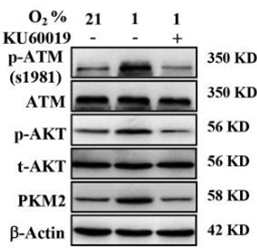
| Western blot | p-ATM / ATM / p-AKT / AKT / PKM2 |
|
30799198 |
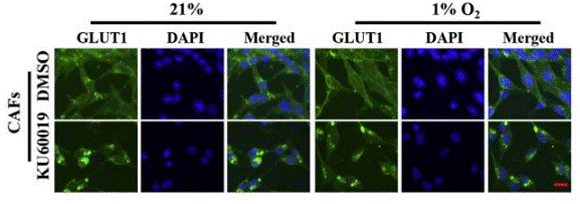
| Immunofluorescence | GLUT1 |
|
30799198 |
Soporte técnico
Tel: +1-832-582-8158 Ext:3
Si tiene alguna otra consulta, por favor deje un mensaje.
Preguntas frecuentes
Pregunta 1:
what vehicle do you recommend for in vivo use of this compound?
Respuesta:
The formula for i.p. injections of this compound: 5% stock solution (100mg/ml) +30% PEG 300+ddH2O could reach a final concentration of 5mg/ml.

Los productos son solo para uso de investigación. No para uso humano. No vendemos a pacientes.
©Copyright 2013 Selleck Chemicals. Todos los derechos reservados.