
solo para uso en investigación
Bupivacaine HCl Sodium Channel inhibidor
Cat. No.S2454
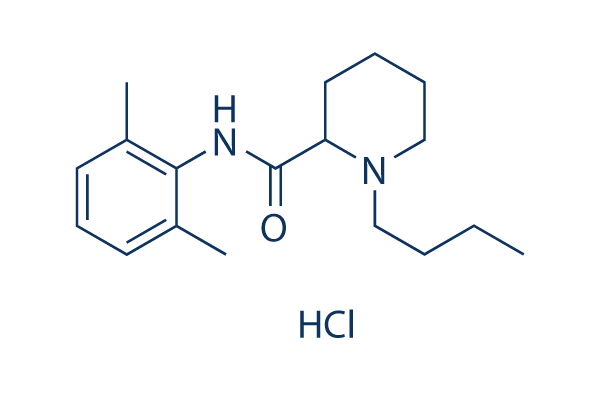
Estructura química
Peso molecular: 324.89
Control de calidad
| Dianas relacionadas | CFTR CRM1 CD markers AChR Calcium Channel Potassium Channel GABA Receptor TRP Channel ATPase GluR |
|---|---|
| Otros Sodium Channel Inhibidores | Camostat Mesilate A-803467 cariporide Tolperisone HCl Vinpocetine Veratramine Bulleyaconi cine A Ambroxol HCl Benzocaine Nefopam HCl |
Información química, almacenamiento y estabilidad
| Peso molecular | 324.89 | Fórmula | C18H28N2O.HCl |
Almacenamiento (Desde la fecha de recepción) | |
|---|---|---|---|---|---|
| Nº CAS | 18010-40-7 | Descargar SDF | Almacenamiento de soluciones madre |
|
|
| Sinónimos | N/A | Smiles | CCCCN1CCCCC1C(=O)NC2=C(C=CC=C2C)C.Cl | ||
Solubilidad
|
In vitro |
DMSO
: 65 mg/mL
(200.06 mM)
Water : 65 mg/mL Ethanol : 65 mg/mL |
Calculadora de Molaridad
|
In vivo |
|||||
Calculadora de formulación in vivo (Solución clara)
Paso 1: Introduzca la información a continuación (Recomendado: Un animal adicional para tener en cuenta la pérdida durante el experimento)
Paso 2: Introduzca la formulación in vivo (Esto es solo la calculadora, no la formulación. Por favor, contáctenos primero si no hay una formulación in vivo en la sección de Solubilidad.)
Resultados del cálculo:
Concentración de trabajo: mg/ml;
Método para preparar el líquido maestro de DMSO: mg fármaco predissuelto en μL DMSO ( Concentración del líquido maestro mg/mL, Por favor, contáctenos primero si la concentración excede la solubilidad del DMSO del lote del fármaco. )
Método para preparar la formulación in vivo: Tomar μL DMSO líquido maestro, luego añadirμL PEG300, mezclar y clarificar, luego añadirμL Tween 80, mezclar y clarificar, luego añadir μL ddH2O, mezclar y clarificar.
Método para preparar la formulación in vivo: Tomar μL DMSO líquido maestro, luego añadir μL Aceite de maíz, mezclar y clarificar.
Nota: 1. Por favor, asegúrese de que el líquido esté claro antes de añadir el siguiente disolvente.
2. Asegúrese de añadir el (los) disolvente(s) en orden. Debe asegurarse de que la solución obtenida, en la adición anterior, sea una solución clara antes de proceder a añadir el siguiente disolvente. Se pueden utilizar métodos físicos como el vórtice, el ultrasonido o el baño de agua caliente para ayudar a la disolución.
Mecanismo de acción
| Targets/IC50/Ki |
Sodium channel
|
|---|---|
| In vitro |
La solución de Bupivacaine es citotóxica para los condrocitos articulares bovinos y el cartílago articular in vitro después de solo 15 a 30 minutos de exposición. La Bupivacaine actúa en mitocondrias aisladas, como desacoplador entre el consumo de oxígeno y la fosforilación de difosfato de adenosina. La Bupivacaine provoca una despolarización mitocondrial dependiente de la concentración y una oxidación de nucleótidos de piridina en mitocondrias aisladas, que se corresponden con un aumento del consumo de oxígeno a concentraciones de Bupivacaine de 1,5 mM o menos a pH 7,4, mientras que la respiración se inhibe a concentraciones más altas. La Bupivacaine provoca la apertura del poro de transición de permeabilidad (PTP), un canal de la membrana interna sensible a la ciclosporina A que desempeña un papel clave en muchas formas de muerte celular. La Bupivacaine provoca despolarización mitocondrial y oxidación de nucleótidos de piridina que se corresponden con un aumento de las concentraciones de Ca(2+) libre citosólico, la liberación de citocromo c y, finalmente, la hipercontractura en fibras intactas del flexor corto de los dedos. La Bupivacaine inhibe los canales GIRK a los pocos segundos de la aplicación, independientemente de si los canales se activan a través del receptor muscarínico o directamente a través de las subunidades G(beta)gamma de la proteína G coexpresadas. La Bupivacaine también inhibe las corrientes GIRK inducidas por alcohol en ausencia de proteínas G funcionales sensibles a la toxina pertussis. Bupivacaine HCl también inhibe potentemente la producción de cAMP con una IC50 de 2,3 μM.
|
| In vivo |
La Bupivacaine no solo induce la liberación de Ca2+ del retículo sarcoplásmico (RS) en ratas, sino que también inhibe la captación de Ca2+ por el RS, que está regulada principalmente por la actividad de la adenosina trifosfatasa de Ca2+ del RS.
|
Referencias |
|
Información del ensayo clínico
(datos de https://clinicaltrials.gov, actualizado el 2024-05-22)
| Número NCT | Reclutamiento | Condiciones | Patrocinador/Colaboradores | Fecha de inicio | Fases |
|---|---|---|---|---|---|
| NCT05038956 | Not yet recruiting | Video-assisted Thoracic Surgery (VATS) |
University of Utah |
May 1 2024 | -- |
| NCT06252662 | Not yet recruiting | Breast Cancer |
United States Naval Medical Center Portsmouth |
April 2024 | Phase 4 |
| NCT06350981 | Not yet recruiting | Back Pain|Surgery-Complications|Narcotic Use|Physical Stress|Post Operative Pain |
Foundation for Orthopaedic Research and Education|Pacira Pharmaceuticals Inc |
April 1 2024 | Phase 2|Phase 3 |
| NCT04003506 | Not yet recruiting | Pain Postoperative |
The University of Hong Kong |
March 1 2024 | Phase 4 |
| NCT06293404 | Not yet recruiting | Hip Fractures|Spinal Anesthesia |
Ankara City Hospital Bilkent |
March 1 2024 | Not Applicable |
Soporte técnico
Tel: +1-832-582-8158 Ext:3
Si tiene alguna otra consulta, por favor deje un mensaje.

Los productos son solo para uso de investigación. No para uso humano. No vendemos a pacientes.
©Copyright 2013 Selleck Chemicals. Todos los derechos reservados.