
solo para uso en investigación
VPA (Valproic acid) HDAC inhibidor
Cat. No.S3944
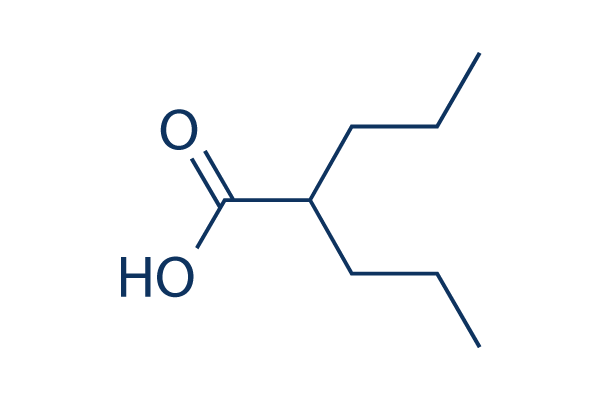
Estructura química
Peso molecular: 144.21
Control de calidad
Cultivo celular, tratamiento y concentración de trabajo
| Líneas celulares | Tipo de ensayo | Concentración | Tiempo de incubación | Formulación | Descripción de la actividad | PMID |
|---|---|---|---|---|---|---|
| HEK293 | Function assay | 1 mM | Increase in protein disulfide isomerase level in HEK293 cells at 1 mM by immunoblot | 17566732 | ||
| HEK293 | Function assay | 1 mM | Increase in GRP78 protein level in HEK293 cells at 1 mM by immunoblot | 17566732 | ||
| A549 | Function assay | 150 uM | 24 hrs | Inhibition of human HDAC in A549 cells assessed as increase in histone-H4 acetylation at 150 uM after 24 hrs by Western blot | 18294844 | |
| GM15850 | Function assay | 400 uM | 12 hrs | Inhibition of HDAC in human GM15850 cells assessed as increase in total acetylated histone level at 400 uM after 12 hrs by Western blot analysis | 16921367 | |
| PC12 | Function assay | 1 uM | 24 hrs | Induction of autophagy in rat stable inducible PC12 cells expressing A53T alpha-synuclein assessed as A53T alpha-synuclein clearance at 1 uM after 24 hrs by densitometric analysis | 18391949 | |
| PC12 | Function assay | 1 uM | 96 hrs | Induction of autophagy in rat stable inducible PC12 cells expressing EGFP-HDQ74 assessed as soluble EGFP-HDQ74 clearance at 1 uM after 96 hrs by densitometric analysis | 18391949 | |
| SK-N-MC | Function assay | 1 mM | 48 hrs | Induction of autophagy in human SK-N-MC cells expressing EGFP-HDQ74 assessed as reduction in EGFP-HDQ74 aggregation at 1 uM after 48 hrs by densitometric analysis | 18391949 | |
| HL60 | Function assay | 1 mM | 24 hrs | Inhibition of HDAC in human HL60 cells assessed as increase in histone H3 acetylation at 1 mM after 24 hrs by Western blotting method | 25304896 | |
| Haga clic para ver más datos experimentales de líneas celulares | ||||||
Información química, almacenamiento y estabilidad
| Peso molecular | 144.21 | Fórmula | C8H16O2 |
Almacenamiento (Desde la fecha de recepción) | 2 years -20°C liquid |
|---|---|---|---|---|---|
| Nº CAS | 99-66-1 | -- | Almacenamiento de soluciones madre |
|
|
| Sinónimos | 2-Propylvaleric Acid, Valproate | Smiles | CCCC(CCC)C(=O)O | ||
Solubilidad
|
In vitro |
DMSO
: 29 mg/mL
(201.09 mM)
Water : 29 mg/mL Ethanol : 29 mg/mL |
Calculadora de Molaridad
|
In vivo |
|||||
Calculadora de formulación in vivo (Solución clara)
Paso 1: Introduzca la información a continuación (Recomendado: Un animal adicional para tener en cuenta la pérdida durante el experimento)
Paso 2: Introduzca la formulación in vivo (Esto es solo la calculadora, no la formulación. Por favor, contáctenos primero si no hay una formulación in vivo en la sección de Solubilidad.)
Resultados del cálculo:
Concentración de trabajo: mg/ml;
Método para preparar el líquido maestro de DMSO: mg fármaco predissuelto en μL DMSO ( Concentración del líquido maestro mg/mL, Por favor, contáctenos primero si la concentración excede la solubilidad del DMSO del lote del fármaco. )
Método para preparar la formulación in vivo: Tomar μL DMSO líquido maestro, luego añadirμL PEG300, mezclar y clarificar, luego añadirμL Tween 80, mezclar y clarificar, luego añadir μL ddH2O, mezclar y clarificar.
Método para preparar la formulación in vivo: Tomar μL DMSO líquido maestro, luego añadir μL Aceite de maíz, mezclar y clarificar.
Nota: 1. Por favor, asegúrese de que el líquido esté claro antes de añadir el siguiente disolvente.
2. Asegúrese de añadir el (los) disolvente(s) en orden. Debe asegurarse de que la solución obtenida, en la adición anterior, sea una solución clara antes de proceder a añadir el siguiente disolvente. Se pueden utilizar métodos físicos como el vórtice, el ultrasonido o el baño de agua caliente para ayudar a la disolución.
Mecanismo de acción
| Targets/IC50/Ki |
HDAC
HDAC1
(Cell-free assay) 0.4 mM
|
|---|---|
| In vitro |
Al igual que el litio, el ácido valproico (VPA) activa la expresión génica dependiente de Wnt, pero a diferencia del litio, no inhibe la GSK-3β in vivo. Este compuesto puede inhibir la fosforilación de un péptido CREB mediada por GSK-3β in vitro. Puede activar la expresión génica dependiente de Wnt a través de la inhibición de HDAC, lo que a su vez conduce tanto a un aumento de la expresión de β-catenina como a la desrepresión de Tcf/Lef (así como a la activación de otros genes regulados por HDAC). In vitro, el VPA puede estimular la glutamato descarboxilasa, que está implicada en la biosíntesis de GABA, e inhibir la GABA transaminasa, la semialdehído succínico deshidrogenasa y la α-cetoglutarato deshidrogenasa, enzimas implicadas en la degradación de GABA. Alivia la represión transcripcional dependiente de HDAC y provoca la hiperacetilación de histonas en células cultivadas e in vivo. El VPA induce la diferenciación y/o la apoptosis de células de carcinoma, células progenitoras hematopoyéticas transformadas por PML-RAR y blastos leucémicos de pacientes con LMA. Además de inhibir selectivamente la actividad catalítica de las HDAC de clase I, también induce la degradación proteasómica de HDAC2.
|
| In vivo |
El ácido valproico (VPA) aumenta el nivel del neurotransmisor inhibidor γ-aminobutírico (GABA), con una administración aguda que provoca un aumento del 15-45% de GABA en el cerebro de roedores. También inhibe el crecimiento tumoral y la metástasis en experimentos con animales, y es un fármaco bien tolerado incluso durante el tratamiento a largo plazo.
|
Referencias |
|
Aplicaciones
| Métodos | Biomarcadores | Imágenes | PMID |
|---|---|---|---|
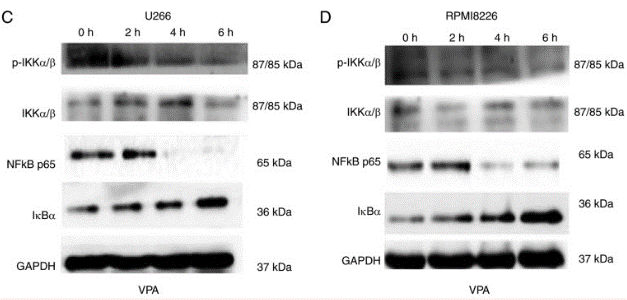
| Western blot | p-IKKα/β / IKKα/β / NF-κB p65 / IκBα Acetyl-H3 acetyl-H4 |
|
30387821 |
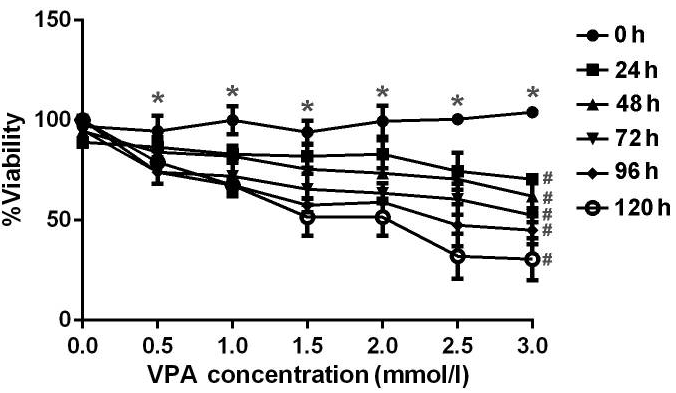
| Growth inhibition assay | Cell viability |
|
28101176 |
Información del ensayo clínico
(datos de https://clinicaltrials.gov, actualizado el 2024-05-22)
| Número NCT | Reclutamiento | Condiciones | Patrocinador/Colaboradores | Fecha de inicio | Fases |
|---|---|---|---|---|---|
| NCT04671589 | Unknown status | Drug Toxicity |
Mabaret Al-Asafara Hospitals |
June 2021 | Phase 4 |
| NCT04384172 | Recruiting | Female Sexual Dysfunction|Spinal Cord Injuries |
University of Michigan|International Society for the Study of Women''s Sexual Health|The Craig H. Neilsen Foundation |
November 11 2020 | Not Applicable |
| NCT03962829 | Terminated | Eating Behavior|Obesity |
University of Birmingham|University Hospital Birmingham |
February 1 2019 | Not Applicable |
| NCT03681158 | Completed | Epilepsy |
Sanofi |
October 5 2018 | Phase 1 |
Soporte técnico
Tel: +1-832-582-8158 Ext:3
Si tiene alguna otra consulta, por favor deje un mensaje.

Los productos son solo para uso de investigación. No para uso humano. No vendemos a pacientes.
©Copyright 2013 Selleck Chemicals. Todos los derechos reservados.