
solo para uso en investigación
TBHQ Nrf2 activador
Cat. No.S4990
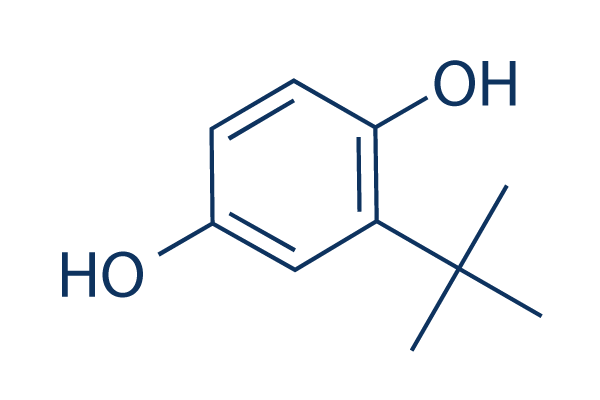
Estructura química
Peso molecular: 166.22
Control de calidad
| Dianas relacionadas | PD-1/PD-L1 CXCR STING AhR Immunology & Inflammation related CD markers Interleukins Anti-infection Antioxidant COX |
|---|---|
| Otros Nrf2 Inhibidores | Bardoxolone Methyl (RTA 402) ML385 Brusatol Sulforaphane Oltipraz Bardoxolone (CDDO) 4-Octyl Itaconate (4-OI) KI696 CDDO-Im (RTA-403) Mangiferin |
Información química, almacenamiento y estabilidad
| Peso molecular | 166.22 | Fórmula | C10H14O2 |
Almacenamiento (Desde la fecha de recepción) | |
|---|---|---|---|---|---|
| Nº CAS | 1948-33-0 | -- | Almacenamiento de soluciones madre |
|
|
| Sinónimos | Tert-butylhydroquinone | Smiles | CC(C)(C)C1=C(C=CC(=C1)O)O | ||
Solubilidad
|
In vitro |
DMSO
: 33 mg/mL
(198.53 mM)
Ethanol : 33 mg/mL Water : 4 mg/mL |
Calculadora de Molaridad
|
In vivo |
|||||
Calculadora de formulación in vivo (Solución clara)
Paso 1: Introduzca la información a continuación (Recomendado: Un animal adicional para tener en cuenta la pérdida durante el experimento)
Paso 2: Introduzca la formulación in vivo (Esto es solo la calculadora, no la formulación. Por favor, contáctenos primero si no hay una formulación in vivo en la sección de Solubilidad.)
Resultados del cálculo:
Concentración de trabajo: mg/ml;
Método para preparar el líquido maestro de DMSO: mg fármaco predissuelto en μL DMSO ( Concentración del líquido maestro mg/mL, Por favor, contáctenos primero si la concentración excede la solubilidad del DMSO del lote del fármaco. )
Método para preparar la formulación in vivo: Tomar μL DMSO líquido maestro, luego añadirμL PEG300, mezclar y clarificar, luego añadirμL Tween 80, mezclar y clarificar, luego añadir μL ddH2O, mezclar y clarificar.
Método para preparar la formulación in vivo: Tomar μL DMSO líquido maestro, luego añadir μL Aceite de maíz, mezclar y clarificar.
Nota: 1. Por favor, asegúrese de que el líquido esté claro antes de añadir el siguiente disolvente.
2. Asegúrese de añadir el (los) disolvente(s) en orden. Debe asegurarse de que la solución obtenida, en la adición anterior, sea una solución clara antes de proceder a añadir el siguiente disolvente. Se pueden utilizar métodos físicos como el vórtice, el ultrasonido o el baño de agua caliente para ayudar a la disolución.
Mecanismo de acción
| Targets/IC50/Ki |
Nrf2
|
|---|---|
| In vitro |
La terc-butilhidroquinona (tBHQ) es un metabolito del compuesto químico butilhidroxianisol e induce la activación de Nrf2 y confiere protección contra el peróxido de hidrógeno, la 6-hidroxidopamina, la deltametrina pesticida y otros tóxicos. Este compuesto altera preferentemente el estado redox en el compartimento mitocondrial en células HeLa. Las células HeLa tratadas con este químico muestran una oxidación preferencial de la tiorredoxina-2 mitocondrial (Trx2), mientras que el glutatión celular y la tiorredoxina-1 citosólica no se ven afectados. En células H9c2 cultivadas y miocitos cardíacos primarios, estimula la fosforilación de Akt y suprime la apoptosis inducida por oxidantes.
|
| In vivo |
El tratamiento con TBHQ provoca acciones citoprotectoras significativas en diferentes órganos bajo condiciones patológicas. El tratamiento sistémico o local intracerebroventricular con este compuesto en un modelo de accidente cerebrovascular isquémico en ratas reduce significativamente el tamaño del infarto y los déficits neurológicos. La administración de este químico en ratas suprime el daño renal y el estrés oxidativo después de una lesión por isquemia y reperfusión. En ratones con diabetes tipo 1, el tratamiento crónico con este compuesto reduce significativamente el grado de fibrosis glomerular y mejora la proteinuria. Este compuesto previene la dilatación ventricular izquierda y la disfunción cardíaca inducidas por la constricción aórtica transversa (TAC), y disminuye la prevalencia de apoptosis miocárdica. Los efectos beneficiosos de este químico están asociados con un aumento en la activación de Akt, pero no relacionados con las activaciones de Nrf2 o la proteína quinasa activada por AMP. La activación de Akt inducida por este compuesto se acompaña de un aumento de la fosforilación de Bad, la glucógeno sintasa quinasa-3β (GSK-3β) y el objetivo mamífero de la rapamicina (mTOR).
|
Referencias |
|
Aplicaciones
| Métodos | Biomarcadores | Imágenes | PMID |
|---|---|---|---|
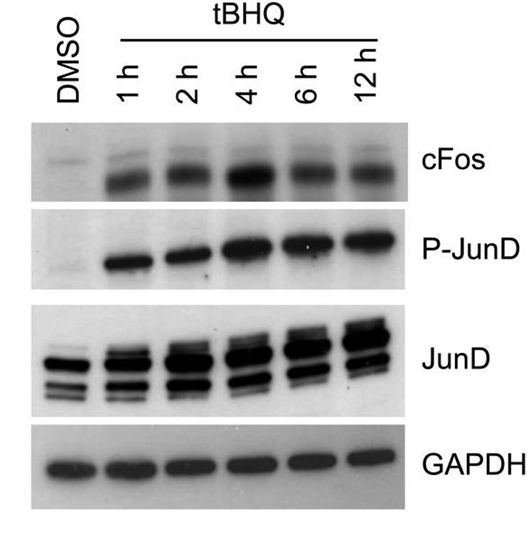
| Western blot | c-Fos / p-JunD / JunD p-JNK / JNK / p-ERK / ERK p-AKT / AKT α-Nrf2 / α-AKR1C1 |
|
24830941 |
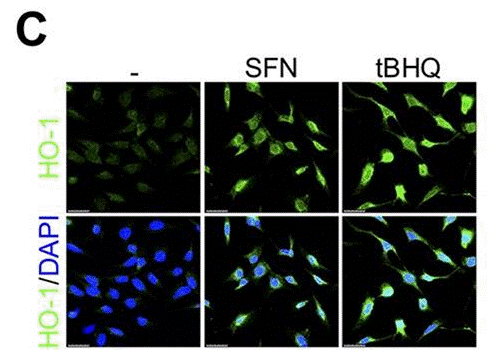
| Immunofluorescence | HO-1 |
|
31333462 |
Soporte técnico
Tel: +1-832-582-8158 Ext:3
Si tiene alguna otra consulta, por favor deje un mensaje.

Los productos son solo para uso de investigación. No para uso humano. No vendemos a pacientes.
©Copyright 2013 Selleck Chemicals. Todos los derechos reservados.