
solo para uso en investigación
Simvastatin (MK-733) HMG-CoA Reductase inhibidor
Cat. No.S1792
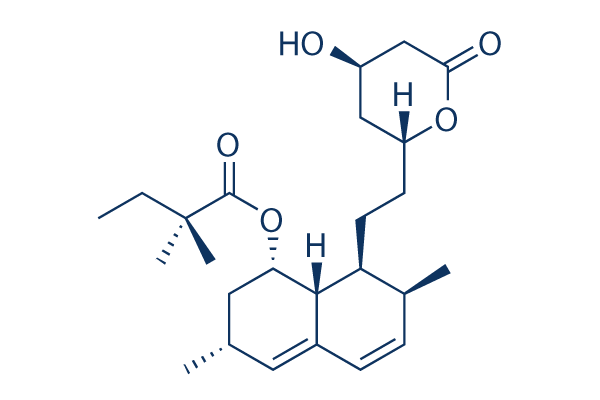
Estructura química
Peso molecular: 418.57
Control de calidad
| Dianas relacionadas | Dehydrogenase HSP Transferase P450 (e.g. CYP17) PDE phosphatase PPAR Vitamin Carbohydrate Metabolism Mitochondrial Metabolism |
|---|---|
| Otros HMG-CoA Reductase Inhibidores | Mevastatin SR-12813 Clinofibrate Dihydrolanosterol 7-ketocholesterol Cerivastatin sodium |
Cultivo celular, tratamiento y concentración de trabajo
| Líneas celulares | Tipo de ensayo | Concentración | Tiempo de incubación | Formulación | Descripción de la actividad | PMID |
|---|---|---|---|---|---|---|
| rat liver hepatocytes | Function assay | 4 h | Inhibition of cholesterol synthesis in rat liver hepatocytes after 4 hrs, IC50=1.3 nM | |||
| rat L6 cells | Function assay | Inhibition of cholesterol synthesis in rat L6 cells assessed as incorporation of [14C]acetate into cholesterol, IC50=0.027 μM | ||||
| HepG2 cells | Function assay | In vitro inhibitory activity was evaluated on cholesterol biosynthesis in HepG2 cells, IC50=0.04 μM | ||||
| HEK293 cells | Function assay | Inhibition of OATP1B1 (unknown origin) expressed in HEK293 cells using estradiol-17beta-glucuronide substrate, IC50=4.4 μM | ||||
| human A549 cells | Cytotoxic assay | 72 h | Cytotoxicity against human A549 cells after 72 hrs by MTT assay, IC50=16.3 μM | |||
| human HS68 cells | Cytotoxic assay | Cytotoxicity against human HS68 cells after 72 hrs by MTT assay, IC50=26.4 μM | ||||
| mouse MEF cells | Cytotoxic assay | Cytotoxicity against mouse MEF cells after 72 hrs by MTT assay, IC50=36.7 μM | ||||
| RASMC cells | Function assay | 2 μM | 72 h | Inhibition of rat Ftase in RASMC cells assessed as reduction in Ras prenylation at 2 uM after 72 hrs by Western blot analysis | ||
| Haga clic para ver más datos experimentales de líneas celulares | ||||||
Información química, almacenamiento y estabilidad
| Peso molecular | 418.57 | Fórmula | C25H38O5 |
Almacenamiento (Desde la fecha de recepción) | |
|---|---|---|---|---|---|
| Nº CAS | 79902-63-9 | Descargar SDF | Almacenamiento de soluciones madre |
|
|
| Sinónimos | MK 733 | Smiles | CCC(C)(C)C(=O)OC1CC(C=C2C1C(C(C=C2)C)CCC3CC(CC(=O)O3)O)C | ||
Solubilidad
|
In vitro |
DMSO
: 83 mg/mL
(198.29 mM)
Ethanol : 83 mg/mL Water : Insoluble |
Calculadora de Molaridad
|
In vivo |
|||||
Calculadora de formulación in vivo (Solución clara)
Paso 1: Introduzca la información a continuación (Recomendado: Un animal adicional para tener en cuenta la pérdida durante el experimento)
Paso 2: Introduzca la formulación in vivo (Esto es solo la calculadora, no la formulación. Por favor, contáctenos primero si no hay una formulación in vivo en la sección de Solubilidad.)
Resultados del cálculo:
Concentración de trabajo: mg/ml;
Método para preparar el líquido maestro de DMSO: mg fármaco predissuelto en μL DMSO ( Concentración del líquido maestro mg/mL, Por favor, contáctenos primero si la concentración excede la solubilidad del DMSO del lote del fármaco. )
Método para preparar la formulación in vivo: Tomar μL DMSO líquido maestro, luego añadirμL PEG300, mezclar y clarificar, luego añadirμL Tween 80, mezclar y clarificar, luego añadir μL ddH2O, mezclar y clarificar.
Método para preparar la formulación in vivo: Tomar μL DMSO líquido maestro, luego añadir μL Aceite de maíz, mezclar y clarificar.
Nota: 1. Por favor, asegúrese de que el líquido esté claro antes de añadir el siguiente disolvente.
2. Asegúrese de añadir el (los) disolvente(s) en orden. Debe asegurarse de que la solución obtenida, en la adición anterior, sea una solución clara antes de proceder a añadir el siguiente disolvente. Se pueden utilizar métodos físicos como el vórtice, el ultrasonido o el baño de agua caliente para ayudar a la disolución.
Mecanismo de acción
| Targets/IC50/Ki |
HMG-CoA reductase
(Cell-free assay) 0.1-0.2 nM(Ki)
|
|---|---|
| In vitro |
Antes de su uso en ensayos celulares, la Simvastatin necesita ser activada por tratamiento con NaOH en EtOH. Este compuesto inhibe la síntesis de colesterol en células L-M de ratón (fibroblastos), células H4II E de rata (hígado) y células Hep G2 humanas (hígado) con un IC50 de 19.3 nM, 13.3 nM y 15.6 nM, respectivamente. Este tratamiento con el compuesto conduce a un aumento dosis-dependiente en la fosforilación de serina 473 de Akt en 30 minutos, con la fosforilación máxima ocurriendo a 1.0 µM. Éste (1.0 μM) mejora la fosforilación del sustrato endógeno de Akt, la óxido nítrico sintasa endotelial (eNOS), inhibe la apoptosis de los medios libres de suero y acelera la formación de la estructura vascular. Este químico muestra efectos antiinflamatorios in vitro. Éste (10 μM) reduce la proliferación de células mononucleares derivadas de la sangre periférica y células del líquido sinovial de la sangre de artritis reumatoide estimulada por anticuerpos anti-CD3/anti-CD28, así como la liberación de IFN-γ. Este compuesto (10 μM) suprime la liberación de TNF-γ mediada por macrófagos inducida por interacciones cognadas en aproximadamente un 30 %. |
| Ensayo de quinasa |
Ensayo de actividad de la HMG-CoA reductasa
|
|
El volumen total de cada ensayo es de 95 μL y la mezcla de reacción contenía 10 μL del compuesto inhibidor a probar y 85 μL del tampón de incubación que contenía 2 mg/mL de microsomas hepáticos, 0,1 M de KH2PO4, pH 7,2, 5,7 mM de ditiotreitol, 10 mM de glucosa-6-fosfato, 2 U/mL de glucosa-6-fosfato deshidrogenasa, 1 mM de NADP, 10 μM de miconazol. Los experimentos de control se realizan sin sistema generador de NADPH. Todas las muestras se incuban 10 min a 37 ℃ antes de la adición de 5μL de sustrato (HMG-3-hidroxi-3-metilglutaril CoA no marcado y 14C, concentración final 50 μM, 2,5 nCi/nmole). Después de 30 min a 37 ℃, la reacción se detiene añadiendo 27 μL de HCl 1N y 20 μL de mevalonolactona no marcada (200 μg/ensayo). La conversión de ácido mevalónico a lactona se realiza a temperatura ambiente durante 60 min.
|
|
| In vivo |
La administración oral de Simvastatin inhibe la conversión de acetato radiomarcado a colesterol con una IC50 de 0,2 mg/kg. Este compuesto (4 mg/día) administrado oralmente durante 13 semanas a conejos alimentados con una dieta aterogénica rica en colesterol, devuelve los aumentos inducidos por el colesterol en el colesterol total, el colesterol LDL y el colesterol HDL a niveles normales. Este compuesto (6 mg/kg) produce un aumento en la unión dependiente del receptor de LDL y aumenta el número de receptores de LDL hepáticos en conejos alimentados con una dieta que contiene 0,25% de colesterol. Este compuesto influye en la inflamación independientemente de su efecto sobre el nivel de colesterol plasmático. En monos cynomolgus que consumieron una dieta aterogénica, este compuesto (20 mg/kg/día) induce un contenido de macrófagos 1,3 veces menor en las lesiones, y una expresión 2 veces menor de la molécula de adhesión celular vascular-1, interleucina-1 beta y factor tisular, acompañado de un aumento 2,1 veces mayor en el contenido de células de músculo liso y colágeno de las lesiones. |
Referencias |
|
Aplicaciones
| Métodos | Biomarcadores | Imágenes | PMID |
|---|---|---|---|
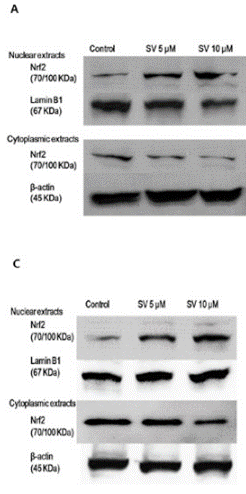
| Western blot | Nrf2 p-RB / Cyclin D1 / p21 / p27 / PCNA / CDC45 AMPK / p-AMPK / P70S6 / p-P70S6 / LC3 / Atg7 Bcl-2 / PARP / Caspase-3 / Cleaved Caspase-3 HMGCR |
|
27323826 |
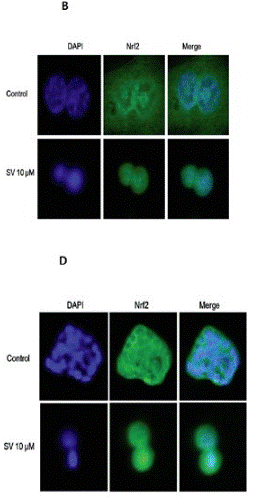
| Immunofluorescence | Nrf2 LC3A/B |
|
27323826 |
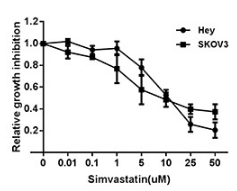
| Growth inhibition assay | Cell viability |
|
26503475 |
Información del ensayo clínico
(datos de https://clinicaltrials.gov, actualizado el 2024-05-22)
| Número NCT | Reclutamiento | Condiciones | Patrocinador/Colaboradores | Fecha de inicio | Fases |
|---|---|---|---|---|---|
| NCT05771675 | Not yet recruiting | Recurrent Acute Pancreatitis|Chronic Pancreatitis |
Cedars-Sinai Medical Center|United States Department of Defense |
January 2024 | Early Phase 1 |
| NCT05542095 | Withdrawn | Olfactory Disorder|COVID-19 |
Washington University School of Medicine|Duke University |
May 1 2023 | Phase 1 |
| NCT06207682 | Completed | Healthy Volunteers |
Amgen |
June 28 2022 | Phase 1 |
Soporte técnico
Tel: +1-832-582-8158 Ext:3
Si tiene alguna otra consulta, por favor deje un mensaje.
Preguntas frecuentes
Pregunta 1:
Can you please advise if it has been tested effectively for in vivo use in mice? What solvent can be used to deliver this compound in vivo?
Respuesta:
This compound is an oral drug and a lot of studies report its use in mice. According to this paper (http://atvb.ahajournals.org/content/21/1/115.full), 0.5% Methyl-cellulose can be used as the vehicle.
Pregunta 2:
If any specific protocols exist for in vitro use, specifically any steps required to activate it?
Respuesta:
This compound is supplied in an inactive form and requires treatment with NaOH in EtOH followed by neutralization to pH 7.2 for activation. Please find the details from the following reference: http://www.ncbi.nlm.nih.gov/pmc/articles/PMC2739764/.

Los productos son solo para uso de investigación. No para uso humano. No vendemos a pacientes.
©Copyright 2013 Selleck Chemicals. Todos los derechos reservados.