
solo para uso en investigación
Prucalopride 5-HT Receptor agonista
Cat. No.S2875
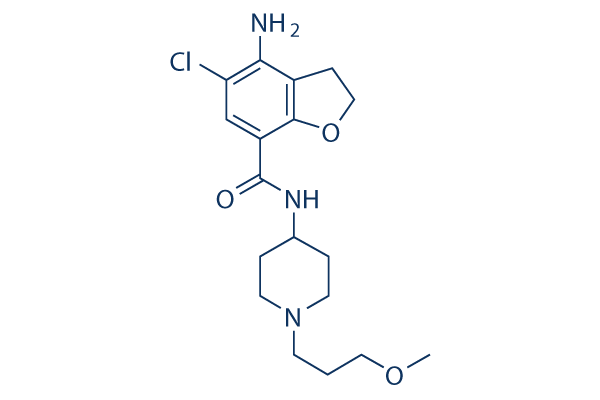
Estructura química
Peso molecular: 367.87
Control de calidad
| Dianas relacionadas | Adrenergic Receptor AChR COX Calcium Channel Histamine Receptor Dopamine Receptor GABA Receptor TRP Channel Cholinesterase (ChE) GluR |
|---|---|
| Otros 5-HT Receptor Inhibidores | WAY-100635 Maleate Serotonin (5-HT) HCl Puerarin BRL-15572 Dihydrochloride SB269970 HCl Ketanserin RS-127445 Nuciferine Flopropione BRL-54443 |
Información química, almacenamiento y estabilidad
| Peso molecular | 367.87 | Fórmula | C18H26ClN3O3 |
Almacenamiento (Desde la fecha de recepción) | |
|---|---|---|---|---|---|
| Nº CAS | 179474-81-8 | Descargar SDF | Almacenamiento de soluciones madre |
|
|
| Sinónimos | R-93877 | Smiles | COCCCN1CCC(CC1)NC(=O)C2=CC(=C(C3=C2OCC3)N)Cl | ||
Solubilidad
|
In vitro |
DMSO
: 74 mg/mL
(201.15 mM)
Ethanol : 74 mg/mL Water : Insoluble |
Calculadora de Molaridad
|
In vivo |
|||||
Calculadora de formulación in vivo (Solución clara)
Paso 1: Introduzca la información a continuación (Recomendado: Un animal adicional para tener en cuenta la pérdida durante el experimento)
Paso 2: Introduzca la formulación in vivo (Esto es solo la calculadora, no la formulación. Por favor, contáctenos primero si no hay una formulación in vivo en la sección de Solubilidad.)
Resultados del cálculo:
Concentración de trabajo: mg/ml;
Método para preparar el líquido maestro de DMSO: mg fármaco predissuelto en μL DMSO ( Concentración del líquido maestro mg/mL, Por favor, contáctenos primero si la concentración excede la solubilidad del DMSO del lote del fármaco. )
Método para preparar la formulación in vivo: Tomar μL DMSO líquido maestro, luego añadirμL PEG300, mezclar y clarificar, luego añadirμL Tween 80, mezclar y clarificar, luego añadir μL ddH2O, mezclar y clarificar.
Método para preparar la formulación in vivo: Tomar μL DMSO líquido maestro, luego añadir μL Aceite de maíz, mezclar y clarificar.
Nota: 1. Por favor, asegúrese de que el líquido esté claro antes de añadir el siguiente disolvente.
2. Asegúrese de añadir el (los) disolvente(s) en orden. Debe asegurarse de que la solución obtenida, en la adición anterior, sea una solución clara antes de proceder a añadir el siguiente disolvente. Se pueden utilizar métodos físicos como el vórtice, el ultrasonido o el baño de agua caliente para ayudar a la disolución.
Mecanismo de acción
| Targets/IC50/Ki |
5-HT4A
2.5 nM(Ki)
5-HT4B
8 nM(Ki)
|
|---|---|
| In vitro |
Prucalopride induce contracciones de manera dosis-dependiente con un pEC50 de 7,5. Este compuesto (1 mM) amplifica significativamente la contracción de rebote del colon proximal de cobaya después de la estimulación por campo eléctrico. Induce la relajación de la preparación de esófago de rata de la túnica muscular de la mucosa del esófago de rata con un pEC50 de 7,8, produciendo una curva de concentración-respuesta monofásica.
|
| In vivo |
El número de evacuaciones intestinales completas por semana es del 30,9 % en los que recibieron 2 mg de Prucalopride y del 28,4 % en los que recibieron 4 mg de este compuesto, en comparación con el 12,0 % en el grupo placebo. El 47,3 % de los pacientes que recibieron 2 mg de este compuesto y el 46,6 % de los que recibieron 4 mg del mismo tuvieron un aumento en el número de evacuaciones intestinales espontáneas y completas de una o más por semana, en promedio, en comparación con el 25,8 % en el grupo placebo. Este compuesto (2 mg o 4 mg) mejora significativamente todos los demás puntos finales de eficacia secundarios, incluida la satisfacción de los pacientes con su función intestinal y el tratamiento, y su percepción de la gravedad de sus síntomas de estreñimiento. Este (4 mg diarios) acelera el vaciamiento gástrico general y el tránsito del intestino delgado en pacientes con estreñimiento sin un trastorno de evacuación rectal. Este químico (4 mg diarios) tiende a acelerar el tránsito colónico general con un tránsito colónico general y un vaciamiento del colon ascendente significativamente más rápidos. Proporciones más altas de pacientes con este compuesto de 2 mg (19,5 %) y 4 mg (23,6 %) tuvieron tres o más evacuaciones intestinales completas espontáneas (SCBM)/semana en comparación con el placebo (9,6 %). También mejora significativamente los puntos finales secundarios de eficacia y calidad de vida, incluida la proporción de pacientes con un aumento de una o más SCBM/semana, la completitud de la evacuación, la gravedad percibida de la enfermedad y la efectividad del tratamiento, y la calidad de vida. Este compuesto altera los patrones de motilidad contráctil colónica de forma dosis-dependiente al estimular contracciones agrupadas de alta amplitud en el colon proximal y al inhibir la actividad contráctil en el colon distal de perros en ayunas. También provoca una disminución dosis-dependiente en el tiempo hasta la primera contracción migratoria gigante (GMC); a dosis más altas de este químico, la primera GMC generalmente ocurre dentro de la primera media hora después del tratamiento.
|
Referencias |
|
Información del ensayo clínico
(datos de https://clinicaltrials.gov, actualizado el 2024-05-22)
| Número NCT | Reclutamiento | Condiciones | Patrocinador/Colaboradores | Fecha de inicio | Fases |
|---|---|---|---|---|---|
| NCT04838522 | Recruiting | Chronic Constipation |
Takeda|UC San Diego Human Milk Research Biorepository |
March 2 2022 | -- |
| NCT04429802 | Completed | Gastrointestinal Motility Disorder|Dyspepsia |
Universitaire Ziekenhuizen KU Leuven |
September 26 2013 | Not Applicable |
| NCT01807000 | Completed | Healthy |
Shire|Takeda |
March 18 2013 | Phase 1 |
| NCT01692132 | Withdrawn | Chronic Constipation |
Janssen Pharmaceutica |
February 2013 | -- |
| NCT03279341 | Completed | Chronic Constipation |
University Hospital Gasthuisberg |
December 3 2012 | Phase 4 |
| NCT01117051 | Terminated | Non-cancer Pain|Opioid Induced Constipation |
Shire|Takeda |
May 19 2010 | Phase 3 |
Soporte técnico
Tel: +1-832-582-8158 Ext:3
Si tiene alguna otra consulta, por favor deje un mensaje.

Los productos son solo para uso de investigación. No para uso humano. No vendemos a pacientes.
©Copyright 2013 Selleck Chemicals. Todos los derechos reservados.