
solo para uso en investigación
Probenecid TRP Channel agonista
Cat. No.S4022
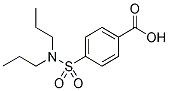
Estructura química
Peso molecular: 285.36
Control de calidad
| Dianas relacionadas | CFTR CRM1 CD markers AChR Calcium Channel Sodium Channel Potassium Channel GABA Receptor ATPase GluR |
|---|---|
| Otros TRP Channel Inhibidores | 2-APB (2-Aminoethyl Diphenylborinate) SKF96365 AMG-517 GSK2193874 GSK1016790A HC-030031 Capsazepine EIPA (L593754) SB705498 HC-067047 |
Información química, almacenamiento y estabilidad
| Peso molecular | 285.36 | Fórmula | C13H19NO4S |
Almacenamiento (Desde la fecha de recepción) | |
|---|---|---|---|---|---|
| Nº CAS | 57-66-9 | Descargar SDF | Almacenamiento de soluciones madre |
|
|
| Sinónimos | Benemid | Smiles | CCCN(CCC)S(=O)(=O)C1=CC=C(C=C1)C(=O)O | ||
Solubilidad
|
In vitro |
DMSO
: 57 mg/mL
(199.74 mM)
Ethanol : 19 mg/mL Water : Insoluble |
Calculadora de Molaridad
|
In vivo |
|||||
Calculadora de formulación in vivo (Solución clara)
Paso 1: Introduzca la información a continuación (Recomendado: Un animal adicional para tener en cuenta la pérdida durante el experimento)
Paso 2: Introduzca la formulación in vivo (Esto es solo la calculadora, no la formulación. Por favor, contáctenos primero si no hay una formulación in vivo en la sección de Solubilidad.)
Resultados del cálculo:
Concentración de trabajo: mg/ml;
Método para preparar el líquido maestro de DMSO: mg fármaco predissuelto en μL DMSO ( Concentración del líquido maestro mg/mL, Por favor, contáctenos primero si la concentración excede la solubilidad del DMSO del lote del fármaco. )
Método para preparar la formulación in vivo: Tomar μL DMSO líquido maestro, luego añadirμL PEG300, mezclar y clarificar, luego añadirμL Tween 80, mezclar y clarificar, luego añadir μL ddH2O, mezclar y clarificar.
Método para preparar la formulación in vivo: Tomar μL DMSO líquido maestro, luego añadir μL Aceite de maíz, mezclar y clarificar.
Nota: 1. Por favor, asegúrese de que el líquido esté claro antes de añadir el siguiente disolvente.
2. Asegúrese de añadir el (los) disolvente(s) en orden. Debe asegurarse de que la solución obtenida, en la adición anterior, sea una solución clara antes de proceder a añadir el siguiente disolvente. Se pueden utilizar métodos físicos como el vórtice, el ultrasonido o el baño de agua caliente para ayudar a la disolución.
Mecanismo de acción
| Targets/IC50/Ki |
organic anion transport
TRPV2
TAS2R16
|
|---|---|
| In vitro |
Probenecid es capaz de prevenir el eflujo de colorantes fluorescentes sensibles al calcio durante los estudios de movilización de calcio celular. Se ha descubierto que este compuesto (2,5 mM) bloquea la exportación de Fura-2 de las células de astrocitoma 1321N1, y no cambia la concentración basal de calcio ni la respuesta de calcio muscarínica. Es un potente agonista del potencial de receptor transitorio vanilloide 2 (TRPV2). Este químico induce selectivamente un aumento en el influjo intracelular de Ca2+ en células HEK293T que expresan transitoriamente TRPV2 exógeno. Es capaz de interactuar con los Transmembrane Transporters de aniones orgánicos (OAT). 0,1 mM de este compuesto inhibe eficientemente la captación vesicular activa de N-etilmaleimida glutatión (NEM-GS) dependiente de ATP por las Proteínas de Resistencia a Múltiples Fármacos Humanas 1 (MRP1) y MRP2. En membranas de células Sf9 aisladas, estimula la actividad ATPasa de MRP2 con un KACT aproximado de 250 μM, pero inhibe la actividad ATPasa de MRP1. Este químico es un inhibidor de los Taste Receptor amargos hTAS2R16, hTAS2R38 y hTAS2R43. 1 mM del mismo atenúa las respuestas de flujo de calcio inducidas por sacarina de hTAS2R16 a niveles cercanos a la línea base. Inhibe de forma dosis-dependiente hTAS2R16 (en presencia de 3 mM de salicina) y hTAS2R38 (en presencia de 300 μM de PTC). Esta actividad es independiente de su actividad como inhibidor del transporte, pero está relacionada con su interacción con el receptor. |
| In vivo |
Probenecid es un inhibidor del transporte orgánico in vivo. Este compuesto es capaz de disminuir el aclaramiento renal de antibióticos, como la penicilina, lo que mejora los niveles séricos de antibióticos. Aumenta la excreción renal de urato al actuar como un inhibidor competitivo de OAT, lo que previene la recaptación de ácido úrico mediada por OAT de la orina al suero. Se ha descubierto que este químico bloquea la salida de metabolitos ácidos del sistema nervioso central y es un inhibidor competitivo del transporte de monoaminas en el riñón, el hígado y el ojo. |
Referencias |
|
Información del ensayo clínico
(datos de https://clinicaltrials.gov, actualizado el 2024-05-22)
| Número NCT | Reclutamiento | Condiciones | Patrocinador/Colaboradores | Fecha de inicio | Fases |
|---|---|---|---|---|---|
| NCT04939623 | Recruiting | Chronic Pain|Drug Dependence of Morphine Type|Symptom Withdrawal |
University of Calgary |
October 31 2023 | Phase 2 |
| NCT05497674 | Completed | Type 2 Diabetes Mellitus |
Sunshine Lake Pharma Co. Ltd. |
February 21 2022 | Phase 1 |
| NCT05082909 | Unknown status | Infection Bacterial |
Imperial College London |
December 21 2021 | Phase 1|Phase 2 |
Soporte técnico
Tel: +1-832-582-8158 Ext:3
Si tiene alguna otra consulta, por favor deje un mensaje.

Los productos son solo para uso de investigación. No para uso humano. No vendemos a pacientes.
©Copyright 2013 Selleck Chemicals. Todos los derechos reservados.