
solo para uso en investigación
Idebenone ROS químico
Cat. No.S2605
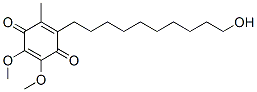
Estructura química
Peso molecular: 338.44
Control de calidad
Información química, almacenamiento y estabilidad
| Peso molecular | 338.44 | Fórmula | C19H30O5 |
Almacenamiento (Desde la fecha de recepción) | |
|---|---|---|---|---|---|
| Nº CAS | 58186-27-9 | Descargar SDF | Almacenamiento de soluciones madre |
|
|
| Sinónimos | CV-2619 | Smiles | CC1=C(C(=O)C(=C(C1=O)OC)OC)CCCCCCCCCCO | ||
Solubilidad
|
In vitro |
DMSO
: 68 mg/mL
(200.92 mM)
Ethanol : 68 mg/mL Water : Insoluble |
Calculadora de Molaridad
|
In vivo |
|||||
Calculadora de formulación in vivo (Solución clara)
Paso 1: Introduzca la información a continuación (Recomendado: Un animal adicional para tener en cuenta la pérdida durante el experimento)
Paso 2: Introduzca la formulación in vivo (Esto es solo la calculadora, no la formulación. Por favor, contáctenos primero si no hay una formulación in vivo en la sección de Solubilidad.)
Resultados del cálculo:
Concentración de trabajo: mg/ml;
Método para preparar el líquido maestro de DMSO: mg fármaco predissuelto en μL DMSO ( Concentración del líquido maestro mg/mL, Por favor, contáctenos primero si la concentración excede la solubilidad del DMSO del lote del fármaco. )
Método para preparar la formulación in vivo: Tomar μL DMSO líquido maestro, luego añadirμL PEG300, mezclar y clarificar, luego añadirμL Tween 80, mezclar y clarificar, luego añadir μL ddH2O, mezclar y clarificar.
Método para preparar la formulación in vivo: Tomar μL DMSO líquido maestro, luego añadir μL Aceite de maíz, mezclar y clarificar.
Nota: 1. Por favor, asegúrese de que el líquido esté claro antes de añadir el siguiente disolvente.
2. Asegúrese de añadir el (los) disolvente(s) en orden. Debe asegurarse de que la solución obtenida, en la adición anterior, sea una solución clara antes de proceder a añadir el siguiente disolvente. Se pueden utilizar métodos físicos como el vórtice, el ultrasonido o el baño de agua caliente para ayudar a la disolución.
Mecanismo de acción
| In vitro |
Idebenone protege eficazmente contra el daño de las células retinianas después de estrés oxidativo o hipoglucemia, mientras que la protección proporcionada después de la postincubación de ambos antioxidantes disminuye. Este compuesto atenúa el daño tardío de las células retinianas, mediado por isquemia química. Este químico, un antioxidante de acción central utilizado para tratar la demencia multiinfarto, protege las células de esta forma de citotoxicidad inducida por glutamato in vitro. Proporciona una protección significativa contra la degeneración neuronal inducida por la inyección intraestriatal de ácido kaínico y ácido quisquálico, pero no el agonista del receptor NMDA, ácido quinolínico.
|
|---|---|
| In vivo |
Idebenone previene los déficits conductuales en las tareas de laberinto en Y y laberinto acuático, pero no en la evitación pasiva, en ratas infundidas con A beta-(1-42) cuando se administra repetidamente por vía oral una vez al día desde 3 días antes del inicio de la infusión de A beta hasta el final de los experimentos conductuales. Este compuesto (100 y 300 mg/kg) se administra oralmente a ratas durante 3 días, aumenta la respiración en estado 3 estimulada por ADP, disminuye ligeramente la respiración en estado 4 después del consumo de ADP y resulta en un aumento significativo del índice de control respiratorio (RCI) en un 14-19% para la oxidación de glutamato y un 10-17% para la oxidación de succinato, respectivamente. Suprime significativamente en aproximadamente un 10% el consumo de oxígeno no respiratorio, que está estrechamente asociado con reacciones no enzimáticas como la peroxidación lipídica, la lisis de la membrana y el hinchamiento de las mitocondrias.
|
Referencias |
|
Información del ensayo clínico
(datos de https://clinicaltrials.gov, actualizado el 2024-05-22)
| Número NCT | Reclutamiento | Condiciones | Patrocinador/Colaboradores | Fecha de inicio | Fases |
|---|---|---|---|---|---|
| NCT01303406 | Completed | Friedreich''s Ataxia |
Santhera Pharmaceuticals |
April 2011 | Phase 3 |
| NCT00758225 | Completed | Duchenne Muscular Dystrophy |
Santhera Pharmaceuticals |
September 2008 | Phase 2 |
| NCT00747487 | Completed | Leber''s Hereditary Optic Neuropathy |
Santhera Pharmaceuticals |
November 2007 | Phase 2 |
| NCT00229632 | Completed | Friedreich Ataxia |
National Institute of Neurological Disorders and Stroke (NINDS)|National Institutes of Health Clinical Center (CC) |
September 27 2005 | Phase 2 |
Soporte técnico
Tel: +1-832-582-8158 Ext:3
Si tiene alguna otra consulta, por favor deje un mensaje.

Los productos son solo para uso de investigación. No para uso humano. No vendemos a pacientes.
©Copyright 2013 Selleck Chemicals. Todos los derechos reservados.