
solo para uso en investigación
GW3965 Hydrochloride Agonista LXR
Cat. No.S2630
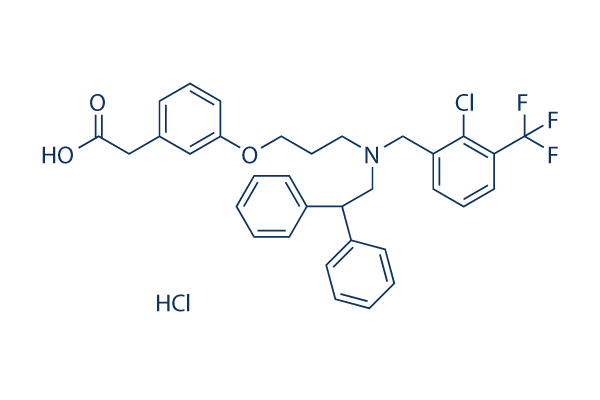
Estructura química
Peso molecular: 618.51
Control de calidad
Productos que se suelen utilizar junto con GW3965 Hydrochloride
| Dianas relacionadas | Dehydrogenase HSP Transferase P450 (e.g. CYP17) PDE phosphatase PPAR Vitamin Carbohydrate Metabolism Mitochondrial Metabolism |
|---|---|
| Otros Liver X Receptor Inhibidores | T0901317 LXR-623 (WAY-252623) GSK2033 SR9243 Abequolixron (RGX-104) AZ876 GSK3987 Desmosterol |
Cultivo celular, tratamiento y concentración de trabajo
| Líneas celulares | Tipo de ensayo | Concentración | Tiempo de incubación | Formulación | Descripción de la actividad | PMID |
|---|---|---|---|---|---|---|
| HEK293 | 10 uM | 20 hrs | Activation of human LXRalpha expressed in HEK293 cells co-expressing human RXRalpha at 10 uM after 20 hrs by luciferase reporter gene assay | 28006909 | ||
| HEK293 | 10 uM | 20 hrs | Activation of rat LXRbeta expressed in HEK293 cells co-expressing human RXRalpha at 10 uM after 20 hrs by luciferase reporter gene assay | 28006909 | ||
| THP1 | Function assay | Induction of cholesterol efflux in THP1 cells, EC50 = 0.01 μM. | 17587573 | |||
| THP1 | Function assay | 18 hrs | Induction of cholesterol efflux in THP1 cells after 18 hrs, EC50 = 0.01 μM. | 17416521 | ||
| COS7 | Function assay | 16 hrs | Agonist activity at human LXRbeta receptor transfected in COS7 cells after 16 hrs by reporter transactivation assay, EC50 = 0.015 μM. | 17587573 | ||
| COS7 | Function assay | Activation of LXRbeta co-transfected in COS7 cells with RXRalpha by reporter transactivation assay, EC50 = 0.015 μM. | 17416521 | |||
| THP1 | Antiinflammatory assay | 6 hrs | Antiinflammatory activity against human THP1 cells assessed as inhibition of LPS-stimulated IL6 production after 6 hrs by ELISA, IC50 = 0.02 μM. | 18800767 | ||
| THP1 | Function assay | Agonist activity at GAL-linked human LXRbeta expressed in THP1 cells assessed as stimulation of co-activator recruitment by FRET assay, EC50 = 0.027 μM. | 17665897 | |||
| RAW264.7 | Function assay | 24 hrs | Induction of [3H]cholesterol efflux in mouse RAW264.7 cells loaded with acetylated-LDL after 24 hrs, EC50 = 0.029 μM. | 19717304 | ||
| THP1 | Function assay | Stimulation of [3H]cholesterol efflux in human THP1 foam cells loaded with ac-LDL, EC50 = 0.031 μM. | 18973288 | |||
| CV1 | Function assay | Antagonist activity at LXRbeta ligand binding domain assessed as inhibition of T1317-induced transcriptional activity in african green monkey CV1 cells co-transfected with Gal4-SRC1 by luciferase reporter assay, IC50 = 0.03981 μM. | 20345102 | |||
| THP1 | Function assay | Agonist activity at GAL-linked human LXRalpha expressed in THP1 cells assessed as stimulation of coactivator recruitment by FRET assay, EC50 = 0.097 μM. | 17665897 | |||
| CV1 | Function assay | Antagonist activity at LXRalpha ligand binding domain assessed as inhibition of T1317-induced transcriptional activity in african green monkey CV1 cells co-transfected with Gal4-SRC1 by luciferase reporter assay, IC50 = 0.1 μM. | 20345102 | |||
| SH-SY5Y | Function assay | 24 hrs | Agonist activity at human LXRbeta expressed in human SH-SY5Y cells co-transfected with Gal4-LBD after 24 hrs by luciferase reporter gene assay, EC50 = 0.13 μM. | 19264481 | ||
| HepG2 | Function assay | Effect on SREBP1c gene expression in human HepG2 cells, EC50 = 0.21 μM. | 18973288 | |||
| HuH7 | Function assay | Agonist activity at human recombinant LXRbeta ligand binding domain in human HuH7 cells co-transfected with fused Gal4-DBD by transactivation assay, EC50 = 0.31 μM. | 18973288 | |||
| SH-SY5Y | Function assay | 24 hrs | Agonist activity at human LXRalpha expressed in human SH-SY5Y cells co-transfected with Gal4-LBD after 24 hrs by luciferase reporter gene assay, EC50 = 0.31 μM. | 19264481 | ||
| CHO | Function assay | Agonist activity at human LXR beta receptor expressed in CHO cells by reporter assay, EC50 = 0.41 μM. | 17034119 | |||
| CHOK1 | Function assay | 24 hrs | Agonist activity at Gal4-tagged LXRbeta (unknown origin) expressed in CHOK1 cells after 24 hrs by luciferase reporter gene assay, EC50 = 0.42 μM. | 25677664 | ||
| THP1 | Function assay | Effect on ABCA1 gene expression in human differentiated THP1 cells, EC50 = 0.434 μM. | 18973288 | |||
| CV1 | Function assay | Agonist activity at LXRbeta ligand binding domain-mediated transcriptional activity in african green monkey CV1 cells co-transfected with Gal4-SRC1 by luciferase reporter assay, EC50 = 0.50119 μM. | 20345102 | |||
| HuH7 | Function assay | Agonist activity at human recombinant LXRalpha ligand binding domain in human HuH7 cells co-transfected with fused Gal4-DBD by transactivation assay, EC50 = 0.66 μM. | 18973288 | |||
| CV1 | Function assay | Agonist activity at LXRalpha ligand binding domain-mediated transcriptional activity in african green monkey CV1 cells co-transfected with Gal4-SRC1 by luciferase reporter assay, EC50 = 0.79433 μM. | 20345102 | |||
| CHOK1 | Function assay | 24 hrs | Agonist activity at Gal4-tagged LXRalpha (unknown origin) expressed in CHOK1 cells after 24 hrs by luciferase reporter gene assay, EC50 = 1.3 μM. | 25677664 | ||
| HepG2 | Function assay | Effect on triglyceride accumulation in human HepG2 cells, EC50 = 2.002 μM. | 18973288 | |||
| HepG2 | Function assay | 500 nM | Inhibition of 2-(3-(3-((2-chloro-3-(trifluoromethyl)benzyl)(2,2-diphenylethyl)amino)propoxy)phenyl)acetic acid-induced srebp1c mRNA expression in human HepG2 cells at 500 nM | 18800767 | ||
| HepG2 | Function assay | 500 nM | Inhibition of 2-(3-(3-((2-chloro-3-(trifluoromethyl)benzyl)(2,2-diphenylethyl)amino)propoxy)phenyl)acetic acid-induced fas mRNA expression in human HepG2 cells at 500 nM | 18800767 | ||
| RAW264.7 | Function assay | 1 uM | Reduction of LPS-stimulated iNOS gene expression in mouse RAW264.7 cells expressing LXRalpha at 1 uM by luciferase reporter gene assay | 18800767 | ||
| RAW264.7 | Function assay | 1 uM | Inhibition of LPS-stimulated nuclear co-repressor release from iNOS promoter in mouse RAW264.7 cells at 1 uM by RT-PCR | 18800767 | ||
| HeLa | Function assay | 1 uM | Induction of LXRbeta SUMOylation by SUMO2 in human HeLa cells at 1 uM by Western blot analysis | 18800767 | ||
| HeLa | Function assay | 1 uM | Induction of LXRbeta SUMOylation by SUMO3 in human HeLa cells at 1 uM by Western blot analysis | 18800767 | ||
| HeLa | Function assay | 1 uM | Induction of LXRalpha SUMOylation by SUMO3 in human HeLa cells at 1 uM by Western blot analysis | 18800767 | ||
| DAOY | qHTS assay | qHTS of pediatric cancer cell lines to identify multiple opportunities for drug repurposing: Primary screen for DAOY cells | 29435139 | |||
| SJ-GBM2 | qHTS assay | qHTS of pediatric cancer cell lines to identify multiple opportunities for drug repurposing: Primary screen for SJ-GBM2 cells | 29435139 | |||
| A673 | qHTS assay | qHTS of pediatric cancer cell lines to identify multiple opportunities for drug repurposing: Primary screen for A673 cells | 29435139 | |||
| SK-N-MC | qHTS assay | qHTS of pediatric cancer cell lines to identify multiple opportunities for drug repurposing: Primary screen for SK-N-MC cells | 29435139 | |||
| BT-37 | qHTS assay | qHTS of pediatric cancer cell lines to identify multiple opportunities for drug repurposing: Primary screen for BT-37 cells | 29435139 | |||
| NB-EBc1 | qHTS assay | qHTS of pediatric cancer cell lines to identify multiple opportunities for drug repurposing: Primary screen for NB-EBc1 cells | 29435139 | |||
| SK-N-SH | qHTS assay | qHTS of pediatric cancer cell lines to identify multiple opportunities for drug repurposing: Primary screen for SK-N-SH cells | 29435139 | |||
| BT-12 | qHTS assay | qHTS of pediatric cancer cell lines to identify multiple opportunities for drug repurposing: Primary screen for BT-12 cells | 29435139 | |||
| OHS-50 | qHTS assay | qHTS of pediatric cancer cell lines to identify multiple opportunities for drug repurposing: Primary screen for OHS-50 cells | 29435139 | |||
| RD | qHTS assay | qHTS of pediatric cancer cell lines to identify multiple opportunities for drug repurposing: Primary screen for RD cells | 29435139 | |||
| MG 63 (6-TG R) | qHTS assay | qHTS of pediatric cancer cell lines to identify multiple opportunities for drug repurposing: Primary screen for MG 63 (6-TG R) cells | 29435139 | |||
| Rh30 | qHTS assay | qHTS of pediatric cancer cell lines to identify multiple opportunities for drug repurposing: Primary screen for Rh30 cells | 29435139 | |||
| Rh41 | qHTS assay | qHTS of pediatric cancer cell lines to identify multiple opportunities for drug repurposing: Primary screen for Rh41 cells | 29435139 | |||
| Haga clic para ver más datos experimentales de líneas celulares | ||||||
Información química, almacenamiento y estabilidad
| Peso molecular | 618.51 | Fórmula | C33H31ClF3NO3.HCl |
Almacenamiento (Desde la fecha de recepción) | |
|---|---|---|---|---|---|
| Nº CAS | 405911-17-3 | Descargar SDF | Almacenamiento de soluciones madre |
|
|
| Sinónimos | N/A | Smiles | C1=CC=C(C=C1)C(CN(CCCOC2=CC=CC(=C2)CC(=O)O)CC3=C(C(=CC=C3)C(F)(F)F)Cl)C4=CC=CC=C4.Cl | ||
Solubilidad
|
In vitro |
DMSO
: 100 mg/mL
(161.67 mM)
Water : Insoluble Ethanol : Insoluble |
Calculadora de Molaridad
|
In vivo |
|||||
Calculadora de formulación in vivo (Solución clara)
Paso 1: Introduzca la información a continuación (Recomendado: Un animal adicional para tener en cuenta la pérdida durante el experimento)
Paso 2: Introduzca la formulación in vivo (Esto es solo la calculadora, no la formulación. Por favor, contáctenos primero si no hay una formulación in vivo en la sección de Solubilidad.)
Resultados del cálculo:
Concentración de trabajo: mg/ml;
Método para preparar el líquido maestro de DMSO: mg fármaco predissuelto en μL DMSO ( Concentración del líquido maestro mg/mL, Por favor, contáctenos primero si la concentración excede la solubilidad del DMSO del lote del fármaco. )
Método para preparar la formulación in vivo: Tomar μL DMSO líquido maestro, luego añadirμL PEG300, mezclar y clarificar, luego añadirμL Tween 80, mezclar y clarificar, luego añadir μL ddH2O, mezclar y clarificar.
Método para preparar la formulación in vivo: Tomar μL DMSO líquido maestro, luego añadir μL Aceite de maíz, mezclar y clarificar.
Nota: 1. Por favor, asegúrese de que el líquido esté claro antes de añadir el siguiente disolvente.
2. Asegúrese de añadir el (los) disolvente(s) en orden. Debe asegurarse de que la solución obtenida, en la adición anterior, sea una solución clara antes de proceder a añadir el siguiente disolvente. Se pueden utilizar métodos físicos como el vórtice, el ultrasonido o el baño de agua caliente para ayudar a la disolución.
Mecanismo de acción
| Targets/IC50/Ki |
hLXRβ
(Cell-free assay) 30 nM(EC50)
LXRα/SRC1 LiSA
(Cell-free assay) 125 nM(EC50)
hLXRα
(Cell-free assay) 190 nM(EC50)
|
|---|---|
| In vitro |
GW3965 recluta el coactivador 1 del receptor de esteroides para el LXRα humano con una EC50 de 125 nM en un ensayo de detección de ligandos sin células. GW3965 muestra una potente actividad antagonista contra hLXRα y hLXRβ en ensayos basados en células con una EC50 de 190 nM y 30 nM, respectivamente. Además, GW3965 también muestra una excelente selectividad sobre otros receptores nucleares. En los islotes humanos, GW3965 (1 μM) reduce la expresión de citoquinas proinflamatorias seleccionadas, incluyendo IL-8, proteína quimiotáctica de monocitos-1 y factor tisular. |
| In vivo |
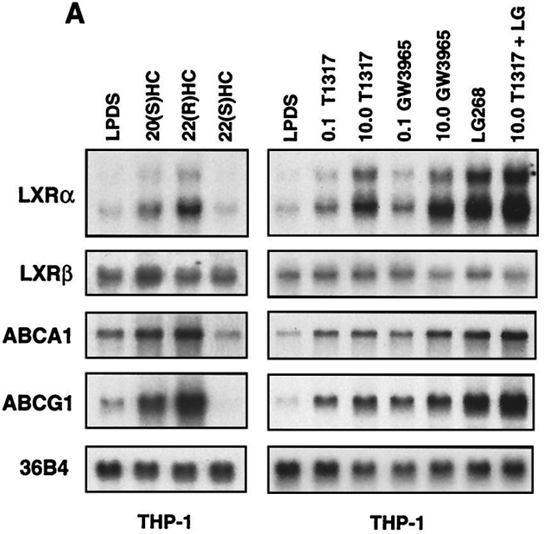
En ratones, GW3965 a una dosis de 10 mg/kg aumenta la expresión de ABCA1 8 veces y eleva los niveles circulantes de HDL en un 30% con una Cmax de 12,7 μg/mL y una t1/2 de 2 horas. GW3965 (10 mg/kg) induce la expresión de ABCA1 y ABCG1 y muestra una potente actividad antiaterogénica tanto en ratones LDLR−/− como apoE−/−. En ratas Sprague-Dawley macho, GW3965 reduce los aumentos de la presión arterial mediados por Ang II y disminuye la expresión génica del receptor de Ang II vascular. En el modelo de ratón con glioblastoma, GW3965 provoca la degradación de LDLR mediada por un degradador inducible de LDLR, una mayor expresión del transportador de eflujo de colesterol ABCA1 y, por lo tanto, promueve potentemente la muerte de células tumorales. |
Referencias |
|
Aplicaciones
| Métodos | Biomarcadores | Imágenes | PMID |
|---|---|---|---|
| Western blot | LXRα / LXRβ / ABCA1 / ABCG1 Skp2 / pEGFR / EGFR / pERK / ERK |
|
11604492 |
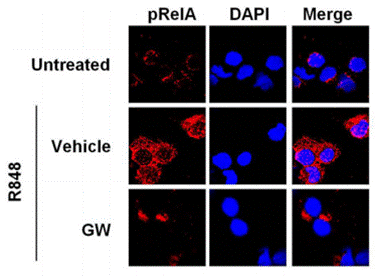
| Immunofluorescence | pRelA LAMP-1 / LDLR |
|
26635040 |
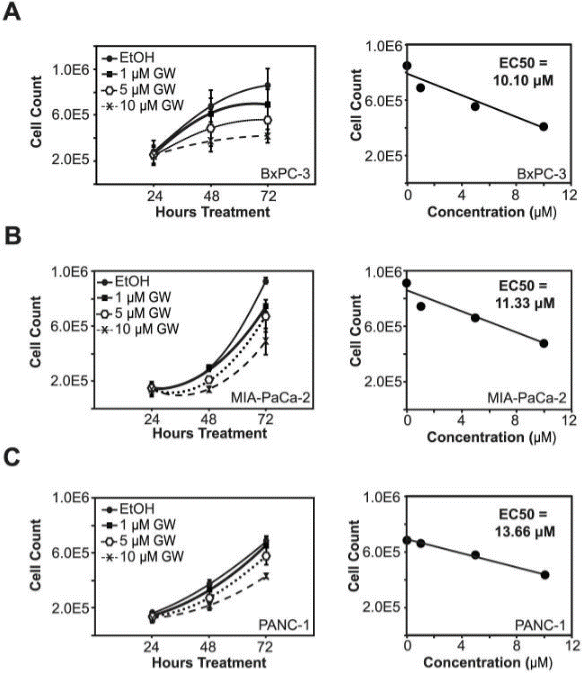
| Growth inhibition assay | Cell viability |
|
25184494 |
Soporte técnico
Tel: +1-832-582-8158 Ext:3
Si tiene alguna otra consulta, por favor deje un mensaje.
Preguntas frecuentes
Pregunta 1:
How to formulate it for mouse in vivo experiment?
Respuesta:
It can be dissolved in 2% DMSO/30% PEG 300/dd H2O at 10 mg/mL as a homogeneous suspension. This vehicle is suitable for oral gavage to mice.

Los productos son solo para uso de investigación. No para uso humano. No vendemos a pacientes.
©Copyright 2013 Selleck Chemicals. Todos los derechos reservados.