
solo para uso en investigación
FCCP Desacoplador de OXPHOS
Cat. No.S8276
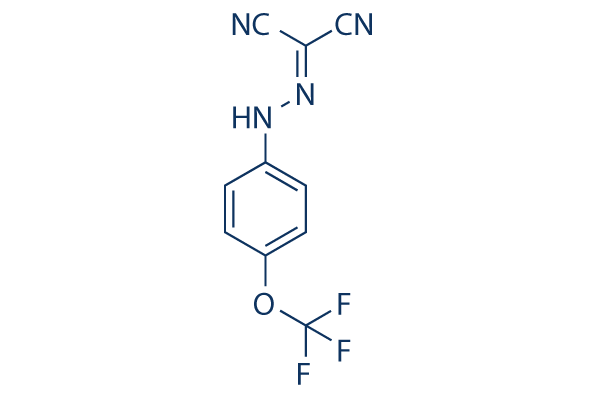
Estructura química
Peso molecular: 254.17
Control de calidad
| Dianas relacionadas | Bcl-2 Caspase PD-1/PD-L1 Ferroptosis p53 Apoptosis related Synthetic Lethality STAT TNF-alpha Ras |
|---|---|
| Otros OXPHOS Inhibidores | IACS-010759 (IACS-10759) ME-344 Gboxin S-Gboxin VLX600 4-Methyl-2-oxovaleric acid BAY-179 Diphenylamine Hydrochloride DX3-213B MS-L6 |
Cultivo celular, tratamiento y concentración de trabajo
| Líneas celulares | Tipo de ensayo | Concentración | Tiempo de incubación | Formulación | Descripción de la actividad | PMID |
|---|---|---|---|---|---|---|
| T47D | Function assay | Inhibition of 1, 10-phenanthroline-induced HIF1 activation in human T47D cells by HRE3-TK-luciferase reporter gene assay, IC50=0.31μM | 20929261 | |||
| T47D | Function assay | Inhibition of hypoxia-induced HIF1 activation in human T47D cells by HRE3-TK-luciferase reporter gene assay, IC50=0.51μM | 20929261 | |||
| T47D | Function assay | 1 to 10 uM | Inhibition of HIF1-mediated induction of secreted VEGF level in 1, 10-phenanthroline-stimulated human T47D cells at 1 to 10 uM by ELISA | 20929261 | ||
| T47D | Function assay | 0.3 uM | 15 mins | Decrease in mitochondrial membrane potential in human T47D cells 0.3 uM after 15 mins by TMRM assay | 20929261 | |
| MDA-MB-231 | Cytotoxicity assay | 1 uM | Cytotoxicity against human MDA-MB-231 cells assessed as inhibition of cell proliferation/viability at 1 uM | 23245650 | ||
| MDA-MB-231 | Cytotoxicity assay | 0.1 to 3 uM | Cytotoxicity against human MDA-MB-231 cells assessed as inhibition of cell proliferation/viability at 0.1 to 3 uM in presence of 0.1 uM rotenone mitochondrial electron transport inhibitor | 23245650 | ||
| MDA-MB-231 | Function assay | 0.3 uM | Stimulation of oligomycin-induced state 4 respiration in human MDA-MB-231 cells at 0.3 uM | 23245650 | ||
| T47D | Function assay | 0.1 to 3 uM | Effect on cellular respiration in human T47D cells assessed as increase in oxygen consumption at 0.1 to 3 uM | 22938093 | ||
| T47D | Function assay | 10 to 30 uM | Stimulation of state 4 cellular respiration in human T47D cells at 10 to 30 uM in presence of oligomycin | 22938093 | ||
| T47D | Function assay | 0.3 to 1 uM | Stimulation of state 4 cellular respiration in human T47D cells at 0.3 to 1 uM in presence of oligomycin | 22938093 | ||
| Hep3B | Function assay | 10 uM | Stimulation of state 4 cellular respiration in human Hep3B cells at 10 uM in presence of oligomycin | 22938093 | ||
| Hep3B | Function assay | 1 uM | Stimulation of state 4 cellular respiration in human Hep3B cells at 1 uM in presence of oligomycin | 22938093 | ||
| T47D | Function assay | 3 uM | 15 to 20 mins | Decrease in mitochondrial membrane potential in human T47D cells at 3 uM after 15 to 20 mins by TMRM assay | 22938093 | |
| TA3/Ha | Function assay | 6 uM | Induction of NAD(P)H oxidation in mouse TA3/Ha cells assessed as reduction of NAD(P)H/NAD(P)+ ratio at 6 uM by spectrofluorometer analysis | 24568614 | ||
| SH-SY5Y | Function assay | 10 uM | 5 mins | Inhibition of SOC in human SH-SY5Y cells assessed as reduction in thapsigargin-induced Ca2+ influx at 10 uM pre-incubated for 5 mins with 0.2 uM CsA followed by compound addition by FURA-2AM dye based fluorescence assay | 25265024 | |
| SH-SY5Y | Function assay | 10 uM | 10 mins | Induction of mitochondrial membrane potential loss in human SH-SY5Y cells at 10 uM incubated for 10 mins in presence of 0.2 uM CsA by TMRE dye based assay | 25265024 | |
| T47D | Function assay | 0.3 uM | 3 to 12 mins | Increase in oxygen consumption rate of mitochondrial state 4 respiration in human T47D cells assessed as reinitiation of oligomycin-stalled cellular respiration at 0.3 uM incubated for 3 to 12 mins by Clark-type oxygen electrode assay | 26637046 | |
| T47D | Function assay | 0.3 uM | 30 mins | Effect on mitochondrial membrane potential in human T47D cells at 0.3 uM after 30 mins by TMRM dye based fluorescence microscopy | 26637046 | |
| T47D | Function assay | 0.3 uM | Increase in oxygen consumption rate in digitonin permeabilized human T47D cells assessed as reinitiation of sodium azide-stalled cellular respiration at 0.3 uM by oxytherm Clark-type electrode assay in presence of ascorbate | 26637046 | ||
| HCT116 | Function assay | 2 uM | 30 mins | Induction of AMPK phosphorylation at Thr-172 residue in human HCT116 cells at 2 uM after 30 mins in glucose supplemented media by immunoblot method | 28233680 | |
| HCT116 | Function assay | 2 uM | 30 mins | Induction of AMPK phosphorylation at Thr-172 residue in human HCT116 cells at 2 uM after 30 mins in absence of glucose by immunoblot method | 28233680 | |
| DLD1 | Function assay | 1 uM | Induction of mitochondrial dysfunction in human DLD1 cells assessed as reduction in mitochondrial ATP production at 1 uM by Seahorse XF real-time assay | 31774672 | ||
| DLD1 | Function assay | 1 uM | Induction of mitochondrial dysfunction in human DLD1 cells assessed as increase in glycolytic ATP production at 1 uM by Seahorse XF real-time assay | 31774672 | ||
| LS174T | Function assay | 1 uM | Induction of mitochondrial dysfunction in human LS174T cells assessed as reduction in mitochondrial ATP production at 1 uM by Seahorse XF real-time assay | 31774672 | ||
| LS174T | Function assay | 1 uM | Induction of mitochondrial dysfunction in human LS174T cells assessed as increase in glycolytic ATP production at 1 uM by Seahorse XF real-time assay | 31774672 | ||
| DLD1 | Function assay | 1 uM | Uncoupling of mitochondrial oxidative phosphorylation in human DLD1 cells at 1 uM in presence of oligomycin A by seahorse XFe96 analyser based assay | 31774672 | ||
| DLD1 | Function assay | 1 uM | Uncoupling of mitochondrial oxidative phosphorylation in human DLD1 cells assessed as increase in oxygen consumption rate at 1 uM in presence of oligomycin A by seahorse XFe96 analyser based assay | 31774672 | ||
| HEK293 | Function assay | 1 to 3 uM | Inhibition of LiCl-activated Wnt signaling in HEK293 cells at 1 to 3 uM by TOPFlash reporter gene assay | 31774672 | ||
| KOPN8 | Function assay | 10 uM | 0.3 hrs | Induction of mitochondrial membrane potential loss in human KOPN8 cells at 10 uM after 0.3 hrs by TMRM staining based flow cytometric analysis | 31084028 | |
| HepG2 | Function assay | Luciferase/luciferin-expressing antifolate-resistant parasites were used to infect a culture of HepG2 cells that were pre-incubated with compounds. Infected hepatocytes emit light due to the luciferase reaction. Assay results are presented as the percent , IC50=0.245μM | ChEMBL | |||
| Haga clic para ver más datos experimentales de líneas celulares | ||||||
Información química, almacenamiento y estabilidad
| Peso molecular | 254.17 | Fórmula | C10H5F3N4O |
Almacenamiento (Desde la fecha de recepción) | |
|---|---|---|---|---|---|
| Nº CAS | 370-86-5 | Descargar SDF | Almacenamiento de soluciones madre |
|
|
| Sinónimos | Trifluoromethoxy carbonylcyanide phenylhydrazone, Carbonyl cyanide 4-(trifluoromethoxy)phenylhydrazone | Smiles | C1=CC(=CC=C1NN=C(C#N)C#N)OC(F)(F)F | ||
Solubilidad
|
In vitro |
DMSO
: 6 mg/mL
(23.6 mM)
Water : Insoluble Ethanol : Insoluble |
Calculadora de Molaridad
|
In vivo |
|||||
Calculadora de formulación in vivo (Solución clara)
Paso 1: Introduzca la información a continuación (Recomendado: Un animal adicional para tener en cuenta la pérdida durante el experimento)
Paso 2: Introduzca la formulación in vivo (Esto es solo la calculadora, no la formulación. Por favor, contáctenos primero si no hay una formulación in vivo en la sección de Solubilidad.)
Resultados del cálculo:
Concentración de trabajo: mg/ml;
Método para preparar el líquido maestro de DMSO: mg fármaco predissuelto en μL DMSO ( Concentración del líquido maestro mg/mL, Por favor, contáctenos primero si la concentración excede la solubilidad del DMSO del lote del fármaco. )
Método para preparar la formulación in vivo: Tomar μL DMSO líquido maestro, luego añadirμL PEG300, mezclar y clarificar, luego añadirμL Tween 80, mezclar y clarificar, luego añadir μL ddH2O, mezclar y clarificar.
Método para preparar la formulación in vivo: Tomar μL DMSO líquido maestro, luego añadir μL Aceite de maíz, mezclar y clarificar.
Nota: 1. Por favor, asegúrese de que el líquido esté claro antes de añadir el siguiente disolvente.
2. Asegúrese de añadir el (los) disolvente(s) en orden. Debe asegurarse de que la solución obtenida, en la adición anterior, sea una solución clara antes de proceder a añadir el siguiente disolvente. Se pueden utilizar métodos físicos como el vórtice, el ultrasonido o el baño de agua caliente para ayudar a la disolución.
Mecanismo de acción
| Targets/IC50/Ki |
OXPHOS
ATP synthase
|
|---|---|
| In vitro |
El tratamiento con FCCP induce un aumento muy rápido de 2 veces en la concentración intracelular de Ca2+ que se acompaña de una fuerte inhibición de la tasa de síntesis de proteínas. La inhibición de la traducción se correlaciona con un aumento de la fosforilación de la subunidad α de eIF2 (eIF2α) y un aumento de 1,7 veces en la actividad de la proteína quinasa dependiente de ARN de doble cadena. Este compuesto también disminuye ligeramente los niveles de ATP y especies reactivas de oxígeno. Aumenta la expresión de genes mitocondriales como Tfam y COXIV, mientras induce características morfológicas de HSCs de ratón quiescentes y anula la transducción de señales de TGF-β. |
| In vivo |
FCCP reduce significativamente el potencial de membrana mitocondrial y la producción de ATP en embriones de ratón de 8 células y el número de células de la masa celular interna dentro de los blastocistos con un desarrollo de blastocistos inalterado. Esta función mitocondrial embrionaria alterada es concomitante con un peso al nacer reducido en la descendencia femenina después de la transferencia de embriones, que persiste hasta el destete. Aunque los machos tratados con este compuesto también exhiben una tolerancia reducida a la glucosa como las hembras, su sensibilidad a la insulina y el aumento de adiposidad entre las 4 y las 14 semanas no se modifican. La reducción de la función mitocondrial y, por lo tanto, la disminución de la producción de ATP en el embrión de precompactación puede influir en el fenotipo de la descendencia. |
Referencias |
|
Soporte técnico
Tel: +1-832-582-8158 Ext:3
Si tiene alguna otra consulta, por favor deje un mensaje.

Los productos son solo para uso de investigación. No para uso humano. No vendemos a pacientes.
©Copyright 2013 Selleck Chemicals. Todos los derechos reservados.