
solo para uso en investigación
Atorvastatin Calcium (CI-981) HMG-CoA Reductase inhibidor
Cat. No.S2077
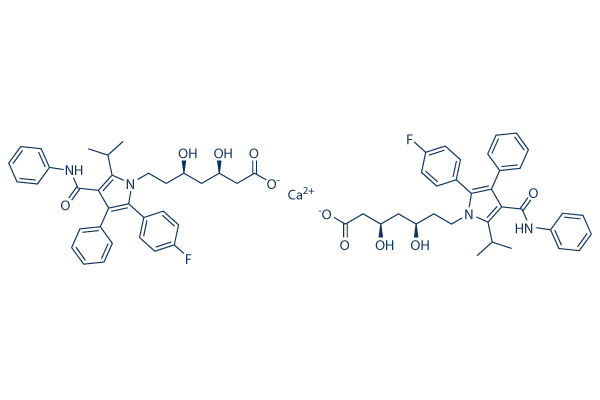
Estructura química
Peso molecular: 1155.34
Control de calidad
| Dianas relacionadas | Dehydrogenase HSP Transferase P450 (e.g. CYP17) PDE phosphatase PPAR Vitamin Carbohydrate Metabolism Mitochondrial Metabolism |
|---|---|
| Otros HMG-CoA Reductase Inhibidores | Mevastatin SR-12813 Clinofibrate Dihydrolanosterol 7-ketocholesterol Cerivastatin sodium |
Cultivo celular, tratamiento y concentración de trabajo
| Líneas celulares | Tipo de ensayo | Concentración | Tiempo de incubación | Formulación | Descripción de la actividad | PMID |
|---|---|---|---|---|---|---|
| CHO | Function assay | Ki values for sodium fluorescein (10 uM) uptake in OATP1B1-transfected CHO cells, Ki=0.45μM. | 23571415 | |||
| CHO | Function assay | pIC50 values for sodium fluorescein (10 uM) uptake in OATP1B1-transfected CHO cells, IC50=0.81283μM. | 23571415 | |||
| Me300 | Cytotoxicity assay | 72 hrs | Cytotoxicity against human Me300 cells after 72 hrs by MTT assay, IC50=1.2μM. | 22533316 | ||
| KB | Cytotoxicity assay | 72 hrs | Cytotoxicity against human KB cells after 72 hrs by MTT assay, IC50=1.97μM. | 22533316 | ||
| CHO | Function assay | Ki values for sodium fluorescein (10 uM) uptake in OATP1B3-transfected CHO cells, Ki=2.58μM. | 23571415 | |||
| CHO | Function assay | pIC50 values for sodium fluorescein (10 uM) uptake in OATP1B3-transfected CHO cells, IC50=3.38844μM. | 23571415 | |||
| HeLa | Cytotoxicity assay | 72 hrs | Cytotoxicity against human HeLa cells after 72 hrs by MTT assay, IC50=4.22μM. | 22533316 | ||
| LN18 | Cytotoxicity assay | 72 hrs | Cytotoxicity against human LN18 cells assessed as reduction in cell survival after 72 hrs by MTT assay, IC50=6.9μM. | 22533316 | ||
| LNZ308 | Cytotoxicity assay | 72 hrs | Cytotoxicity against human LNZ308 cells after 72 hrs by MTT assay, IC50=7.44μM. | 22533316 | ||
| LN229 | Cytotoxicity assay | 72 hrs | Cytotoxicity against human LN229 cells assessed as reduction in cell survival after 72 hrs by MTT assay, IC50=8.1μM. | 22533316 | ||
| Caco2 | Cytotoxicity assay | 72 hrs | Cytotoxicity against human Caco2 cells after 72 hrs by MTT assay, IC50=18.7μM. | 22533316 | ||
| HCEC | Cytotoxicity assay | 72 hrs | Cytotoxicity against human HCEC cells assessed as reduction in cell survival after 72 hrs by MTT assay, IC50=20.3μM. | 22533316 | ||
| LN18 | Function assay | 1 to 3 uM | 24 hrs | Inhibition of DNA synthesis in human LN18 cells assessed as inhibition of tritiated thymidine incorporation at 1 to 3 uM after 24 hrs by beta counting | 22533316 | |
| LN229 | Function assay | 1 to 3 uM | 24 hrs | Inhibition of DNA synthesis in human LN229 cells assessed as inhibition of tritiated thymidine incorporation at 1 to 3 uM after 24 hrs by beta counting | 22533316 | |
| DAOY | qHTS assay | qHTS of pediatric cancer cell lines to identify multiple opportunities for drug repurposing: Primary screen for DAOY cells | 29435139 | |||
| SJ-GBM2 | qHTS assay | qHTS of pediatric cancer cell lines to identify multiple opportunities for drug repurposing: Primary screen for SJ-GBM2 cells | 29435139 | |||
| A673 | qHTS assay | qHTS of pediatric cancer cell lines to identify multiple opportunities for drug repurposing: Primary screen for A673 cells | 29435139 | |||
| BT-37 | qHTS assay | qHTS of pediatric cancer cell lines to identify multiple opportunities for drug repurposing: Primary screen for BT-37 cells | 29435139 | |||
| U-2 OS | qHTS assay | qHTS of pediatric cancer cell lines to identify multiple opportunities for drug repurposing: Primary screen for U-2 OS cells | 29435139 | |||
| Saos-2 | qHTS assay | qHTS of pediatric cancer cell lines to identify multiple opportunities for drug repurposing: Primary screen for Saos-2 cells | 29435139 | |||
| SK-N-SH | qHTS assay | qHTS of pediatric cancer cell lines to identify multiple opportunities for drug repurposing: Primary screen for SK-N-SH cells | 29435139 | |||
| BT-12 | qHTS assay | qHTS of pediatric cancer cell lines to identify multiple opportunities for drug repurposing: Primary screen for BT-12 cells | 29435139 | |||
| OHS-50 | qHTS assay | qHTS of pediatric cancer cell lines to identify multiple opportunities for drug repurposing: Primary screen for OHS-50 cells | 29435139 | |||
| MG 63 (6-TG R) | qHTS assay | qHTS of pediatric cancer cell lines to identify multiple opportunities for drug repurposing: Primary screen for MG 63 (6-TG R) cells | 29435139 | |||
| Haga clic para ver más datos experimentales de líneas celulares | ||||||
Información química, almacenamiento y estabilidad
| Peso molecular | 1155.34 | Fórmula | 2(C33H34FN2O5).Ca |
Almacenamiento (Desde la fecha de recepción) | |
|---|---|---|---|---|---|
| Nº CAS | 134523-03-8 | Descargar SDF | Almacenamiento de soluciones madre |
|
|
| Sinónimos | N/A | Smiles | CC(C)C1=C(C(=C(N1CCC(CC(CC(=O)[O-])O)O)C2=CC=C(C=C2)F)C3=CC=CC=C3)C(=O)NC4=CC=CC=C4.CC(C)C1=C(C(=C(N1CCC(CC(CC(=O)[O-])O)O)C2=CC=C(C=C2)F)C3=CC=CC=C3)C(=O)NC4=CC=CC=C4.[Ca+2] | ||
Solubilidad
|
In vitro |
DMSO
: 100 mg/mL
(86.55 mM)
Water : Insoluble Ethanol : Insoluble |
Calculadora de Molaridad
|
In vivo |
|||||
Calculadora de formulación in vivo (Solución clara)
Paso 1: Introduzca la información a continuación (Recomendado: Un animal adicional para tener en cuenta la pérdida durante el experimento)
Paso 2: Introduzca la formulación in vivo (Esto es solo la calculadora, no la formulación. Por favor, contáctenos primero si no hay una formulación in vivo en la sección de Solubilidad.)
Resultados del cálculo:
Concentración de trabajo: mg/ml;
Método para preparar el líquido maestro de DMSO: mg fármaco predissuelto en μL DMSO ( Concentración del líquido maestro mg/mL, Por favor, contáctenos primero si la concentración excede la solubilidad del DMSO del lote del fármaco. )
Método para preparar la formulación in vivo: Tomar μL DMSO líquido maestro, luego añadirμL PEG300, mezclar y clarificar, luego añadirμL Tween 80, mezclar y clarificar, luego añadir μL ddH2O, mezclar y clarificar.
Método para preparar la formulación in vivo: Tomar μL DMSO líquido maestro, luego añadir μL Aceite de maíz, mezclar y clarificar.
Nota: 1. Por favor, asegúrese de que el líquido esté claro antes de añadir el siguiente disolvente.
2. Asegúrese de añadir el (los) disolvente(s) en orden. Debe asegurarse de que la solución obtenida, en la adición anterior, sea una solución clara antes de proceder a añadir el siguiente disolvente. Se pueden utilizar métodos físicos como el vórtice, el ultrasonido o el baño de agua caliente para ayudar a la disolución.
Mecanismo de acción
| Targets/IC50/Ki |
HMG-CoA reductase
(Cell-free assay) |
|---|---|
| In vitro |
Atorvastatin Calcium inhibe la expresión de ARNm de pre-proET-1 de manera dependiente de la concentración y el tiempo (60-70% de inhibición máxima) y reduce los niveles de ET-1 inmunorreactivo (25-50%), este efecto inhibitorio se mantiene en presencia de LDL oxidadas (1-50 mg/mL). Este compuesto reduce significativamente la producción de ROS inducida por angiotensina II y por el factor de crecimiento epidérmico en las VSMC. Regula a la baja la expresión de ARNm de la subunidad nox1 de la NAD(P)H oxidasa en las VSMC, mientras que la expresión de ARNm de p22phox no se altera significativamente. El químico inhibe la translocación de membrana de la GTPasa rac1, que es necesaria para la activación de la NAD(P)H oxidasa. Atorvastatin (0,1 μM) disminuye significativamente la activación de NF-κB inducida por Ang II y TNF-α en células mononucleares y VSMC. Este compuesto (1 μM) disminuye la expresión de MCP-1 inducida por Ang II, TNF-α y se revierte con Mevalonato solo en células estimuladas por Ang II. Este (1 μM) disminuye la expresión de IP-10 inducida por Ang II y por TNF-α en VSMC, y esta reducción se revierte parcialmente con Mevalonato. Los metabolitos de Atorvastatin y Gemfibrozil, pero no los fármacos originales, son potentes antioxidantes contra la oxidación de lipoproteínas. |
| In vivo |
Atorvastatin Calcium reduce la expresión de ARNm vascular de p22phox y nox1 y aumenta la expresión de catalasa aórtica en ratas tratadas con estatinas. Este compuesto inhibe el aumento de los niveles séricos de hsCRP en conejos alimentados con colesterol. Inhibe el aumento de la expresión de osteopontina en toda la valva valvular en las válvulas aórticas hipercolesterolémicas. |
Referencias |
|
Aplicaciones
| Métodos | Biomarcadores | Imágenes | PMID |
|---|---|---|---|
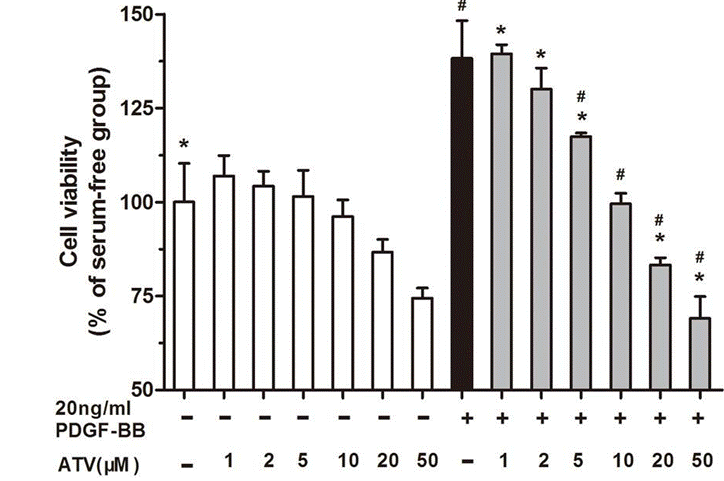
| Growth inhibition assay | Cell viability |
|
25874930 |
Información del ensayo clínico
(datos de https://clinicaltrials.gov, actualizado el 2024-05-22)
| Número NCT | Reclutamiento | Condiciones | Patrocinador/Colaboradores | Fecha de inicio | Fases |
|---|---|---|---|---|---|
| NCT01555632 | Withdrawn | Recurrent Prostate Cancer|Stage I Prostate Cancer|Stage IIA Prostate Cancer|Stage IIB Prostate Cancer|Stage III Prostate Cancer|Stage IV Prostate Cancer |
University of Nebraska|National Cancer Institute (NCI) |
March 2012 | Not Applicable |
Soporte técnico
Tel: +1-832-582-8158 Ext:3
Si tiene alguna otra consulta, por favor deje un mensaje.

Los productos son solo para uso de investigación. No para uso humano. No vendemos a pacientes.
©Copyright 2013 Selleck Chemicals. Todos los derechos reservados.