
solo para uso en investigación
Ondansetron HCl 5-HT Receptor antagonista
Cat. No.S1390
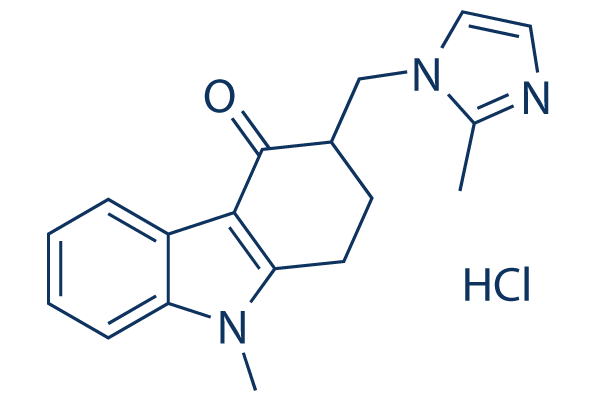
Estructura química
Peso molecular: 329.82
Control de calidad
| Dianas relacionadas | Adrenergic Receptor AChR COX Calcium Channel Histamine Receptor Dopamine Receptor GABA Receptor TRP Channel Cholinesterase (ChE) GluR |
|---|---|
| Otros 5-HT Receptor Inhibidores | WAY-100635 Maleate Serotonin (5-HT) HCl Puerarin BRL-15572 Dihydrochloride SB269970 HCl Ketanserin RS-127445 Nuciferine Flopropione BRL-54443 |
Información química, almacenamiento y estabilidad
| Peso molecular | 329.82 | Fórmula | C18H19N3O.HCl |
Almacenamiento (Desde la fecha de recepción) | |
|---|---|---|---|---|---|
| Nº CAS | 99614-01-4 | Descargar SDF | Almacenamiento de soluciones madre |
|
|
| Sinónimos | GR 38032F,SN 307 | Smiles | CC1=NC=CN1CC2CCC3=C(C2=O)C4=CC=CC=C4N3C.Cl | ||
Solubilidad
|
In vitro |
Water : 166 mg/mL
DMSO
: 66 mg/mL
(200.1 mM)
Ethanol : 13 mg/mL |
Calculadora de Molaridad
|
In vivo |
|||||
Calculadora de formulación in vivo (Solución clara)
Paso 1: Introduzca la información a continuación (Recomendado: Un animal adicional para tener en cuenta la pérdida durante el experimento)
Paso 2: Introduzca la formulación in vivo (Esto es solo la calculadora, no la formulación. Por favor, contáctenos primero si no hay una formulación in vivo en la sección de Solubilidad.)
Resultados del cálculo:
Concentración de trabajo: mg/ml;
Método para preparar el líquido maestro de DMSO: mg fármaco predissuelto en μL DMSO ( Concentración del líquido maestro mg/mL, Por favor, contáctenos primero si la concentración excede la solubilidad del DMSO del lote del fármaco. )
Método para preparar la formulación in vivo: Tomar μL DMSO líquido maestro, luego añadirμL PEG300, mezclar y clarificar, luego añadirμL Tween 80, mezclar y clarificar, luego añadir μL ddH2O, mezclar y clarificar.
Método para preparar la formulación in vivo: Tomar μL DMSO líquido maestro, luego añadir μL Aceite de maíz, mezclar y clarificar.
Nota: 1. Por favor, asegúrese de que el líquido esté claro antes de añadir el siguiente disolvente.
2. Asegúrese de añadir el (los) disolvente(s) en orden. Debe asegurarse de que la solución obtenida, en la adición anterior, sea una solución clara antes de proceder a añadir el siguiente disolvente. Se pueden utilizar métodos físicos como el vórtice, el ultrasonido o el baño de agua caliente para ayudar a la disolución.
Mecanismo de acción
| Targets/IC50/Ki |
5-HT3
|
|---|---|
| In vivo |
El ondansetrón disminuye la intensidad de los signos de abstinencia, como el aumento de la defecación, los saltos y los temblores de perro mojado, eleva los valores del umbral nociceptivo que disminuyen con la abstinencia precipitada, pero no produce cambios en la micción, la temperatura rectal o la salivación. El ondansetrón y el granisetrón mejoran significativamente el vaciamiento gástrico de las perlas de vidrio y mejoran la ralentización del vaciamiento gástrico inducida por el cisplatino en ratas. El ondansetrón exhibe un perfil de dosis-respuesta bifásico en ratones, con efectos antidepresivos que alcanzan su punto máximo a 0,1 mg/kg, en las pruebas de natación forzada y suspensión de la cola. El pretratamiento con ondansetrón aumenta los efectos antidepresivos de la fluoxetina y la venlafaxina, pero no influye en los efectos de la desipramina o el 8-hidroxi-2-(di-n-propilamino) tetralina. El ondansetrón (10 mg/kg) revierte la hiperactividad en el campo abierto y disminuye el porcentaje de entrada y el tiempo pasado en los brazos abiertos en el laberinto elevado en cruz. Se ha demostrado que el ondansetrón, un antagonista selectivo y potente del receptor 5HT3, es eficaz para bloquear la interrupción del LI inducida por la anfetamina a una dosis de 0,01 mg/kg, pero no a 0,1 mg/kg. El ondansetrón es capaz de atenuar los aumentos de la actividad de la dopamina, producidos farmacológicamente con anfetamina sin afectar la actividad basal de la dopamina. El ondansetrón facilita el rendimiento en animales jóvenes adultos y envejecidos, e inhibe un deterioro en la habituación inducido por escopolamina, electrolesiones o lesiones por ácido iboténico del núcleo basal magnocelular. El ondansetrón y la arecolina antagonizan un deterioro inducido por la escopolamina. |
Referencias |
|
Información del ensayo clínico
(datos de https://clinicaltrials.gov, actualizado el 2024-05-22)
| Número NCT | Reclutamiento | Condiciones | Patrocinador/Colaboradores | Fecha de inicio | Fases |
|---|---|---|---|---|---|
| NCT05759481 | Recruiting | Post-operative Nausea and Vomiting |
Milton S. Hershey Medical Center |
February 1 2024 | Phase 2 |
Soporte técnico
Tel: +1-832-582-8158 Ext:3
Si tiene alguna otra consulta, por favor deje un mensaje.

Los productos son solo para uso de investigación. No para uso humano. No vendemos a pacientes.
©Copyright 2013 Selleck Chemicals. Todos los derechos reservados.