
solo para uso en investigación
Odanacatib Cysteine Protease inhibidor
Cat. No.S1115
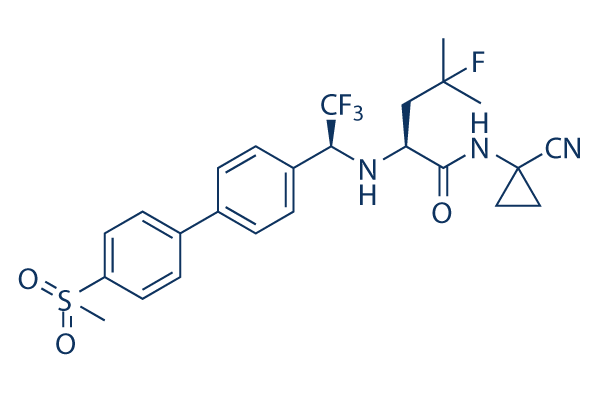
Estructura química
Peso molecular: 525.56
Control de calidad
| Dianas relacionadas | HDAC Caspase Proteasome Secretase MMP HCV Protease DPP Tyrosinase HIV Protease Serine Protease |
|---|---|
| Otros Cysteine Protease Inhibidores | N-Ethylmaleimide (NEM) MG132 SSS Calpeptin Aloxistatin (E-64d) E-64 MG-101 (ALLN) Z-FA-FMK Cathepsin Inhibitor 1 PD 151746 Loxistatin Acid (E-64C) |
Cultivo celular, tratamiento y concentración de trabajo
| Líneas celulares | Tipo de ensayo | Concentración | Tiempo de incubación | Formulación | Descripción de la actividad | PMID |
|---|---|---|---|---|---|---|
| ramos cells | Function assay | Inhibition of cathepsin S in human ramos cells, IC50=0.045μM | 18226527 | |||
| stem cells | Function assay | 7 days | Inhibition of osteoclastogenesis in human bone marrow-derived stem cells assessed as reduction of pit formation by measuring TRACP5b activity after 7 days by bone TRAP assay, IC50=0.1μM | 22984809 | ||
| HepG2 | Function assay | Inhibition of cathepsin B in human HepG2 cells, IC50=1.05μM | 18226527 | |||
| B cells | Function assay | Inhibition of antigen presenting mouse B cells, IC50=1.5μM | 18226527 | |||
| HepG2 | Function assay | Inhibition of cathepsin L in human HepG2 cells, IC50=4.843μM | 18226527 | |||
| SJ-GBM2 | qHTS assay | qHTS of pediatric cancer cell lines to identify multiple opportunities for drug repurposing: Primary screen for SJ-GBM2 cells | 29435139 | |||
| Haga clic para ver más datos experimentales de líneas celulares | ||||||
Información química, almacenamiento y estabilidad
| Peso molecular | 525.56 | Fórmula | C25H27F4N3O3S |
Almacenamiento (Desde la fecha de recepción) | |
|---|---|---|---|---|---|
| Nº CAS | 603139-19-1 | Descargar SDF | Almacenamiento de soluciones madre |
|
|
| Sinónimos | MK-0822 | Smiles | CC(C)(CC(C(=O)NC1(CC1)C#N)NC(C2=CC=C(C=C2)C3=CC=C(C=C3)S(=O)(=O)C)C(F)(F)F)F | ||
Solubilidad
|
In vitro |
DMSO
: 100 mg/mL
(190.27 mM)
Water : Insoluble Ethanol : Insoluble |
Calculadora de Molaridad
|
In vivo |
|||||
Calculadora de formulación in vivo (Solución clara)
Paso 1: Introduzca la información a continuación (Recomendado: Un animal adicional para tener en cuenta la pérdida durante el experimento)
Paso 2: Introduzca la formulación in vivo (Esto es solo la calculadora, no la formulación. Por favor, contáctenos primero si no hay una formulación in vivo en la sección de Solubilidad.)
Resultados del cálculo:
Concentración de trabajo: mg/ml;
Método para preparar el líquido maestro de DMSO: mg fármaco predissuelto en μL DMSO ( Concentración del líquido maestro mg/mL, Por favor, contáctenos primero si la concentración excede la solubilidad del DMSO del lote del fármaco. )
Método para preparar la formulación in vivo: Tomar μL DMSO líquido maestro, luego añadirμL PEG300, mezclar y clarificar, luego añadirμL Tween 80, mezclar y clarificar, luego añadir μL ddH2O, mezclar y clarificar.
Método para preparar la formulación in vivo: Tomar μL DMSO líquido maestro, luego añadir μL Aceite de maíz, mezclar y clarificar.
Nota: 1. Por favor, asegúrese de que el líquido esté claro antes de añadir el siguiente disolvente.
2. Asegúrese de añadir el (los) disolvente(s) en orden. Debe asegurarse de que la solución obtenida, en la adición anterior, sea una solución clara antes de proceder a añadir el siguiente disolvente. Se pueden utilizar métodos físicos como el vórtice, el ultrasonido o el baño de agua caliente para ayudar a la disolución.
Mecanismo de acción
| Características |
A potent, selective, and neutral cathepsin K inhibitor.
|
|---|---|
| Targets/IC50/Ki |
Cathepsin K (human)
0.2 nM
Cathepsin K (rabbit)
1 nM
|
| In vitro |
In vitro, Odanacatib muestra una alta actividad inhibitoria y selectividad sobre la catepsina K con valores de IC50 de 0,2 nM y 1 nM para la catepsina K humana y la catepsina K de conejo, respectivamente. Además, este compuesto también muestra potencias similares en ensayos de ocupación enzimática en células humanas enteras con una IC50 corregida de 5 nM. Un estudio reciente muestra que este químico provoca la reducción de la actividad de reabsorción de osteoclastos (OC) al interrumpir el tráfico vesicular intracelular.
|
| In vivo |
En ratas preclínicas, Odanacatib (10 mg/kg) exhibe una excelente farmacocinética con una depuración (Cl: 2 mL kg-1 min-1), bajo volumen de distribución (Vdss: 1.1 L kg-1), semivida (T1/2: 6 horas) y biodisponibilidad oral (F: 8%), respectivamente. Además, este compuesto también exhibe una excelente estabilidad metabólica en hepatocitos de rata con una recuperación del 96% de la identidad del compuesto original. Este químico administrado por vía oral previene la pérdida ósea en conejas ovariectomizadas (OVX) de manera dosis-dependiente. Además, (9 µM/día) conduce a un aumento significativo en la densidad mineral ósea (DMO) del fémur proximal (7,8%), DMO del cuello femoral (10,8%) y la DMO del trocánter mayor (6,5%). En monos rhesus deficientes en estrógenos y con madurez esquelética, el tratamiento a largo plazo con este compuesto inhibe eficazmente el recambio óseo sin reducir el número de osteoclastos y mantiene las propiedades biomecánicas normales de la columna vertebral de primates no humanos OVX.
|
Referencias |
|
Información del ensayo clínico
(datos de https://clinicaltrials.gov, actualizado el 2024-05-22)
| Número NCT | Reclutamiento | Condiciones | Patrocinador/Colaboradores | Fecha de inicio | Fases |
|---|---|---|---|---|---|
| NCT01803607 | Terminated | Osteoporosis |
Merck Sharp & Dohme LLC |
March 14 2013 | Phase 3 |
| NCT01630616 | Terminated | Osteoporosis |
Merck Sharp & Dohme LLC |
March 12 2013 | Phase 1 |
| NCT01512693 | Completed | Hepatic Insufficiency |
Merck Sharp & Dohme LLC |
February 23 2012 | Phase 1 |
| NCT01512667 | Completed | Renal Insufficiency |
Merck Sharp & Dohme LLC |
January 17 2012 | Phase 1 |
| NCT01068262 | Completed | Osteoporosis |
Merck Sharp & Dohme LLC |
December 8 2009 | Phase 1 |
| NCT00691899 | Withdrawn | Prostate Cancer |
Merck Sharp & Dohme LLC |
September 2008 | Phase 3 |
Soporte técnico
Tel: +1-832-582-8158 Ext:3
Si tiene alguna otra consulta, por favor deje un mensaje.

Los productos son solo para uso de investigación. No para uso humano. No vendemos a pacientes.
©Copyright 2013 Selleck Chemicals. Todos los derechos reservados.