
solo para uso en investigación
Allopurinol ROS inhibidor
Cat. No.S1630
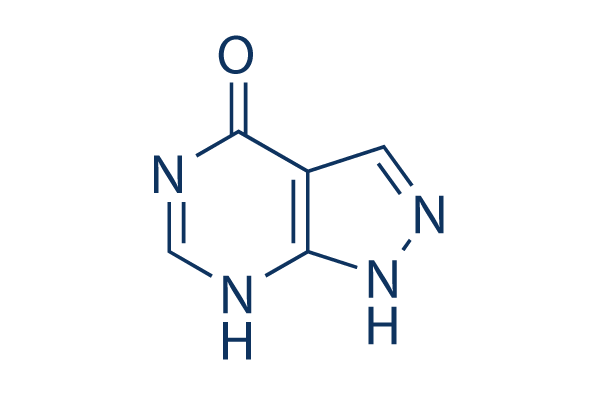
Estructura química
Peso molecular: 136.11
Control de calidad
Información química, almacenamiento y estabilidad
| Peso molecular | 136.11 | Fórmula | C5H4N4O |
Almacenamiento (Desde la fecha de recepción) | |
|---|---|---|---|---|---|
| Nº CAS | 315-30-0 | Descargar SDF | Almacenamiento de soluciones madre |
|
|
| Sinónimos | N/A | Smiles | C1=NNC2=C1C(=O)NC=N2 | ||
Solubilidad
|
In vitro |
DMSO
: 27 mg/mL
(198.36 mM)
Ethanol : 3 mg/mL Water : Insoluble |
Calculadora de Molaridad
|
In vivo |
|||||
Calculadora de formulación in vivo (Solución clara)
Paso 1: Introduzca la información a continuación (Recomendado: Un animal adicional para tener en cuenta la pérdida durante el experimento)
Paso 2: Introduzca la formulación in vivo (Esto es solo la calculadora, no la formulación. Por favor, contáctenos primero si no hay una formulación in vivo en la sección de Solubilidad.)
Resultados del cálculo:
Concentración de trabajo: mg/ml;
Método para preparar el líquido maestro de DMSO: mg fármaco predissuelto en μL DMSO ( Concentración del líquido maestro mg/mL, Por favor, contáctenos primero si la concentración excede la solubilidad del DMSO del lote del fármaco. )
Método para preparar la formulación in vivo: Tomar μL DMSO líquido maestro, luego añadirμL PEG300, mezclar y clarificar, luego añadirμL Tween 80, mezclar y clarificar, luego añadir μL ddH2O, mezclar y clarificar.
Método para preparar la formulación in vivo: Tomar μL DMSO líquido maestro, luego añadir μL Aceite de maíz, mezclar y clarificar.
Nota: 1. Por favor, asegúrese de que el líquido esté claro antes de añadir el siguiente disolvente.
2. Asegúrese de añadir el (los) disolvente(s) en orden. Debe asegurarse de que la solución obtenida, en la adición anterior, sea una solución clara antes de proceder a añadir el siguiente disolvente. Se pueden utilizar métodos físicos como el vórtice, el ultrasonido o el baño de agua caliente para ayudar a la disolución.
Mecanismo de acción
| Targets/IC50/Ki |
xanthine oxidase
|
|---|---|
| In vitro |
Allopurinol revierte el aumento de la actividad de la xantina oxidasa en la lesión por isquemia-reperfusión de corazones de ratas neonatales. El tratamiento con este compuesto (10 mM) suprime la actividad de la xantina oxidasa inducida por la lesión por hipoxia-reoxigenación y la producción de especies reactivas de oxígeno. También disminuye la concentración de Ca2+ intracelular aumentada por la actividad mejorada de la xantina oxidasa.
|
| In vivo |
Allopurinol muestra un metabolismo anormal de pirimidina junto con toxicidad renal que podría ser mejorada por la uridina, indicando que este compuesto esencialmente causa una anormalidad del metabolismo de pirimidina que conduce a daño renal en ratones normales. Aumenta la excreción urinaria de OD en una extensión similar a la de ratones normales a los que se les administró la misma dosis de este químico en ratones sensibilizados con DNFB. Este compuesto promueve una mejora clínica que se acompaña de una reducción en la carga parasitaria en la sangre, piel y ganglios linfáticos, pero, incluso después de un largo período de administración de Allopurinol solo, Leishmania puede persistir en los tejidos de perros infectados por Leishmania. Previene el daño hepático temprano inducido por el alcohol en ratas, muy probablemente al prevenir la activación de NF-kappaB dependiente de oxidantes. Este químico protege de forma dosis-dependiente contra el daño celular inducido por el paracetamol, la pérdida de ATP y el aumento del contenido de GSSG en el hígado total y en el compartimento mitocondrial sin inhibir la formación de metabolitos reactivos en ratones. Inhibe casi completamente la actividad de la xantina oxidasa y deshidrogenasa hepática, pero solo dosis altas previenen el aumento del contenido mitocondrial de GSSG.
|
Referencias |
|
Información del ensayo clínico
(datos de https://clinicaltrials.gov, actualizado el 2024-05-22)
| Número NCT | Reclutamiento | Condiciones | Patrocinador/Colaboradores | Fecha de inicio | Fases |
|---|---|---|---|---|---|
| NCT05665699 | Recruiting | Gout |
InventisBio Co. Ltd |
April 17 2023 | Phase 2 |
| NCT05193838 | Unknown status | Dilated Cardiomyopathy |
Assiut University |
May 1 2022 | -- |
| NCT05360628 | Completed | Healthy |
InventisBio Co. Ltd |
November 1 2021 | Early Phase 1 |
| NCT04853615 | Not yet recruiting | SGLT2i Kideny Protection Against Contrast in Diabetic Kidney |
Fayoum University|Cairo University |
July 1 2021 | -- |
Soporte técnico
Tel: +1-832-582-8158 Ext:3
Si tiene alguna otra consulta, por favor deje un mensaje.

Los productos son solo para uso de investigación. No para uso humano. No vendemos a pacientes.
©Copyright 2013 Selleck Chemicals. Todos los derechos reservados.