
solo para uso en investigación
Terazosin HCl Dihydrate Adrenergic Receptor antagonista
Cat. No.S2059
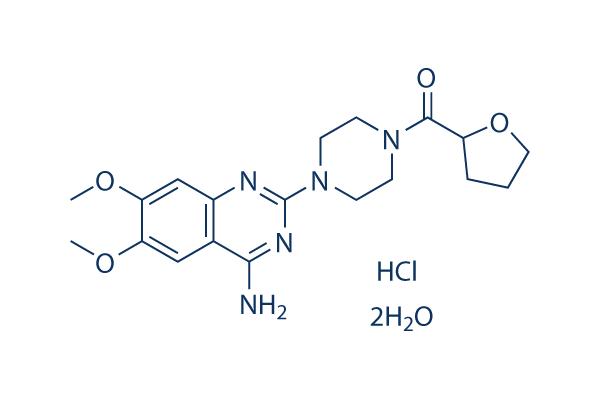
Estructura química
Peso molecular: 459.92
Control de calidad
- Citado en Nature Medicine por su máxima calidad
- COA
- NMR
- SDS
- Hoja de datos
| Dianas relacionadas | AChR 5-HT Receptor COX Calcium Channel Histamine Receptor Dopamine Receptor GABA Receptor TRP Channel Cholinesterase (ChE) GluR |
|---|---|
| Otros Adrenergic Receptor Inhibidores | ICI 118551 Hydrochloride (Zenidolol) L755507 Yohimbine HCl Atipamezole Naftopidil Detomidine HCl Higenamine hydrochloride Adrenalone HCl Medetomidine HCl Deoxycorticosterone acetate |
Información química, almacenamiento y estabilidad
| Peso molecular | 459.92 | Fórmula | C19H25N5O4.HCl.2H2O |
Almacenamiento (Desde la fecha de recepción) | |
|---|---|---|---|---|---|
| Nº CAS | 70024-40-7 | Descargar SDF | Almacenamiento de soluciones madre |
|
|
| Sinónimos | N/A | Smiles | COC1=C(C=C2C(=C1)C(=NC(=N2)N3CCN(CC3)C(=O)C4CCCO4)N)OC.O.O.Cl | ||
Solubilidad
|
In vitro |
DMSO
: 26 mg/mL
(56.53 mM)
Water : Insoluble Ethanol : Insoluble |
Calculadora de Molaridad
|
In vivo |
|||||
Calculadora de formulación in vivo (Solución clara)
Paso 1: Introduzca la información a continuación (Recomendado: Un animal adicional para tener en cuenta la pérdida durante el experimento)
Paso 2: Introduzca la formulación in vivo (Esto es solo la calculadora, no la formulación. Por favor, contáctenos primero si no hay una formulación in vivo en la sección de Solubilidad.)
Resultados del cálculo:
Concentración de trabajo: mg/ml;
Método para preparar el líquido maestro de DMSO: mg fármaco predissuelto en μL DMSO ( Concentración del líquido maestro mg/mL, Por favor, contáctenos primero si la concentración excede la solubilidad del DMSO del lote del fármaco. )
Método para preparar la formulación in vivo: Tomar μL DMSO líquido maestro, luego añadirμL PEG300, mezclar y clarificar, luego añadirμL Tween 80, mezclar y clarificar, luego añadir μL ddH2O, mezclar y clarificar.
Método para preparar la formulación in vivo: Tomar μL DMSO líquido maestro, luego añadir μL Aceite de maíz, mezclar y clarificar.
Nota: 1. Por favor, asegúrese de que el líquido esté claro antes de añadir el siguiente disolvente.
2. Asegúrese de añadir el (los) disolvente(s) en orden. Debe asegurarse de que la solución obtenida, en la adición anterior, sea una solución clara antes de proceder a añadir el siguiente disolvente. Se pueden utilizar métodos físicos como el vórtice, el ultrasonido o el baño de agua caliente para ayudar a la disolución.
Mecanismo de acción
| Targets/IC50/Ki |
α-adrenergic receptor
|
|---|---|
| In vitro |
Terazosin produce una pérdida significativa de la viabilidad celular, a través de la inducción de apoptosis de manera dosis-dependiente en células de cáncer de próstata. La supresión del crecimiento prostático por Terazosin, potencialmente a través de acciones independientes del α1-adrenoceptor, obtiene un mayor apoyo de otro estudio que documenta que Doxazosin inhibe la proliferación de células de músculo liso vascular humano independientemente de un efecto antagonista sobre el α1-adrenoceptor. Terazosin bloquea las corrientes HERG en ovocitos de Xenopus con una CI50 de 113.2 mM, mientras que Terazosin bloquea la inhibición del canal HERG en células HEK 293 humanas con una CI50 de 17.7 mM. El tratamiento con Terazosin o genisteína inhibe el crecimiento de las células DU-145 de manera dosis-dependiente, mientras que no tiene efecto sobre las células epiteliales prostáticas normales. Terazosin provoca que el arresto de las células DU-145 inducido por genisteína en la fase G2/M sea superado y un aumento de las células apoptóticas, como lo demuestran la activación de la procaspasa-3 y la escisión de PARP. Terazosin induce citotoxicidad en células PC-3 y células prostáticas benignas humanas con una CI50 de más de 100 mM.
|
| In vivo |
Terazosin inhibe significativamente la angiogénesis inducida por el factor de crecimiento endotelial vascular en ratones desnudos con una CI50 de 7.9 mM, mostrando que tiene un efecto antiangiogénico más potente que citotóxico. Terazosin también inhibe eficazmente la proliferación y la formación de tubos inducidas por el factor de crecimiento endotelial vascular en células endoteliales de vena umbilical humana cultivadas (CI50 de 9.9 y 6.8 mM, respectivamente).
|
Referencias |
|
Información del ensayo clínico
(datos de https://clinicaltrials.gov, actualizado el 2024-05-22)
| Número NCT | Reclutamiento | Condiciones | Patrocinador/Colaboradores | Fecha de inicio | Fases |
|---|---|---|---|---|---|
| NCT04760860 | Not yet recruiting | Dementia With Lewy Bodies |
Qiang Zhang|University of Iowa |
October 2024 | Phase 1|Phase 2 |
| NCT04551040 | Active not recruiting | Healthy |
University of Iowa|Michael J. Fox Foundation for Parkinson''s Research |
March 26 2021 | Phase 1 |
| NCT04386317 | Recruiting | REM Sleep Behavior Disorder|Pre-motor Parkinson''s Disease|Symptomatic Parkinson Disease |
Cedars-Sinai Medical Center |
November 1 2020 | Phase 2 |
| NCT00449683 | Completed | Hyperhidrosis |
Thomas Jefferson University|National Alliance for Research on Schizophrenia and Depression |
March 2007 | Phase 4 |
| NCT00237510 | Completed | Antidepressant Induced Excessive Sweating |
Thomas Jefferson University |
May 2005 | Not Applicable |
| NCT02244333 | Completed | Prostatic Hyperplasia |
Boehringer Ingelheim |
February 2004 | -- |
Soporte técnico
Tel: +1-832-582-8158 Ext:3
Si tiene alguna otra consulta, por favor deje un mensaje.

Los productos son solo para uso de investigación. No para uso humano. No vendemos a pacientes.
©Copyright 2013 Selleck Chemicals. Todos los derechos reservados.