
solo para uso en investigación
Plerixafor (AMD3100) 8HCl CXCR antagonista
Cat. No.S3013
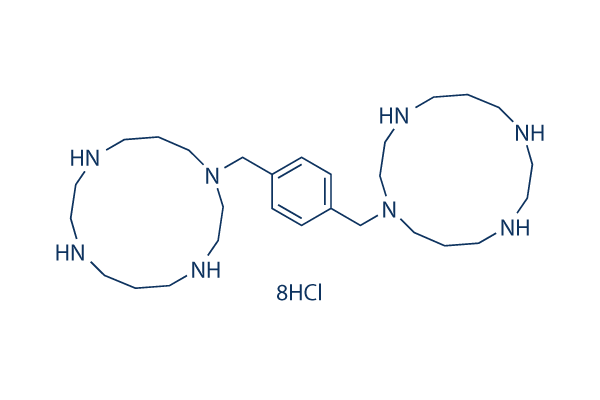
Estructura química
Peso molecular: 794.47
Control de calidad
| Dianas relacionadas | Hedgehog/Smoothened PKA Adrenergic Receptor AChR 5-HT Receptor Histamine Receptor Dopamine Receptor Ras KRas GPR |
|---|---|
| Otros CXCR Inhibidores | AZD5069 SB 225002 Reparixin (Repertaxin) WZ811 Navarixin (SCH-527123) LIT-927 AMG 487 SX-682 LY2510924 Danirixin (GSK1325756) |
Cultivo celular, tratamiento y concentración de trabajo
| Líneas celulares | Tipo de ensayo | Concentración | Tiempo de incubación | Formulación | Descripción de la actividad | PMID |
|---|---|---|---|---|---|---|
| CHOK1 cells | Function assay | Displacement of [125I]SDF1alpha from CXCR4 expressed in CHOK1 cells, IC50=0.81 nM | 17715128 | |||
| GHOST CXCR4 cell line | Function assay | Inhibitory concentration of compound against HIV-1 LAI strain in GHOST CXCR4 cell line, IC50=0.95 nM | 14698189 | |||
| HEK293 cells | Function assay | 2 days | Antiviral activity against T20-resistant HIV1 NL4-3 infected in HEK293 cells assessed as inhibition of viral replication after 2 days, IC50=2.3 nM | 19451305 | ||
| PBMC cells | Function assay | Effective concentration of compound against HIV-1 89.6 strain in PBMC cells, EC50=3.8 nM | 14698189 | |||
| human MT4 cells | Function assay | 4 days | Antiviral activity against HIV1 3B infected in human MT4 cells assessed as inhibition of virus replication after 4 days by MTT assay, EC50=4 nM | 20043638 | ||
| human Jurkat cells | Function assay | Antagonist activity at CXCR4 in human Jurkat cells assessed as inhibition of SDF1-induced cell migration, IC50=27.4 nM | 19188071 | |||
| MT-4 cells | Function assay | Effective concentration of compound against HIV-1 IIIB strain in MT-4 cells, EC50=65 nM | 14698189 | |||
| rat IR983F cells | Function assay | Displacement of [125I]CXCL12 from CXCR4 in rat IR983F cells, IC50=108 nM | 19053768 | |||
| CEM-SS cells | Function assay | Effective concentration of compound against HIV-1 LAI strain in CEM-SS cells, EC50=127 nM | 14698189 | |||
| human HL60 cells | Function assay | Displacement of [125I]SDF1alpha from CXCR4 in human HL60 cells, IC50=15.2 μM | 19188071 | |||
| human MOLT4 cells | Function assay | 1000 nM | Inhibition of Mab 12G5 binding to CXCR4 expressed in human MOLT4 cells at 1000 nM by FACS analysis | 19451305 | ||
| human MT2 cells | Function assay | 1 ug/mL | 4 days | Antiviral activity against HIV1 3B infected in human MT2 cells assessed as inhibition of viral p24 antigen production at 1 ug/mL after 4 days by ELISA | 21168336 | |
| human U87 cells | Function assay | 1000 nM | Antagonist activity at CXCR4 in human U87 cells assessed as inhibition of SDF1-induced modulation of cAMP production at 1000 nM by TR-FRET assay | 17958344 | ||
| MT4 | Antiviral assay | Antiviral activity against HIV1 3B assessed as reduction in cytopathic effect in MT4 cells, EC50=0.011μM | 17034122 | |||
| U87 | Function assay | 15 mins | Antagonist activity at human CXCR4 expressed in human U87 cells expressing CD4 assessed as inhibition of CXCL12-induced cAMP production pretreated for 15 mins before forskolin challenge by TR-FRET analysis, IC50=0.695μM | 21105715 | ||
| MT4 | Antiviral assay | Antiviral activity against X4-tropic HIV1 NL4.3 infected in human MT4 cells assessed as protection from virus-induced cytopathogenicity, EC50=0.062μM | 22579418 | |||
| MT4 | Antiviral assay | 5 days | Antiviral activity against HIV1 infected in MT4 cells expressing CXCR4 assessed as inhibition of virus-induced cytopathic effect after 5 days, EC50=0.002μM | 22909088 | ||
| CHO | Function assay | Binding affinity to human recombinant CXCR4 expressed in CHO cells, Kb=0.077μM | 22909088 | |||
| CHO | Function assay | Antagonist activity at human recombinant CXCR4 expressed in CHO cells assessed as inhibition of SDF1a-induced electrical impedance by dielectric spectroscopic analysis, IC50=0.26μM | 22909088 | |||
| CD44null | Function assay | 7 days | Effect on human GBM2 cell differentiation assessed as increase in CD44null cells after 7 days by flow cytometric analysis | 22909088 | ||
| CD44null | Function assay | 7 days | Effect on human GBM1 cell differentiation assessed as increase in CD44null cells after 7 days by flow cytometric analysis | 22909088 | ||
| Haga clic para ver más datos experimentales de líneas celulares | ||||||
Información química, almacenamiento y estabilidad
| Peso molecular | 794.47 | Fórmula | C28H54N8.8HCl |
Almacenamiento (Desde la fecha de recepción) | |
|---|---|---|---|---|---|
| Nº CAS | 155148-31-5 | Descargar SDF | Almacenamiento de soluciones madre |
|
|
| Sinónimos | JM 3100 8HCl,Plerixafor Octahydrochloride,AMD3100 octahydrochloride,SID791 octahydrochloride | Smiles | C1CNCCNCCCN(CCNC1)CC2=CC=C(C=C2)CN3CCCNCCNCCCNCC3.Cl.Cl.Cl.Cl.Cl.Cl.Cl.Cl | ||
Solubilidad
|
In vitro |
Water : 100 mg/mL
DMSO
: Insoluble
Ethanol : Insoluble |
Calculadora de Molaridad
|
In vivo |
|||||
Calculadora de formulación in vivo (Solución clara)
Paso 1: Introduzca la información a continuación (Recomendado: Un animal adicional para tener en cuenta la pérdida durante el experimento)
Paso 2: Introduzca la formulación in vivo (Esto es solo la calculadora, no la formulación. Por favor, contáctenos primero si no hay una formulación in vivo en la sección de Solubilidad.)
Resultados del cálculo:
Concentración de trabajo: mg/ml;
Método para preparar el líquido maestro de DMSO: mg fármaco predissuelto en μL DMSO ( Concentración del líquido maestro mg/mL, Por favor, contáctenos primero si la concentración excede la solubilidad del DMSO del lote del fármaco. )
Método para preparar la formulación in vivo: Tomar μL DMSO líquido maestro, luego añadirμL PEG300, mezclar y clarificar, luego añadirμL Tween 80, mezclar y clarificar, luego añadir μL ddH2O, mezclar y clarificar.
Método para preparar la formulación in vivo: Tomar μL DMSO líquido maestro, luego añadir μL Aceite de maíz, mezclar y clarificar.
Nota: 1. Por favor, asegúrese de que el líquido esté claro antes de añadir el siguiente disolvente.
2. Asegúrese de añadir el (los) disolvente(s) en orden. Debe asegurarse de que la solución obtenida, en la adición anterior, sea una solución clara antes de proceder a añadir el siguiente disolvente. Se pueden utilizar métodos físicos como el vórtice, el ultrasonido o el baño de agua caliente para ayudar a la disolución.
Mecanismo de acción
| Targets/IC50/Ki |
CXCL12
(Cell-free assay) 5.7 nM
CXCR4
(Cell-free assay) 44 nM
|
|---|---|
| In vitro |
Plerixafor inhibe la quimiotaxis mediada por CXCL12 con una potencia ligeramente mejor que su afinidad por CXCR4. Plerixafor también antagoniza la unión del ligando SDF-1/CXCL12 con una IC50 de 651 nM. Plerixafor inhibe la unión de GTP mediada por SDF-1, el flujo de calcio mediado por SDF-1 y la quimiotaxis estimulada por SDF-1 con IC50 de 27 nM, 572 nM y 51 nM, respectivamente. Plerixafor no inhibe el flujo de calcio en células que expresan CXCR3, CCR1, CCR2b, CCR4, CCR5 o CCR7 cuando se estimulan con sus ligandos cognados, ni Plerixafor inhibe la unión al receptor de LTB4. Plerixafor no induce, por sí mismo, un flujo de calcio en las células CCRF–CEM, que expresan múltiples GPCRs incluyendo CXCR4, CCR4 y CCR7. |
| In vivo |
Una única aplicación tópica de Plerixafor promueve la cicatrización de heridas en ratones diabéticos al aumentar la producción de citoquinas, movilizar las CPH de la médula ósea y mejorar la actividad de los fibroblastos y monocitos/macrófagos, aumentando así tanto la angiogénesis como la vasculogénesis. Se administran a cohortes de ratones PBS, IGF1, PDGF, SCF o VEGF durante cinco días consecutivos y Plerixafor el quinto día. El número y tamaño de las colonias son mayores en los ratones inyectados con IGF1 más Plerixafor en comparación con los grupos tratados con PDGF, SCF y VEGF, en combinación con Plerixafor. |
Referencias |
|
Aplicaciones
| Métodos | Biomarcadores | Imágenes | PMID |
|---|---|---|---|
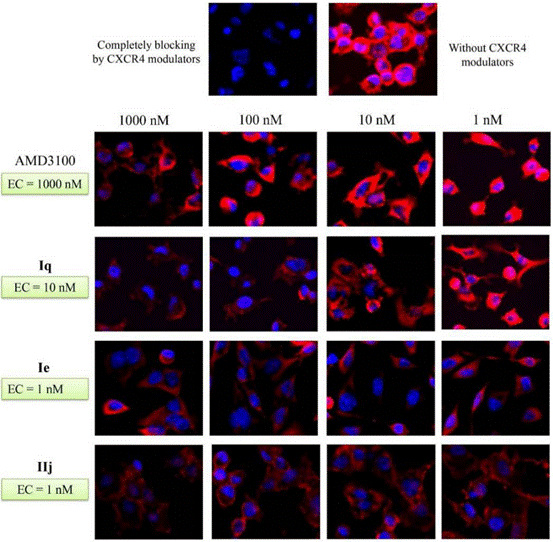
| Immunofluorescence | CXCR4 β-arrestin2 |
|
28521261 |
Información del ensayo clínico
(datos de https://clinicaltrials.gov, actualizado el 2024-05-22)
| Número NCT | Reclutamiento | Condiciones | Patrocinador/Colaboradores | Fecha de inicio | Fases |
|---|---|---|---|---|---|
| NCT05421416 | Not yet recruiting | Stem Cell Transplant Complications |
AHS Cancer Control Alberta |
April 1 2024 | Phase 2 |
| NCT05343572 | Recruiting | Asherman Syndrome|Atrophic Endometrium|Recurrent Implantation Failure |
Hugh Taylor|Yale University |
November 1 2023 | Early Phase 1 |
| NCT05844527 | Recruiting | Wound of Skin|Abdominal Wound |
MedRegen LLC |
November 20 2023 | Phase 2 |
| NCT05411575 | Withdrawn | COVID-19 Acute Respiratory Distress Syndrome|COVID-19 |
4Living Biotech|4P-Pharma |
July 19 2022 | Phase 2 |
| NCT05445128 | Terminated | Sickle Cell Disease |
Ensoma|bluebird bio |
June 24 2022 | Phase 2 |
| NCT05835726 | Recruiting | Multiple Myeloma|Daratumumab|Autologous Stem Cell Transplantation|Leukapheresis |
Fondazione Policlinico Universitario Agostino Gemelli IRCCS |
January 1 2022 | -- |
Soporte técnico
Tel: +1-832-582-8158 Ext:3
Si tiene alguna otra consulta, por favor deje un mensaje.

Los productos son solo para uso de investigación. No para uso humano. No vendemos a pacientes.
©Copyright 2013 Selleck Chemicals. Todos los derechos reservados.