
Datos técnicos
| Fórmula | C28H54N8.8HCl |
|||
| Peso molecular | 794.47 | Número CAS | 155148-31-5 | |
| Solubilidad (25°C)* | In vitro | Water | 100 mg/mL (125.87 mM) | |
| DMSO | Insoluble | |||
| Ethanol | Insoluble | |||
|
* <1 mg/ml significa ligeramente soluble o insoluble. * Tenga en cuenta que Selleck prueba la solubilidad de todos los compuestos internamente, y la solubilidad real puede diferir ligeramente de los valores publicados. Esto es normal y se debe a ligeras variaciones entre lotes. * Envío a temperatura ambiente (Las pruebas de estabilidad demuestran que este producto se puede enviar sin medidas de refrigeración.) |
||||
Preparación de soluciones madre
Actividad biológica
| Descripción | Plerixafor (AMD3100, JM 3100, Plerixafor Octahidrocloruro, AMD3100 octahidrocloruro, SID791 octahidrocloruro) 8HCl es el hidrocloruro de Plerixafor, un antagonista del receptor de quimiocinas para CXCR4 y la quimiotaxis mediada por CXCL12 con una IC50 de 44 nM y 5,7 nM en ensayos sin células, respectivamente. Plerixafor puede usarse como un agente anti-HIV. | ||||
|---|---|---|---|---|---|
| Objetivos |
|
||||
| In vitro | Plerixafor inhibe la quimiotaxis mediada por CXCL12 con una potencia ligeramente mejor que su afinidad por CXCR4. Plerixafor también antagoniza la unión del ligando SDF-1/CXCL12 con una IC50 de 651 nM. Plerixafor inhibe la unión de GTP mediada por SDF-1, el flujo de calcio mediado por SDF-1 y la quimiotaxis estimulada por SDF-1 con IC50 de 27 nM, 572 nM y 51 nM, respectivamente. Plerixafor no inhibe el flujo de calcio en células que expresan CXCR3, CCR1, CCR2b, CCR4, CCR5 o CCR7 cuando se estimulan con sus ligandos cognados, ni Plerixafor inhibe la unión al receptor de LTB4. Plerixafor no induce, por sí mismo, un flujo de calcio en las células CCRF–CEM, que expresan múltiples GPCRs incluyendo CXCR4, CCR4 y CCR7. |
||||
| In vivo | Una única aplicación tópica de Plerixafor promueve la cicatrización de heridas en ratones diabéticos al aumentar la producción de citoquinas, movilizar las CPH de la médula ósea y mejorar la actividad de los fibroblastos y monocitos/macrófagos, aumentando así tanto la angiogénesis como la vasculogénesis. Se administran a cohortes de ratones PBS, IGF1, PDGF, SCF o VEGF durante cinco días consecutivos y Plerixafor el quinto día. El número y tamaño de las colonias son mayores en los ratones inyectados con IGF1 más Plerixafor en comparación con los grupos tratados con PDGF, SCF y VEGF, en combinación con Plerixafor. |
Protocolo (de referencia)
| Estudio en animales: |
|
|---|
Referencias
|
Validación de productos por parte del cliente
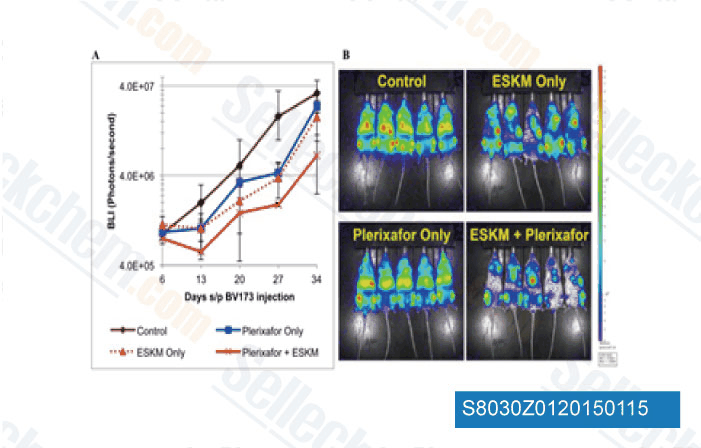
-
Datos de [ Blood , 2014 , 123(21), 3296-304 ]
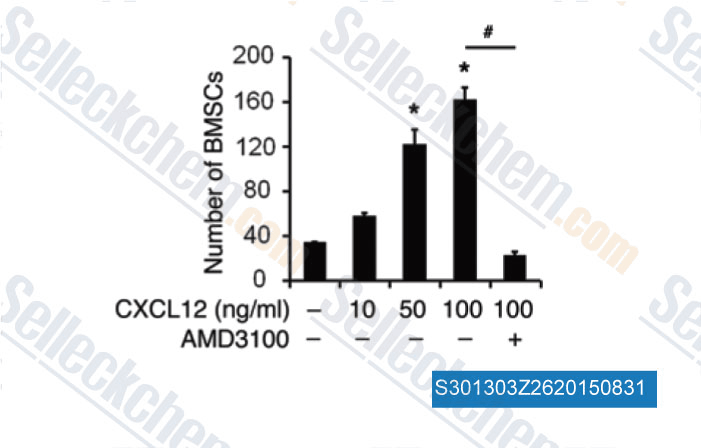
-
Datos de [ , , J Clin Invest, 2015, 125(8): 3226-40 ]
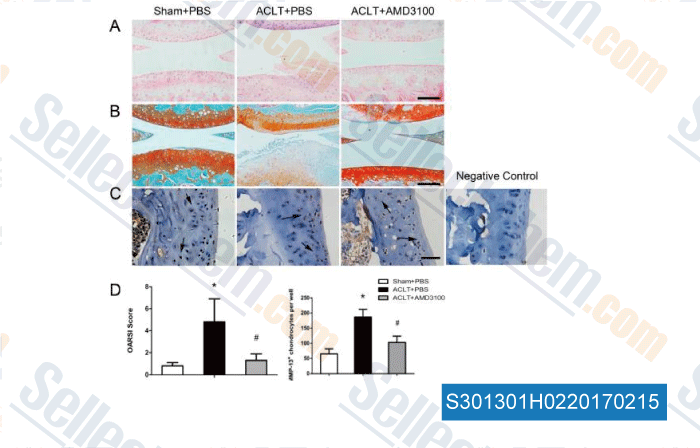
-
Datos de [ , , Int J Mol Sci, 2016, 17(6): 943. ]
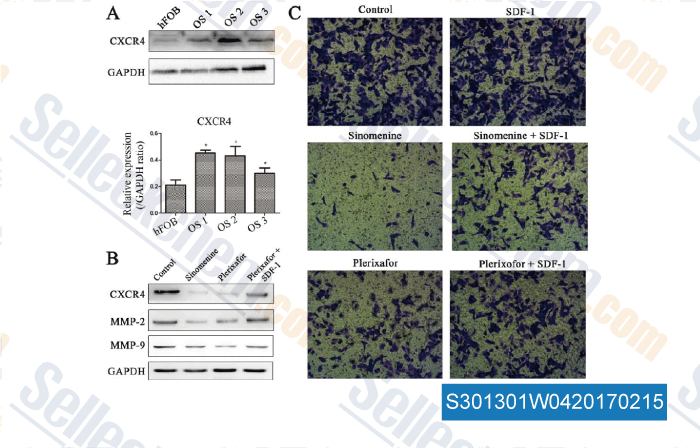
-
Datos de [ , , Int J Oncol, 2016, 48(5):2098-112. ]
Sellecks Plerixafor (AMD3100) 8HCl Ha sido citado por 50 Publicaciones
| SDF-1α mRNA therapy in peripheral artery disease [ Angiogenesis, 2025, 28(3):26] | PubMed: 40314870 |
| BMP9 regulates the endothelial secretome to drive pulmonary hypertension [ bioRxiv, 2025, 2025.08.29.673113] | PubMed: 40950088 |
| PAMD-Ch17, a Polymeric Analog of Plerixafor, Induces Mitochondrial Dysfunction in T-ALL Cells Independent of CXCR4 [ bioRxiv, 2025, 2025.05.28.656643] | PubMed: 40501752 |
| CXCL17 is an allosteric inhibitor of CXCR4 through a mechanism of action involving glycosaminoglycans [ Sci Signal, 2024, 17(828):eabl3758] | PubMed: 38502733 |
| Patient-derived rhabdomyosarcoma cells recapitulate the genetic and transcriptomic landscapes of primary tumors [ iScience, 2024, 27(10):110862] | PubMed: 39319271 |
| Metformin potentiates nephrotoxicity by promoting NETosis in response to renal ferroptosis [ Cell Discov, 2023, 9(1):104] | PubMed: 37848438 |
| Vascular regeneration and skeletal muscle repair induced by long-term exposure to SDF-1α derived from engineered mesenchymal stem cells after hindlimb ischemia [ Exp Mol Med, 2023, 10.1038/s12276-023-01096-9] | PubMed: 37779148 |
| PDGF-BB is involved in HIF-1α/CXCR4/CXCR7 axis promoting capillarization of hepatic sinusoidal endothelial cells [ Heliyon, 2023, 9(1):e12715] | PubMed: 36685431 |
| Targeting CXCR4 abrogates resistance to trastuzumab by blocking cell cycle progression and synergizes with docetaxel in breast cancer treatment [ Res Sq, 2023, rs.3.rs-2388864] | PubMed: 36824840 |
| Targeting vasoactive intestinal peptide-mediated signaling enhances response to immune checkpoint therapy in pancreatic ductal adenocarcinoma [ Nat Commun, 2022, 13(1):6418] | PubMed: 36302761 |
POLÍTICA DE DEVOLUCIÓN
La Política de Devolución Incondicional de Selleck Chemical garantiza una experiencia de compra en línea fluida para nuestros clientes. Si no está satisfecho con su compra de alguna manera, puede devolver cualquier artículo(s) dentro de los 7 días posteriores a su recepción. En caso de problemas de calidad del producto, ya sean problemas relacionados con el protocolo o con el producto, puede devolver cualquier artículo(s) dentro de los 365 días a partir de la fecha de compra original. Siga las instrucciones a continuación al devolver productos.
ENVÍO Y ALMACENAMIENTO
Los productos Selleck se transportan a temperatura ambiente. Si recibe el producto a temperatura ambiente, tenga la seguridad de que el Departamento de Inspección de Calidad de Selleck ha realizado experimentos para verificar que la colocación a temperatura normal durante un mes no afectará la actividad biológica de los productos en polvo. Después de la recogida, guarde el producto de acuerdo con los requisitos descritos en la hoja de datos. La mayoría de los productos Selleck son estables en las condiciones recomendadas.
NO PARA USO HUMANO, DIAGNÓSTICO VETERINARIO O TERAPÉUTICO.